
Nation
THE STATES

Borno
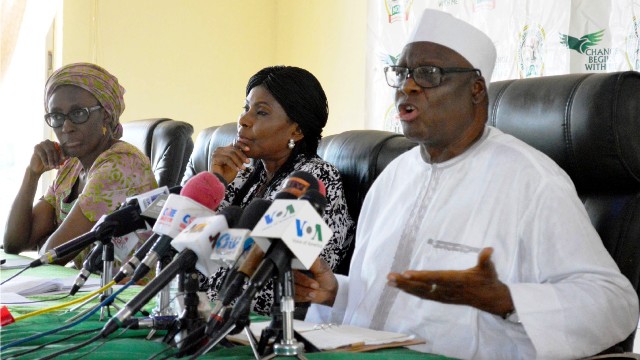
The United Nations last Saturday reaffirmed its commitment to support the Federal Government’s counter-terrorism efforts in the North-East region.
The UN Deputy Humanitarian Coordinator for Nigeria, Mr Peter Lundberg, said this at a press conference in Maiduguri.
Lundberg said the UN would continue to support Nigeria to address the major problems affecting education, health, malnutrition and security challenges occasioned by the Boko Haram insurgency.
He said the raid conducted by the military on UN Humanitarian facility in Maiduguri would not affect its relations with Nigeria, adding that the issue had been amicably resolved.
“I am very pleased to inform you that our relationship of collaboration and trust is intact, and at this stage we are focused on the work ahead, to ensure that the millions of vulnerable people in the North-East are supported with life saving humanitarian aid”, he said.
FCT
The Academic Staff Union of Universities (ASUU), has commenced an indefinite nationwide strike due to the Federal Government’s failure to fulfill the 2009 agreement made with the union.
President of the union Prof. Biodun Ogunyemi, disclosed this at a news conference on Monday in Abuja.
Ogunyemi said the decision to embark on the industrial action was resolved at its emergency National Executive Council meeting held on August 12.
According to him, during the strike, “there shall be no teaching, no examination and no attendance of statutory meetings of any kind in any of our branches till government meets the union’s demands”.
The industrial action actually took effect from August 13.
Gombe
The National Drugs Law Enforcement Agency (NDLEA) last Saturday said it had arrested three farmers in Kulani village, Balanga Local Government Area of Gombe State for allegedly cultivating 160 Kilograms of Indian hemp.
The NDLEA Commandant in the state, Mr Aliyu Adole, told newsmen in Gombe.
Adole said many farmers were involved in the cultivation of the weed in the state and the agency had been on their trail.
He said the agency had been monitoring the suspects before their arrest, adding, “this morning my boys went to the bush and brought them with the exhibits.’’
The commandant said the agency would continue to comb villages in the state to apprehend those involved in the cultivation of Cannabis.
Jigawa
The Jigawa State Agency for Nomadic Education says it would soon distribute school uniforms free to 8,000 nomadic pupils in the state.
The Executive Secretary of the agency, Alhaji Ali Manu, disclosed this in an interview with newsmen in Dutse last Sunday.
Manu said the items would be distributed to the pupils in 132 out of the 304 nomadic schools across the state.
He said the uniforms were provided by the state government to encourage children of herdsmen to go to school.
‘‘I assure you that very soon we will distribute these uniforms to the pupils in 132 nomadic schools across the state.
‘‘And they will be distributed to the pupils free,” the executive secretary said.
Kaduna
Some Civil Society Organisations (CSOs) say they are working hard to minimise the frequency of occurrence of conflicts in the North West, particularly in Southern Kaduna.
A survey conducted by newsmen indicated that various organisations had been meeting with key stakeholders, organising town hall meetings and bringing warring groups to agree to peace deals aimed at ending conflicts in some of the states in the zone.
They were also focusing on tracking hate speeches and encouraging residents to ignore divisive comments, especially in the social media.
In Kaduna State, where ethno-religious crises keep reccurring, some of the CSOs had been actively involved in peace-building and encouraging mutual respect among the diverse communities.
Kano
The Director General, National Youth Service Corps (NYSC), Brig.-Gen. Sule Kazaure, has charged corps members to be committed in the discharge of their duties at their places of primary assignment.
Kazaure, made the call during an inspection visit to the permanent orientation camp at Kusalla la in Karaye Local Government Area of Kano State.
The DG, who was represented by the Director, Human Resources Department, Mrs. Eze Makinde said it was only through commitment, dedication and selfless service that the corps members could excel and achieve the desired results.
“You should also consider your posting to Kano State as a will of God, and put in all efforts through conducting yourselves in such a way others can admire you”, he said.
Kogi
Officials of Ecological Fund Office, under the aegis of Office of Secretary to the Government of the Federation, last Monday arrived in Kogi State for an assessment of flood and erosion sites.
Mr Abdullazeez Umar, who spoke on behalf of the team at the office of the Deputy governor in Lokoja, said that they were in the state to carry out a comprehensive assessment of the flood and erosion sites.
He said that the exercise was approved by the Federal Executive Council, as part of efforts to tackle the ecological problems facing the country via the effective management, co-ordination, monitoring and implementation of programmes.
Speaking, the Deputy Governor, Mr Simon Achuba, welcomed the team on behalf of the state government and said that their visit to Kogi was timely.
Lagos
The new President of Rotary Club of Omole Golden District 9110, Nigeria, Rotarian Oshinibosi Abiodun, said last Sunday, that the club would provide 30 incubators and 10 phototherapy machines for Ifako/Ijaiye General Hospital.
Abiodun announced the plan during his installation as president for 2017/2018 at the Excellence Hotel, Omole, Ogba, Lagos
He promised that the club would continue to put smiles on the faces of the less-privileged during his tenure.
The Rotarian said that the incubators planned for Ifako/Ijaiye General Hospital would help in saving lives.
Abiodun said a visit to the hospital showed that the seven incubators there were the ones the club donated some years back.
Nasarawa
Nasarawa State Police Command has arrested two persons in connection with a mob action that led to the death of a soldier, Lance Cpl. Ayuba Ali, on Mondaym in Akwanga, Nasarawa State.
The Command’s Spokesman, DSP Kennedy Idirisu, confirmed the arrest to newsmen last Monday in Lafia.
Idirisu said that available information revealed the victim, allegedly hit a street hawker at Agwan Affi area of the town while riding on a motorbike.
According to him, the victim, who was in mufti, tried to pacify the hawker and an altercation ensued resulting in irate youth beating him to coma.
Niger
The police last Friday, arraigned two men, Ado Sani and Shafiu Umar in a Minna Magistrates’ Court for allegedly killing two members of the force.
The defendants are standing trial on charges of criminal conspiracy, criminal trespass, abduction, armed robbery, causing hurt, mischief and murder.
The Prosecutor, Insp. Emmanuel Danladi, told the court that one Alhaji Bello of Tagina Kabata village reported a case of abduction of seven persons to the police on June 2.
Danladi alleged that on May 5, the accused who hail from Allawa village, conspired with 16 others now at large, and committed the act at the Tagina Kabata Central Mosque.
He alleged that the accused robbed one of the victims of N750, 000.
He said that a team of five police detectives had gone to Allawa village on investigation, but the accused attacked them, killing two and injuring three.
Ondo
Governor Oluwarotimi Akeredolu (SAN) of Ondon State, last Monday called for more effective community policing as one of the ways to tackle criminal activities in rural areas.
Akeredolu gave the advice during a courtesy visit to the Commissioner of Police, Mrs. Hilda Ibifuro-Harrison, at the Police headquarters in Akure.
He thanked the command for the selfless discharge of its duties and urged them to discourage loitering by non-uniformed people around checkpoints.
The governor canvassed for more police commands in the state, saying that the three existing commands were not enough to tackle the noticeable increase in criminal activities.
He said that five area commands were needed for effective policing of the state.
Taraba
A total of 1,100 intending pilgrims from Taraba State will commence their journey to Saudi Arabia for the Hajj tomorrow, Executive Secretary of the state Muslim Pilgrims’ Welfare Board, Alhaji Umaru Leme, has said.
Leme told newsmen in Jalingo last Monday that 177 of the pilgrims were sponsored by the state government and 37 by local councils.
According to him, the state governor, Mr Darius Ishaku has appointed the Lamido Gashaka, Alhaji Zubairu Sambo as leader of the state contingent for the pilgrimage.
He disclosed that the state government had released N310 million to the board to ensure successful hajj operation.
Leme said that 1,100 passports for the intending pilgrims had been processed and assured that all the pilgrims would be transported before the end of August.




The Hydrocarbon Pollution Remediation Project (HYPREP) has commemorated the 15th anniversary of the release of the United Nations Environment Programme (UNEP) Environmental Assessment Report on Ogoniland, reaffirming its commitment to restoring the environment and improving the livelihoods of affected communities.
In a statement signed by the Project Coordinator, Prof Nenibarini Zabbey, to commemorate the anniversary, HYPREP described the anniversary as a significant milestone in Nigeria’s environmental restoration efforts, noting that the project has made remarkable progress in implementing the recommendations of the landmark UNEP report released on August 4, 2011.
The UNEP report had revealed extensive oil pollution across Ogoniland, severe environmental degradation, and serious public health risks resulting from decades of petroleum operations. It also recommended an initial $1 billion fund to commence the cleanup of the affected communities.
According to HYPREP, the Federal Government formally launched the Ogoni clean-up in 2016, while the Project Coordination Office was established in 2017 to drive the implementation of UNEP’s recommendations.
Zabbey said the current administration has continued to prioritise the project under the Renewed Hope Agenda.
Providing an update on the cleanup, the Project Coordinator disclosed that 30 of the 65 contaminated sites identified by UNEP have been fully remediated, while work is ongoing at several medium- and high-risk locations. It also stated that more than 1.5 million mangrove seedlings have been planted as part of what it described as the world’s largest restoration of oil-degraded mangroves, with over 1,000 hectares of shoreline already rehabilitated.
Zabbey further revealed that 49 Ogoni communities have been connected to potable water schemes through multiple water projects and booster stations aimed at providing safe drinking water across the region.
In the health sector, he said the 100-bed Ogoni Specialist Hospital in Kpite and the 43-bed Cottage Hospital in Buan are nearing completion, adding that several existing health facilities have been upgraded with modern medical equipment, while five ambulances have been donated to improve emergency healthcare services. The Project Coordinator also disclosed that a three-year human health biomonitoring study is being conducted in collaboration with the World Health Organization’s International Agency for Research on Cancer (IARC).
On economic empowerment, Zabbey stated that the Project has created more than 8,000 direct jobs and trained thousands of Ogoni youths and women in various vocational and technical skills, including software development, cybersecurity, aviation, commercial diving, seafaring, mechatronics, and creative arts. The project also reported awarding scholarships to more than 1,000 students, providing grants to small businesses, and supporting persons living with special needs through skills acquisition programmes.
The statement further highlighted ongoing legacy projects, including the Ogoni Power Project and the Centre of Excellence for Environmental Restoration, which it said is about 96 per cent complete. HYPREP also welcomed the recent designation of the Ogoni Wetland as a Ramsar Site of International Importance and pledged to continue promoting biodiversity conservation and sustainable management of the ecosystem.
Marking the anniversary, Zabbey said the progress achieved over the past 15 years demonstrates the collective commitment of government, development partners, stakeholders, and local communities to restoring Ogoniland. He called for renewed collaboration to sustain the cleanup effort, promote environmental sustainability, and support the long-term development of the region. 3
-

 News2 days ago
RSG Targets Nine Million Residents in Mosquito Net Distribution Campaign
-

 Oil & Energy2 days ago
Aiyedatiwa Signs New Electricity Bill
-

 Maritime2 days ago
Marine Minister Commends President Tinubu On NPERA Bill Assent
-

 Oil & Energy2 days ago
NLNG Commissions Research And Innovation Centre In RSU
-

 News2 days ago
KenPoly Holds Eight Convocations, August 29
-

 News2 days ago
RMAFC Completes Revenue Sharing Review, Proposes New Pay
-

 News2 days ago
RSG Begins Another Phase of Projects Commissioning Today
-

 Maritime2 days ago
NAGAFF Petitions IGP Over Alleged Maritime Police Harassment