
Agriculture
FG Plans Urgent Poultry Industry Relief

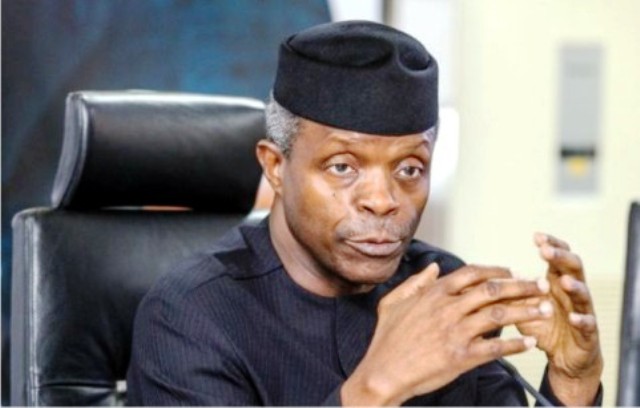
Acting President, Yemi Osinbajo, says the Federal Government has urgent relief plans for the poultry farmers to cushion the poultry industry in the country from collapse.
He said this while meeting with representatives of poultry farmers the second time recently at the Presidential Villa.
“The poultry industry is a local industry that needs to be protected urgently,” Osinbajo said at the meeting where specific measures were tabled and considered on how the FG could be of help.
He said the industry should be a major plank of the agriculture sector and as such the Buhari administration would ensure that it got help regarding the challenges being faced by operators of the sub-sector.
He added that by supporting the local industry, poultry-related importation which was currently a drain on the country’s Foreign Exchange could be a thing of the past.
In his remarks, the president, Poultry Association of Nigeria, noted that poultry presently contributed 25 per cent of the Agricultural Gross Domestic Product of the Nigerian economy amounting to N1.6 trillion.
He added that Nigeria was rat
ed as the number one egg-producing nation and number four in poultry meat in the continent.
“The poultry sub-sector is said to generate over 14 million direct and indirect jobs in the country, “he said.
Present at the meeting were the Finance Minister, Mrs Kemi Adeosun, Agriculture & Rural Development Minister of State, Heineken Lokpobiri.
Others were the Comptroller-General of the Nigeria Customs Service, Col. Hameed Ali, (rtd), and the Central Bank Governor Mr Godwin Emefiele.
Lokpobiri later told State House correspondents that the ministry would embark on aggressive maize and soya bean cultivation to produce surplus of poultry feed input.
“What we have is that we are going to develop a programme that will deliberately grow more maize which will satisfy not only our local market but the international market.
“We have a demand from Algeria and some other countries.
“They are saying that if we are able to grow two million metric tons and above for them they are going to construct a rail line to Kano to come and buy,’’ the minister disclosed.
He also advised farmers hoarding maize with the intention of selling later to the federal government to desist as such produce would not be bought from them by the government.
“It is also an opportunity to send this signal to those who are hoarding maize that anybody who is hoarding maize does so at his own peril.
“Federal Government will not buy maize.
“The Federal government buys grains as the buyer of last resort,’’ he said.
The minister also said that the government was also planning to address the loss suffered by poultry farmers during the outbreak of Avian Influenza.
“We also discussed the issue of avian influenza that led to the destruction of a lot of birds in the country.
“Some part of the money has been paid, but we still have an outstanding of N1.7billion,’’ he said
The Tide source reports that the promised intervention was part of an urgent effort by the Federal Government to address challenges in the agricultural sub-sector in line with its policy on self-sufficiency in food production.
The poultry industry has had to contend with a number of challenges including an outbreak of Avian Influenza which affected almost four million birds in 2015.
It also suffered non-allocation of Foreign Exchange for the importation of needed machinery and other critical inputs, and high production costs in the industry.



Federal Government and the Ogun State Government, on Wednesday, distributed farm inputs to farmers as part of effort to address food security challenge.
The State Director, Federal Ministry of Agriculture and Food Security, Dr. Toyin Ayo-Ajayi, during the flag-off ceremony of Inputs Redemption Under The National Agricultural Growth Scheme-Agro Pocket (NAGS-AP), in Ogun State, disclosed that beneficiaries of the gesture were primarily rice, maize and cassava farmers across the State.
Ayo-Ajayi commended the Ogun State Government for partnering with the government at the centre for the effort in supporting farmers with inputs that would bring about yieldings for local consumption and likely exportation.
She noted that government is supporting rice, cassava and maize farmers with inputs worth N212,000; N189,000 and N186,000 respectively.
The Permanent Secretary in the State Ministry of Agriculture, Mrs Kehinde Jokotoye, who represented the Commissioner in the Ministry, Bolu Owotomo, stated that traditional farmers are critical in food production, hence the need to encourage and support them with inputs that would bring about desired results during harvesting.
Owotomo said: “Let us make good use of this opportunity, so that the success of this phase will make farmers benefit more from the state and federal governments of Nigeria.”
Earlier, State Coordinator, Federal Ministry of Agriculture and Food Security, Dr. Oluwatoyin Ayo-Ajayi, appreciated the present administration for partnering with the federal government for the initiative, adding that the programme is designed to support farmers at the grassroots level in cassava, rice and maize with inputs such as, seeds, pesticides, herbicides and fertilizers, to boost their production and enhance their livelihood.
-
News5 days ago
Decentralizing Pipeline Surveillance Poses Greater Dangers To Niger Delta …. Group Warns
-

 Politics5 days ago
APC Resumes Electronic Membership Registration Nationwide
-

 Rivers5 days ago
Court Rules Out Interim Administration In Jumbo House, Bonny
-
 Business5 days ago
33 Banks Raise N4.65tn As Recapitalisation Ends
-

 Politics5 days ago
Alleged Coup: Protests Rock N’Assembly As Detained Officers’ Children, Wives Demand Justice
-
Sports5 days ago
Lewandowski Leads Top Stars Missing From W/Cup Roll Call
-

 Nation5 days ago
Nile University Hosts ICA Nigeria First National Confab On Global Communication
-

 Sports5 days ago
Para Games: Team Rivers Wins 53 Medals On Day 5 … Director Praise Athletes