Connect with us

Politics

We’ll Stand By Dismissed Police Officers – Wike

Published

on

The New Year Banquet threw the curtain open for the week and year in Government House last week. The launching of the Armed Forces Remembrance Day emblem for fallen soldiers also took centre stage in the past week.
The State Governor, Chief Nyesom Wike who joined the guests and other citizens of the state to celebrate the New Year, thanked God Almighty for His infinite mercies. He said, “This is a unique banquet because this is jubilee year for our state. 2017 will be a prosperous year for Rivers State.”
Chief Wike lauded the security agencies for their effort in making the state safe for all citizens and urged them to put more effort in the new year to ensure safety of lives and property of all Rivers people.
Enumerating his plans for the year, the Rivers State Chief Executive said all ongoing projects will commence in earnest this new year. He specifically mentioned the Sakpenwa/Bori Road and the Andoni/Opobo Unity Road among other projects that will get priority attention in 2017.
The governor on Wednesday last week played host to the Managing Director of Independent Newspapers, Mr. Ted Iwere and later hosted the new General Officer Commending (GOC) of the 6th Brigade of the Nigerian Army, Maj. General K. I. Abdulkarim.
Within the week, Chief Wike met with Caretaker Chairmen of Local Government Areas.
Following the sudden sack of policemen, under the governor’s security/convoy by the Police Service Commissioner on Wednesday, the State Commissioner for Information and Communications, Dr. Austin Tam-George released a statement on Thursday condemning the action.
In the statement, Dr. Tam-George noted with dissatisfaction the way and manner the six policemen attached to the governor’s security were dismissed from service following an unfair and secret trial by the police authorities in Abuja,.
The State Commissioner for Information and Communication said the action displays lack of professionalism and respect for human rights in the Nigeria Police Force. He continued, “the dismissed officers committed no crime, other than foiled a carefully-orchestrated electoral heist by officials of the Independent National Electoral Commission (INEC), in collusion with the All Progressives Congress (APC) and the Nigeria Police Force.”
The governor on Saturday last week during a “welcome back: ceremony for High Chief Cassidy Ikegbidi in Ahoada reiterated the commissioner’s statement. Chief Wike said, “Rivers State will stand by the sacked police officers forever.”
He stressed that no amount of intimidation will make the State Government to abandon the dismissed police officers, as it’s ready to pursue the matter to a logical conclusion.
On the return of Chief Ikegbidi to the fold of the Peoples Democratic Party (PDP), the governor charged the former Ahaoda-East Local Government Chairman to stand firm even in the face of intimidation and persecution.
Chief Wike described Chief Ikegbidi as one who stands for what he believes in and for standing firm with Senator Ossy Ideozu to win the area.
He used the ceremony to announce plans to construct some abandoned roads, which include Ochiba/Uzochi Road, Ahaoda/Udereke Ihugbogo Road and Odiokwu/Uzbeta/Odereke Road, Chief Wike also announced the elevation of Akporo Traditional Ruler to a second class.


Continue Reading

Featured

INEC Proposes N873.78bn For 2027 Elections, N171bn For 2026 Operations

Published

on

The Independent National Electoral Commission (INEC) yesterday told the National Assembly that it requires N873.78bn to conduct the 2027 general elections, even as it seeks N171bn to fund its operations in the 2026 fiscal year.

INEC Chairman, Prof Joash Amupitan, made the disclosure while presenting the commission’s 2026 budget proposal and the projected cost for the 2027 general elections before the National Assembly Joint Committee on Electoral Matters in Abuja.

According to Amupitan, the N873.78bn election budget covers the full conduct of national polls in 2027.

An additional N171bn is needed to support INEC’s routine activities in 2026, including bye-elections and off-season elections, the commission stated.

The INEC boss said the proposed election budget does not include a fresh request from the National Youth Service Corps seeking increased allowances for corps members engaged as ad-hoc staff during elections.

He explained that, although the details of specific line items were not exhaustively presented, the almost N1tn election budget is structured across five major components.

“N379.75bn is for operational costs, N92.32bn for administrative costs, N209.21bn for technological costs, N154.91bn for election capital costs and N42.61bn for miscellaneous expenses,” Amupitan said.

The INEC chief noted that the budget was prepared “in line with Section 3(3) of the Electoral Act 2022, which mandates the Commission to prepare its election budget at least one year before the general election.”

On the 2026 fiscal year, Amupitan disclosed that the Ministry of Finance provided an envelope of N140bn, stressing, however, that “INEC is proposing a total expenditure of N171bn.”

The breakdown includes N109bn for personnel costs, N18.7bn for overheads, N42.63bn for election-related activities and N1.4bn for capital expenditure.

He argued that the envelope budgeting system is not suitable for the Commission’s operations, noting that INEC’s activities often require urgent and flexible funding.

Amupitan also identified the lack of a dedicated communications network as a major operational challenge, adding that if the commission develops its own network infrastructure, Nigerians would be in a better position to hold it accountable for any technical glitches.

Speaking at the session, Senator Adams Oshiomhole (APC, Edo North) said external agencies should not dictate the budgeting framework for INEC, given the unique and sensitive nature of its mandate.

He advocated that the envelope budgeting model should be set aside.

He urged the National Assembly to work with INEC’s financial proposal to avoid future instances of possible underfunding.

In the same vein, a member of the House of Representatives from Edo State, Billy Osawaru, called for INEC’s budget to be placed on first-line charge as provided in the Constitution, with funds released in full and on time to enable the Commission to plan early enough for the 2027 general election.

The Joint Committee approved a motion recommending the one-time release of the Commission’s annual budget.

The committee also said it would consider the NYSC’s request for about N32bn to increase allowances for corps members to N125,000 each when engaged for election duties.

The Chairman of the Senate Committee on INEC, Senator Simon Along, assured that the National Assembly would work closely with the Commission to ensure it receives the necessary support for the successful conduct of the 2027 general elections.

Similarly, the Chairman of the House Committee on Electoral Matters, Bayo Balogun, also pledged legislative support, warning INEC to be careful about promises it might be unable to keep.

He recalled that during the 2023 general election, INEC made strong assurances about uploading results to the INEC Result Viewing portal, creating the impression that results could be monitored in real time.

“iREV was not even in the Electoral Act; it was only in INEC regulations. So, be careful how you make promises,” Balogun warned.

The N873.78bn proposed by INEC for next year’s general election is a significant increase from the N313.4bn released to the Commission by the Federal Government for the conduct of the 2023 general election.

Continue Reading

Politics

APC Releases Adjusted Timetable For Nationwide Congresses, Convention

Published

on

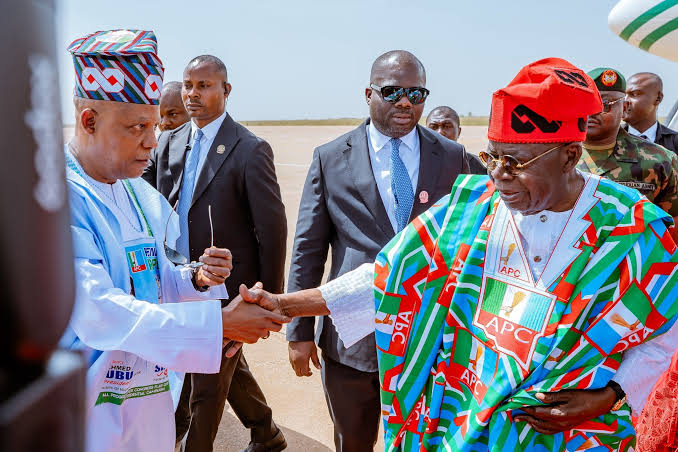
The All Progressives Congress (APC) has released an adjusted schedule for its 2026 nationwide ward, local government, state and zonal congresses, culminating in the party’s national convention slated for late March.
 

In a timetable issued by its National Secretariat in Abuja and signed by the National Organising Secretary, Sulaiman Argungu, the party said the activities were in line with provisions of its constitution guiding the election of party officials across all tiers.

According to the schedule, membership e-registration began on January 31 and ended on February 8, while notices of congresses were dispatched to state and Federal Capital Territory chapters on February 2.

Submission of nomination forms for ward and local government congresses closed on February 9, followed by screening and appeals between February 10 and February 14.

Ward congresses are fixed for February 18, with appeals the following day, while local government congresses will take place on February 21 and appeals on February 23.

At the state level, purchase of forms for state executive positions will run from February 22 to February 25, with screening set for February 27–28 and appeals from March 1–2. State congresses are scheduled for March 3, and appeals on March 4.

Activities leading to zonal congresses and the national convention include purchase and submission of forms between March 12 and March 16, inauguration of screening committees on March 23, and screening of aspirants on March 24. Zonal congresses across the six geo-political zones are slated for March 25, with appeals on March 26.

The party’s national convention will hold from March 27 to March 28.The APC also published fees for expression of interest and nomination forms across the different tiers.

At the ward level, expression of interest costs ?5,000, while nomination forms range from ?15,000 to ?20,000 depending on the position. For local government positions, nomination forms range from ?50,000 to ?100,000 after a ?10,000 expression-of-interest fee.

State executive positions attract ?50,000 for expression of interest, with nomination forms pegged at ?1 million for chairman and ?500,000 for other offices. Zonal offices require ?100,000 expression of interest and ?200,000 for nomination.

For national positions, the fees rise significantly, with expression of interest set at ?100,000. Nomination forms cost ?10 million for national chairman, ?7.5 million for deputy national chairmen and national secretary, ?5 million for other offices, and ?250,000 for National Executive Committee membership.

The party noted that female aspirants, youths and persons living with disabilities would pay only the expression-of-interest fee and 50 per cent of nomination costs. It also clarified that Ekiti, Osun, Rivers states and the FCT are excluded from ward, local government and state congresses, but will participate in electing delegates to the national convention.

Forms are to be completed online after payment verification, with payments directed to designated APC accounts at Zenith Bank and United Bank for Africa.

The congress cycle is expected to determine new party leadership structures ahead of future electoral activities.

Continue Reading

Politics

Police On Alert Over Anticipated PDP Secretariat Reopening

Published

on

The Federal Capital Territory Police Command says it will deploy officers to prevent possible violence as tensions escalate over the planned reopening of the Peoples Democratic Party (PDP) national secretariat by the Abdulrahman Mohammed-led caretaker committee on Monday.

The Tide source reports that the committee, reportedly backed by the Minister of the Federal Capital Territory (FCT), Chief Nyesom Wike, is making moves to reclaim the Wadata Plaza headquarters months after it was sealed following a violent clash between rival factions of the party.

Senior officers at the FCT Police Command told our source that while they had not received an official briefing, police personnel would be stationed at the secretariat and other key locations to maintain peace.

The Acting National Secretary of the Mohammed-led committee, Sen. Samuel Anyanwu, announced last week that the secretariat would reopen for official activities on Monday (today).

He dismissed claims that ongoing litigation would prevent the reopening, saying, “There are no legal barriers preventing the caretaker committee from resuming work at the party’s headquarters.”

However, the Tanimu Turaki-led National Working Committee (NWC) has fiercely rejected the reopening move, insisting that Sen. Anyanwu and his group remain expelled from the PDP and have no authority to act on its behalf.

Speaking with The Tide source, the committee’s National Publicity Secretary, Ini Ememobong, declared: “They are living in fool’s paradise. The worst form of deceit is self-deceit, where the person knows he is deceiving himself yet continues with gusto.

Even INEC, which they claim has recognised them, has denied them. They are indulging in a roller coaster of self-deceit.”

Mr Ememobong further revealed that letters had been sent to both the Inspector-General of Police and the FCT Commissioner of Police, stressing that the matter was still in court and warning against any attempt to “resort to self-help.”

“The case pending before Justice Joyce Abdulmalik was instituted by the expelled members. They cannot resort to self-help until judgment is delivered,” he said.

He warned that reopening the secretariat would amount to contempt of court.

A senior officer at the FCT Police Command, who spoke on condition of anonymity, confirmed that officers would be deployed to the area to avert a repeat of the November 19 violence that led to the secretariat’s initial closure.

“The command would not stand by and allow a breakdown of peace and order by the party or anyone else. Definitely, the police will have to be on the ground,” he said.

Another officer added, “There will definitely be men present at the secretariat, but I can’t say the number of police officers that would be deployed.”

When contacted, the FCT Police Public Relations Officer, Josephine Adeh, said she had not been briefed on the planned reopening and declined to comment on whether officers would be deployed.

Asked to confirm whether the secretariat was initially sealed by police, she responded, “Yes,” but refused to say more about the current deployment plans.

Continue Reading

Trending