
Entertainment
Nigeria Boasts Of Over 1000 Beauty Pageants …As Basketmouth Slams Organisers

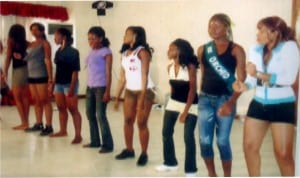
Miss Earth contestants in a dance practice in Port Harcourt
Beauty pageants in Nige
ria precedes the birth of the country in 1960. Daily Times Newspaper started beauty pageant in Nigeria with Miss Nigeria, thus owned the franchise. Miss Nigeria started as a photo contest in 1957. Contestants posted their photographs to the Daily Times headquarters in Lagos where finalists were shortlisted.
Successful candidates were invited to compete in the live finals which at the time did not include the swimsuit sequent at the Lagos Island Club. UAC employee, Grace Oyehide won the maiden edition of Miss Nigeria, she was succeeded by secretarial student, Helen Anyamaeluna, while former seamstress, Nene Etule remains the only non Nigerian to have won the contest.
She was eligible as Southern Cameroon was under the Nigerian constitution in 1959. The following year, the contest was briefly renamed miss independence to commensurate the country’s independence from Britain and the winner, Rosemary Anieze was crowned.
The 1960s saw Miss Nigeria competing at international level, Yemi Idowu who won the contest in 1962, was a semi finalist at the Miss United States in 1963. Her successor sales girl Edna Park was the first Nigerian at Miss Universe in 1964. She is best remembered for disrupting the event by collapsing after failing to reach the first 15 spot. After park, no other Miss Nigeria competed in Miss Universe. Rose Balogun became the first official Miss Nigeria at Miss World in 1967.
MBGN Pageant
The Most Beautiful Girl in Nigeria, also known as MBGN is a beauty pageant organised by the Silverbird group with the aim of sending representatives to international competition originally known as Miss Universe, Nigeria. It was renamed most Beautiful Girl in Nigeria after Daily Times lost its license to send delegates from rival contests, Miss Nigeria, to Miss World and Miss Universe.
Silverbird boss, Senator Ben Murray Bruce promoted a new pageant known as Miss Universe in 1983, after it changed it’s name to most Beautiful Girl In Nigeria (MBGN) in 1986, its maiden winner was model Lynda Chuba. In 2007 Silverbird announced that the pageant would produce four more representatives besides the winner.
The original titles were Miss MBGN Universe, (to represent Miss Universe), MBGN Tourism (for Miss Tourism International) and MBGN ECOWAS (for Miss ECOWAS pageant). A fifth title MBGN Model which allowed its holder to compete in modeling contests at the international level was dropped, and replaced with MBGN Ambassador, with its winner performing ceremonial functions in the country.
Miss Agbani Derego became the winner of the MBGN crown in 2011 and later went on to win the Miss World pageant in 2011.
She became the first black African to wear the coveted crown.
Miss Earth Pageant
Miss earth-Nigeria is an annual beauty pageant in Nigeria to select its representatives to the international Miss Earch pageant with the theme “Beauties for a course” it is orgnaised by AMC productions and began sending representatives to Miss Earth, a year after the international pageant was established in 2001. The National Director for Nigeria to Miss Earth is Ibinabo Fiberesima.
Miss ECOWAS PEACE PAGEANT
The Miss ECOWAS Nigeria pageant is a wholly intellectual pageant that produces two delegates who will move on to represent Nigeria alongside delegates from other ECOWAS member states at the international ECOWAS peace pageant endorsed by the ECOWAS Commission in Abuja, among several other pageants.
A recent report has revealed that there are over 1000 beauty pageants in Nigeria and they have been keeping lots of Nigerian Youths busy with monetary gains for both the winners and the organizers through the sale of forms, endorsements and sponsorships by corporate organizations.
Meanwhile Nigeria’s humour merchant, Basketmouth who is one celebrity that is not known for holding his tongue has criticized the high number of beauty pageants in Nigeria. He recently slammed the ridiculous beauty pageants in the country.
He said: “it started with Miss Nigeria and MBGN, now we have the following Miss Comely Queen Nigeria, Face of Unity Nigeria, Miss Heritage Beauty pageants, Miss Tourism Nigeria, Miss Ideal Face of the Globe, Miss Teen World Super Model, Miss Dazzle Nigeria, Queen of Aso Rock and Miss Grand Nigeria.”
Others are: “Miss VIP Nigeria, Miss Ambassador for Peace Nigeria, Queen of Trust beauty Nigeria, Face of Nigeria, Miss Global beauty pageant, Sisi Oge beauty pageant, Miss Esquisite, Miss Olokun, etc.”
He noted that “very soon you will hear of Miss Pretty Feet Nigeria, Miss Long Neck pageant, Miss High Heels Nigeria, Miss Fresh Lap pageant, Miss No Hair for leg Nigeria pageant, Miss pointed Boobs Nigeria, Miss No Stretch Marks for Body etc, just watch,” he posted in his instagram.
A showbiz personality in Port Harcourt Prince William Atari has called on stake holders and the relevant authorities to check the proliferation of beauty pageants in the country and to regulate the activities of the organizers so as to bring sanity to the sector and maintain the high standards of which beauty pageants are known for.



Critics claimed that her body makeover was one of the reasons she allegedly left the marriage and noted that she was still out in public with the video of her club outing.
Reacting to the allegations, Ogbodo came to Bambam’s defence. She stated that no woman would leave her marriage simply because she went under the knife. According to her, it is the man who drives a woman to leave.
The mother of three further explained that no woman willingly leaves a marriage she has invested in over many years. If a woman does leave, it is the man’s fault, possibly due to abuse that she chooses not to disclose publicly.
She added that a man must have shown the woman disrespect or failed to nurture the marriage.
Ogbodo emphasised that if a man refuses to love, protect, and give peace to his wife, the responsibility for the breakdown rests entirely with him.
It would be recalled that Uche Ogbodo also recently underwent cosmetic surgery and shared videos with her fans online,
The actress had remained on the lips of many Nigerians following her role in the trending movie Love in Every Word.

Nollywood actress Kate Henshaw has expressed her distaste for individuals who attend events without being invited. The actress in an Instagram video, spoke about the importance of self respect and being considerate.
Nollywood actress Kate Henshaw has expressed her distaste for individuals who attend events without being invited. The actress in an Instagram video, spoke about the importance of self respect and being considerate.
The Tide Entertainment reports that she questioned the popular act of ‘gate crashing’, regarding it as a rude and disrespectful behaviour. Henshaw also urged Nigerians to refrain from attending gatherings where they are not invited.Nigerian Politics Analysis
”I want to talk about something rampant, has been rampant, and is still rampant. I just want to ask those of you who show up uninvited at events and parties, what’s your purpose? What do you aim to achieve? Then, those of you who receive a card that admits only one person and invite all your village people, don’t check with the host; you pack your people and come. What are you doing there? Why don’t you respect yourself and stay away? It’s rude, you’re a gate crasher. Respect yourself enough to stay away from places you aren’t invited to,” she said.
The Academy of Motion Picture Arts and Sciences has unveiled dates for both the 99th Academy Awards and its landmark 100th ceremony. The back-to-back events, set for 2027 and 2028, will mark the final years of the Oscars airing on longtime broadcast partner ABC before a major shift to YouTube.
The 99th Oscars will take place on Sunday, March 14, 2027, followed by the historic 100th edition on Sunday, March 5, 2028. Both ceremonies will broadcast live at 7 p.m. ET from the iconic Dolby Theatre in Hollywood and reach audiences in over 200 territories worldwide. Looking ahead, the Academy has also confirmed a venue change, with the ceremony set to move to the Peacock Theater beginning in 2029, where it will remain through 2039.
The Tide Entertainment reports that the announcement comes amid a shifting broadcast landscape. ABC is gearing up for a packed 2027 schedule, including its debut as the home of the Grammy Awards and its first Super Bowl broadcast in over two decades. Meanwhile, this year’s Oscars telecast saw a dip in viewership, drawing 17.86 million viewers across ABC and Hulu, a 9% decline from the previous year’s five-year high.
Still, excitement around the awards remains strong. The most recent ceremony crowned Paul Thomas Anderson’s “One Battle After Another” as Best Picture, while early buzz for the upcoming season is already building. Anticipated contenders include the Ryan Gosling-led “Project Hail Mary,” Denis Villeneuve’s “Dune: Part Three” starring Timothée Chalamet and Zendaya, and Alejandro G. Iñárritu’s “Digger” featuring Tom Cruise.
No hosts have been announced yet for either ceremony, adding another layer of anticipation to the milestone events.
In addition to confirming the ceremony dates, the Academy also released its full calendar for the 2026–2027 awards season, outlining key milestones from the eligibility period beginning January 1, 2026, to nominations voting in January 2027, and final voting in early March.
-

 Editorial2 days ago
Enough Of Xenophobic Attacks On Nigerians
-

 Nation2 days ago
RSU, Otonti Nduka Foundation Holds Centenary Conference, Unveil Book on Values in Nigeria
-

 Oil & Energy2 days ago
Rivers PETROAN Elects 12-Member Executive
-

 Sports2 days ago
Oparaodu Urges Rivers United To Win Katsina United
-
Politics2 days ago
APC Group Protests Ex–Presidential Aspirant’s Disqualification From Rivers Senatorial Race
-
Politics2 days ago
Reps Speaker Secures APC Return Ticket For Fifth Term
-

 Sports2 days ago
” Nigeria’s best domestic players are not in NPFL”
-
Politics2 days ago
Primaries: Diri Lauds APC’s Unity, Cohesion In Bayelsa