
Nation
THE STATES

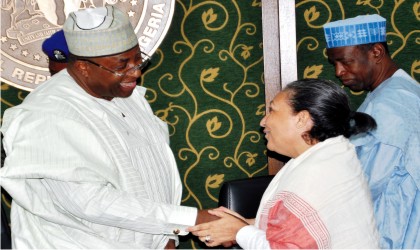
Governor Muhammed Abubakar of Bauchi State (left), welcoming the unicef Country Representative to Nigeria and Ecowas, Ms Jean Gough, during her courtesy visit to Government House in Bauchi, recently.
Adamawa
Some staff of Adamawa State University (ADSU), Mubi, have
petitioned the state House of Assembly accusing the Vice Chancellor, Prof Joshua Shall, of misconduct.
The petition, which receipt was acknowledged by the House of Assembly Speaker, Alhaji Kabiru Mijinyawa, at the plenary was referred to the House Committee on Public Complaint, for consideration and advise.
The petitioners, Dr Umar Jongur, Dr Idris Atadashi, Dr Kamkwis Markus, Mr Moses Mairabo and Mallam Khalid Bello, accused the vice chancellor of some wrongdoings, among which were administrative high handedness and violation of established rules.
Reacting to the development, the vice chancellor, Prof Joshua Shall, said he was just hearing about the petition, and that the petitioners did not give him a copy as expected.
Bauchi
Chairman of the Bauchi State Council of the Nigeria Union of
Journalists (NUJ), Comrade Dahiru Mohammed, has assumed duty as the new General Manager of Radio Nigeria Globe FM, Bauchi.
Mohammed took over from Malam Aminu Goggo, who acted as the manager of the station, following the redeployment of the substantive General Manager, Malam Zakari Nadabo, to the Presidency.
Until his recent appointment, the new manager was the head of News and Current Affairs Unit of Bauchi State Television (BATV) and currently serving his second term as the chairman of Bauchi Council of the NUJ.
In an interview shortly after assumption of office, Mohammed said that his target was to make the station a “pacesetter among its peers”.
Benue
The Save-Our-Women and Youth Initiative in Benue State, an
NGO, has called for an urgent assessment of the numbers and locations of all Internally Displaced Persons (IDPs).
The group’s state Coordinator, Mrs Erdoo Iber, said in Makurdi that the group also wants basic social amenities made available in camps when properly identified.
She said the IDPs require clinics, security posts, movable camps or tents, food and water to save lives and make life more meaningful for them in the camps.
Iber appealed to the National Emergency Management Agency and the State Emergency Management Agency to, as a matter of urgency, provide relief materials to such camps.
Ekiti
Ekiti State Government has issued a three-week ultimatum to
contractors handling the 2013 Millennium Development Goals (MDGs) projects to complete and hand over or face the consequences.
The Chairman, MDGs State Implementation Committee, Chief Dipo Anisulowo, gave the ultimatum during a review meeting of the second phase of MDGs projects held with the contractors in Ado-Ekiti.
He warned that government would not hesitate to sanction erring contractors, stressing that the era of abandoned projects was over.
In his remarks, Mr Idowu Popoola Special Assistant to the Governor on MDGs, stressed the importance of quality and timely job delivery by contractors.
Jigawa
The Jahun Local Government Council of Jigawa State, says it has
purchased spare parts worth N2.8 million to repair broken and damaged hand pumps in the area.
The Area’s Information Officer, Malam Muhammad Umar, who made this known in Dutse.
Umar, who said the items had been handed over to the 11 wards of the local government, stressing that the aim was to ensure safe drinking water in the area.
He said that the items were handed over to members of wards committees who would supervise the exercise.
Kaduna
The Chief of Air Staff, Air Marshal Sadiq Abubakar, has said that
the Air Force Institute of Technology, (AFIT) had been repositioned to contribute more effectively in tackling the current security challenges facing the country.
The Air Cheif, who made the remark at the 44th Convacation Ceremony of the institution in Kaduna, said training of technical personnel would impact positively in dealing with the dreaded Boko Haram and other security challenges facing the nation.
Abubakar said the institution was doing well in research and development and charged them to sustain the effort to enable the country address the current Boko Haram menace.
On his part, the Commandant of AFIT, Air Cmdr Misbau Soladoye, said that the institution had made steady progress in both its academic curricular, research and development.
Kano
The Kano State Refuse Management and Sanitation Board, says
it is ready to begin the conversion of wastes to wealth before the end of 2015.
The Managing Director of the board, Retired Group Capt. Mohammed Kura, said in Kano that investors from England and India had sent proposals to start converting scrap tiles into powder, fabrics and wares.
Kura said the board had sent the organic fertiliser to different laboratories, including Ahmadu Bello University and the University of Ibadan where it was tested and confirmed to be good and useful.
He further explained that the state government would also recruit more sanitary inspectors, who would be given the power to enforce and monitor sachet water sellers, biscuit sellers and bottle water traders.
Kebbi
The Kebbi State Committee on Information for the 2015
Hajj is to embark on an awareness campaign to ensure to enlighten the 4,116 intending pilgrims, says the Chairman, Alhaji Umar Babuga.
Babuga told newsmen in Brinin-Kebbi that the essence of the campaign was to ensure effective guidance of the 4,116 intending pilgrims.
He said that pregnant women had been advised to defer undertaking the exercise, to avoid sanctions.
The chairman also requested Journalists to ensure adequate dissemination of information on the 2015 Hajj exercise.
Lagos
Nigerians have urged the Nigeria Police Force to enlist
only men and women of good character when it recruits the 10,000 personnel promised by President Muhammadu Buhari.
They made the call in an interview with newsmen against the backdrop of President Muhammedu Buhari’s promise to offer 10,000 jobs in the force.
The recruitment is to beef up the Police workforce which currently stands at less than 400,000 for a population of 170 million.
The United Nations’ recommendation is a minimum of 222 policemen per 100,000 people, a number that the current 400,000 does not cover.
Nasarawa
The Nasarawa State Government is to use the N25 billion
loan approved by the state House of Assembly in servicing the Contributory Pension Scheme for state civil servants and addressing some development needs.
Chief Press Secretary to Governor Tanko Al-makura, Alhaji Ahmed Tukur,who disclosed this in an interview in Lafia, said explaining to the people what the bailout fund would be utilized for, was aimed at ensuring prudence and accountability.
He said that the fund, if accessed from the Central Bank of Nigeria (CBN), would help in the settling some pending issues for the growth of the state.
According to him, the state government will utilise N12 billion while the 13 local government councils in the state will share N13 billion.
Ogun
An Economist, Mr Toyin Taiwo, has urged local manufacturers
to show more commitment in developing their marketing strategies for enduring economic benefits and job creation.
He told newsmen in Ijebu-Ode, that the manufacturers could enhance their businesses by developing their marketing strategies themselves, rather than outsourcing the process.
Taiwo, who is the president, Ijebu Chamber of Commerce, Industry, Mines and Agriculture (ICCIMA), said this would help them set good records of market penetration and increase the value chain of end products.
The economist, who also operates a food technology consultancy firm, said in order to achieve sustainable success, manufacturers must repeatedly re-examine their company’s sense of purpose.
Oyo
The Oyo State Government would no longer pay the West African
Examinations Council (WAEC) registration fees for students, the state Head of Service, Mr Soji Eniade, has said.
Eniade also said that from the 2015/2016 Academic Session, students would pay annual Education Development Levy of N3,000.
In a statement titled: “Efforts of Oyo State Government to Address Poor Performance of Students in Public Secondary Schools,” issued in Ibadan, Eniade said that government took the decision in order to guard against poor performances of students in public schools.
According to the statement, the state government has stopped further payment of WAEC registration fees with effect from 2015/2016 academic session.
Plateau
As the world marks this year’s Mosquito Day, PTA Chairman in
Plateau State, Mr Sylvester Yakubu, has advised governments to provide treated nets to schools to curb the spread of malaria.
The PTA boss said in Jos that the use of treated nets was particularly effective in preventing the spread of mosquitoes, the carriers of the malaria parasite.
He explained that the World Malaria Day was aimed at reminding the public that malaria remained one of the killer diseases in Africa because of the humid condition of its environment.
Yakubu, however, said that guidelines for using the nets must be observed to avoid complications, and advised government to pay more attention to public schools to lessen the burden of less privileged parents.
Yobe
Some women in Yobe State have commended ‘Waka Rural
Development Initiative’’ a Non-Governmenal Organisation (NGO) for restoring their psychological and physical stability after insurgents’ attacks on their communities.
The Internally Displaced women, who made the commendation in interview in Damaturu said that the entrepreneurship programme initiated by the NGO had trained 300 internally displaced women in various trades.
It assists internally displaced women to engage in productive livelihood in their new communities for economic self reliance.
A displaced mother from Gujba, Mrs Aisa Bukar, said the programme had assisted her and other women to look into the future and begin a new life.
Zamfara
The Zamfara State House of Assembly has called on security agencies in the state to intensify efforts to curb cattle rustling and other crimes in the area.
The Speaker of the assembly, Alhaji Sunusi Rikiji, made the call in Gusau at the house plenary while reacting to a complaint about cases of cattle rustling.
Rikiji commended the partnership between security agencies and the state government in checking cattle rustling and other criminal activities in the state.
A member representing Anka constituency, Alhaji Bello Sarkin-Fagon (APC) had earlier informed the House about cattle rustling activities in his constituency, adding that gunmen had recently attacked Wuya Ward in Anka Local Government Area and seized 200 cows and 200 sheep.

Rivers state Deputy Governor Professor Ngozi Nma Odu has commended “The Port Harcourt City One Love,”a Port Harcourt based humanitarian orgnisation For it’s commitment towards alleviating the sufferings of the poor and vulnerable in the society.
Professor Ngozi Nma Odu said this while speaking at this year’s edition of “operation feed the needy” a yearly outreach program of “The Port Harcourt City One Love ” in Port Harcourt.
The Deputy Governor said by feeding more than sixty thousands hungry people within the past six years, the Port Harcourt City One Love Movement has distinguished itself as a club that cares for the less privilege in the society.
She commended the , organization for listing eleven thousand persons to be fed in the current exercise.
Meanwhile The Port Harcourt City One Love has planned a permanent solution to the problem of feeding the poor in the state.
The leader of the group Mr Idaere Gogo Ogan who said this in an interview with newsmen during the distribution of food items to the poor and vulnerables in Port Harcourt said the organization is planning a permanent food kitchen where poor and vulnerable persons can work in anytime and get fed.
Idaere Gogo Ogan said more than sixty thousands poor and vulnerable persons across Port Harcourt City and environs have been fed since the inception of “The operation feed the needy” program six years ago,adding that so far sixty thousands poor and vulnerable persons have beneffited.
He described the group as a platform to promote friendship, brotherhood, community development empathy and feeding the less privilege and hungry people
“That’s what we are doing today here,so we started the exercise six years ago”.he said.
Ogan said the effort was a private sector driven initiative but added “it also involves people in Government because the platform does not recognize any division,we bring everybody together in unity , friendship and brotherhood”he said.
He said the effort will go along way in alleviating hunger especially following the prevailing hunger in the country.
According to him “you know the country is very tough, people are hungry people are starving, there is a whole lot of economic hardship,so for us, this is just our own way of reaching out, our own social contribution to what is very difficult”he said.
Over eleven thousand persons were fed in the just concluded exercise.
Areas of coverage include, Isaac Boro park, Port Harcourt prison/Macoba, Borokiri/Enugu waterside Bundu areas Waterlines and others.
Some of the beneficiaries including an 80 years old widow commended the movement for the annual programm and urged other organizations to emulate them
John Bibor,/Esuuk Oyet/Suotor Memoye /Jeremiah Hannah
Nation
We’ll Partner Private Sector to Industrialize Rivers State – Fubara …Hints Revitalization of Ahoada, Trans Amadi Industrial layout

“Inclusive growth requires access to capital and the right conditions for businesses to deploy that capital effectively. Women-led enterprises are critical to economic activity, yet they face structural barriers.
“This intervention aims to help close that gap by providing financing that supports job creation, business expansion, and long-term sustainability for women entrepreneurs”, Edun said.
Group Head, SheVentures and Impact Segments at First City Monument Bank (FCMB), Nnenna Jacob-Ogogo said access to affordable finance remains a major constraint for women entrepreneurs.
-

 Nation4 days ago
Education Commissioner Seeks media Collaboration In Rivers
-

 Nation4 days ago
RSUBE Holds Training For 1,000 New Teachers To Strengthen Basic Education
-
Business8 hours ago
Customs Impound N2.35bn Cocaine, 15 Trailers of Rice
-
Rivers7 hours ago
MBA Forex Trial Adjourn To June 3, Amid Bereavement … As Court Declines Cost Application
-
Politics7 hours ago
2027: Bayelsa Senator Gets Critical Endorsement For Second Term
-
Aviation7 hours ago
Passengers Stranded As Delta Airline From Atlanta Route Back Eight Hours After
-

 Featured2 hours ago
WASSCE: RSG Distributes Science Materials To Secondary Schools
-
Business8 hours ago
FG Begins South-West Tour To Promote New Cooperative Bank