
Editorial
Returning Peace, Dev To Rivers

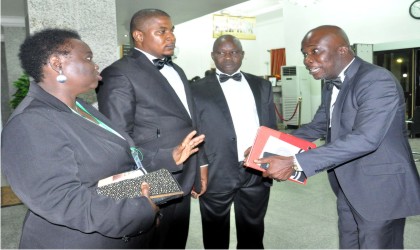
L-R: Mrs Ajiboye Adenike, National Vice President, law Students Association of Nigeria, National Open University, Paul Oyemike, President, Bassy Nwibani, National Vice President and Mr Eugene Ogbonna, National Director of Programmes, at the first national grand dinner in honour of law graduates of National Open University in Abuja, recently.
Barely two months after the inauguration
of the present government in Rivers
State, the state capital Port Harcourt has taken a new look, while social and economic activities appear to be taking off again.
Already the “operation zero potholes” campaign has opened hitherto un-motorable areas in the state capital to life through an aggressive roads rehabilitation exercise. In addition to this, gutters are being desilted and illegal markets dismantled.
Another reason why different sections of Port Harcourt residents are now singing the praise of Governor Nyesom Wike is the apparent enthronement of the rule of law and the human face of the administration.
Consequently, the usual un-certainty that held the population captive and stifled the economy of Rivers State is fast losing grip. Coupled with the release of three months salary within a month, the gridlock is broken. Clearly, Governor Nyesom Wike is making history so soon.
As we join other well meaning people of Rivers State to appreciate the Governor and to wish him well, we think that if the present tempo and philosophy is sustained, Rivers State will soon be seen as belonging to a people, while the existence of a government will no longer be in doubt.
We are particularly proud of the ingenious step taken by Governor Wike to involve the private sector in the reconstruction of the Eleme / Onne end of the East/West Road. This road that had defied the efforts of successive administrations in Rivers State and the Federal level is now going to be a reality.
The present administration has also shown its preparedness to re-open industrialization in Rivers State. The only Industrial district in Port Harcourt that had been in-accessible for many years will soon bubble as the Trans-Amadi Road is being rehabilitated.
By the time the Eleme / Onne Road supports business at the Federal Ocean Terminal, the Petrochemical company, the Refinery, the fertilizer company among others more jobs will be created. Similarly the re-opening of the Trans-Amadi Industrial Area will support the firms there.
The bottom line is that more hands will be engaged and the prospect for peace enhanced while the development of Rivers State would also receive a fresh impetus. These are some of the few things the ordinary people and the business community need to function.
When the present government promised to give Rivers a new face, many people took it for a political talk. But in so short a time we are beginning to lose count of the achievements of the administration. The world need more people who can honour their words and Governor Wike has proven himself to be one of the rare humans.
It is on record that this administration has taken on projects that others fear to take on. For the first time a government has taken steps to complete work on the road to Eagle Island. Similarly the Iwofe Road that had been severally described as the worst road in Nigeria is now under works.
We know that only a home boy that knows the real plight of the Rivers man could have done this. Even more humbling is the fact that this is being done at a time of extreme economic pressure in Rivers State.
At a time other states are still struggling to pay salaries, in fact, many of the new administrations that are not being distracted by electoral tribunals are still at the planning stage, but Governor Wike hit the ground running and giving Rivers people reasons to thank God for voting for him.
If for nothing else, it is expected that Rivers people, no matter their party affiliation or ethnic group should rally round the Governor Wike’s administration and take advantage of this passion to take the development of the people and the State to the next level.



Nigeria stands at a critical juncture as the world marked World Press Freedom Day (WPFD) on May 3. This annual observance is a reminder that a free press is central to democratic life, good governance, and public accountability. For Nigeria, it is also a moment for sober reflection on how far the country has come and how far it still has to go in safeguarding the independence of its media.
World Press Freedom Day exists to highlight the fundamental importance of freedom of expression and to honour journalists who risk their lives in pursuit of truth. It underscores the idea that without a free press, societies cannot function transparently, nor can citizens make informed decisions. In countries like Nigeria, where democracy continues to evolve, the observance carries particular urgency.
This year’s theme, “Shaping a Future at Peace: Promoting Press Freedom for Human Rights, Development and Security”, places journalism at the heart of global stability. It emphasises that a peaceful society cannot be built on silence, fear, or manipulated information. Rather, it depends on the free flow of accurate, timely, and independent reporting.
At its core, the theme highlights the role of journalism in fostering accountability, dialogue, and trust. These are not abstract ideals. In Nigeria, where public confidence in institutions is often fragile, the media remains one of the few platforms through which citizens can question authority and demand transparency. When press freedom declines, so too does public trust.
Journalism serves as a foundation for peace, security, and economic recovery. Countries with robust media systems tend to attract greater investment, maintain stronger institutions, and resolve conflicts more effectively. Nigeria’s economic challenges, ranging from inflation to unemployment, require open scrutiny and informed debate, both of which depend on a free press.
However, the issue of information integrity has become increasingly complex in the digital age. Artificial Intelligence (AI) and online platforms have amplified the spread of misinformation and disinformation. In Nigeria, where internet penetration has grown rapidly, false narratives can travel faster than verified facts. This makes the role of credible journalism more vital than ever.
The challenge is not only technological but also ethical. AI-driven manipulation of information threatens to distort public discourse, influence elections, and deepen social divisions. In such an environment, professional journalism must act as a stabilising force, ensuring that truth prevails over sensationalism and propaganda.
Equally troubling is the safety of journalists. Across Nigeria, reporters face growing levels of online harassment, judicial intimidation, and physical threats. Self-censorship is becoming more common, as media practitioners weigh the risks of reporting sensitive issues. This trend undermines the very essence of journalism.
A particularly alarming incident involved a serving minister in the present administration, who openly threatened to shoot a journalist during a televised exchange. Such conduct, broadcast to the public, sends a dangerous signal that hostility towards the press is acceptable. It erodes the norms of democratic engagement and places journalists in harm’s way.
This year’s theme aligns closely with the United Nations Sustainable Development Goal (SDG)16, which promotes peace, justice, and strong institutions. Freedom of expression is a cornerstone of this goal. Without it, institutions weaken, corruption thrives, and justice becomes elusive. Nigeria’s commitment to SDG 16 must therefore include genuine protection for the media.
Historically, the Nigerian press has been a formidable force. From resisting colonial rule to challenging military dictatorships, our journalists have played a central role in shaping the nation’s political landscape. Today, however, that legacy appears to be under strain, as the media operates under what can best be described as a veneer of freedom.
Beneath this facade lies a troubling reality. Journalists are routinely harassed, detained, and prosecuted for performing their constitutional duties. Reports from media watchdogs indicate that dozens of Nigerian journalists face legal threats or arrest each year, often for exposing corruption or criticising those in power.
The Cybercrimes (Prohibition, Prevention, etc.) Act of 2015 has become a focal point of concern. Originally intended to combat cyber threats, it has increasingly been used to silence dissent. Sections 24 and 27(1)(b), in particular, have been invoked to target journalists, bloggers, and social commentators.
Although amendments introduced in February 2024 were meant to safeguard journalists, concerns persist. The law continues to be wielded in ways that stifle investigative reporting and restrict freedom of expression. Legal reforms must go beyond cosmetic changes to address the root causes of misuse.
To safeguard the future of journalism in Nigeria, decisive action is required. The Cybercrimes Act must be revisited to ensure it cannot be weaponised against the press. Law enforcement agencies must operate free from political influence, upholding the rule of law and protecting journalists’ rights. Civil society and international partners must also strengthen independent media through funding, training, and platforms for wider reach.
In this rapidly evolving world shaped by artificial intelligence and digital innovation, Nigeria faces a clear choice. It can either allow press freedom to erode under pressure, or it can champion a truly independent media landscape. The path it chooses will determine not only the future of journalism, but also the strength of its democracy and the peace it seeks to build.

-

 Featured17 hours ago
WASSCE: RSG Distributes Science Materials To Secondary Schools
-
Rivers22 hours ago
MBA Forex Trial Adjourn To June 3, Amid Bereavement … As Court Declines Cost Application
-
Aviation22 hours ago
Passengers Stranded As Delta Airline From Atlanta Route Back Eight Hours After
-
Business22 hours ago
Customs Impound N2.35bn Cocaine, 15 Trailers of Rice
-
News22 hours ago
Xenophobic Attacks: Nigerian Lives More Important Than Foreign Investment – Oshiomhole
-
News22 hours ago
ActionAid Demands Probe Of Govs Using Public Funds For Campaign
-

 Nation5 days ago
Education Commissioner Seeks media Collaboration In Rivers
-

 Nation5 days ago
RSUBE Holds Training For 1,000 New Teachers To Strengthen Basic Education