
Nation
THE STATES

The Benue State Chief Judge, Justice Iorhemen Hwande,
has restrained Gov Gabriel Suswam from appointing first class chiefs in the state.
Mr Benjamin Adanyi has dragged Suswam and eight others to court challenging the passage of Benue State Council of Chiefs and Traditional Councils Bill/Law by the Benue House of Assembly on April 7, 2015.
Joined in the matter were Tor Tiv, the Och’Idoma, the Bureau for Local Government and Chieftaincy Affairs as well as the Benue House of Assembly.
Moving the motion on behalf of the applicant, Barr. T D Pepe had informed the court that the respondents had put machinery in place to implement the contents of a law that had not been properly or validly passed.
Pepe prayed the court to stop the respondents from appointing any person to the office of the 10 proposed first class chiefs in Benue pending the hearing and determination of the motion on notice in the case.
FCT
The Advocacy for Economic Integrity, an NGO, has advised
the incoming government to provide security, stable political system, regular electricity supply and efficient transportation to boost the nation’s development.
The Director-General of the organisation, Mr Abdullahi Aremu, gave the advice in an interview with newsmen in Abuja.
Aremu said the programmes and projects would help to solve the myriad of problems facing the Nigerian entrepreneur.
According to him, when there is no guarantee of security of lives and properties, it becomes difficult to run a successful venture.
He also urged the incoming government to ensure speedy improvement in the nation’s transportation system.
Kaduna
The Nigeria Union of Journalists (NUJ) has urged the
incoming Muhammadu Buhari administration to ensure adequate protection of journalists and other media workers in the discharge of their duties.
The National President of the union, Malam Mohammed Garba, made the call in Kaduna on Monday as part of the activities marking the World Press Freedom Day 2015.
According to him, good governance can not be achieved when the press do not have unfeterred access to the process of governance.
Garba said it was important for government to allow the journalists to carry out their watchdog role in the society “if any positive impact is to be made in the fight against corruption”.
The theme for this year’s World Press Freedom Day is: “Let Journalism Thrive! Towards Better Reporting Gender Equality and Media Safety in Digital Age.’’
Kwara
The Kwara State Anti-Thuggery Taskforce has said it had
arrested 22 suspected hoodlums at different locations in Adeta and Pakata areas of Ilorin, the state capital.
Alhaji Suleiman Abdulsalam, the Senior Special Assistant to the Governor on Security and Intelligence, made this known in an interview with newsmen in llorin.
He said some of the suspects were arrested at a shrine in Adeta in llorin, adding that some dangerous weapons and charms stained with fresh blood were recovered from them.
Abdulsalam told newsmen that a joint operation comprising the NDLEA, vigilante group and police tagged: ‘Operation Harmony’ on Friday also arrested 32 people at an Indian hemp joint in the outskirt of llorin.
According to him, all the suspects are being detained and interrogated by the security agents.
Lagos
The Lagos State Government has said that 140 convicted
sex offenders had been recorded in a Sex Offenders’ Register created by the state government to shame offenders and serve as deterrent.
Attorney-General and Commissioner of Justice Mr Ade Ipaye, made the disclosure at the 2015 Ministerial Press Briefing in Ikeja.
He said that the state had recorded no fewer than 12, 120 rape cases and other sexual violence matters in the last four years, describing such acts as threats to dignity and humanity.
According to him, the government is doing its best to address the problem through the law and other means.
Giving other statistics, Ipaye said that it had sentenced 5,834 offenders to community service for various offences in the last four years.
Niger
The Niger State government has announced the termination
of the appointment of political appointees and dissolution of State Boards with effect from May 1.
A statement issued on Monday in Minna by Alhaji Saidu Kpaki, Secretary to the state government, said the measure was aimed at ensuring smooth transition and proper handing over to the new administration.
It urged the affected appointees, who are heads of establishment to hand over to the most senior civil servant in such establishments.
“Category of officers entitled to severance gratuity who have vehicle loans and have not served up to two years minimum to qualify for the severance are to return such vehicles.
“They should also return any operational vehicle in their care to the Transport Officer, Government House for proper documentation”, the statement said.
Ogun
The Ogun State Government has pledged to improve on its
Internally Generated Revenue (IGR), so as to complete ongoing developmental projects across the state.
The Commissioner for Finance, Mrs Kemi Adeosun, stated this while briefing the participants of the Institute for Security Studies (ISS) on the activities of the Ministry in Abeokuta.
Represented by the Permanent Secretary, Mrs. Ajibola Chokor, Adeosun said government was planning to extend its cashless policy to ministries, departments and agencies (MDAs) in order to block leakages.
She said revenue consultants would be registered by the Ministry of Finance to monitor and create an enabling environment that would attract local and foreign investors.
Adeosun said the ministry had continued to formulate economic policies geared towards repositioning the state as well as improving on the existing process and systems to support the present administration
Osun
House of Assembly members-elect in Osun State have
been urged to shun partisanship and work together for the development of the state.
The Resident Electoral Commissioner (REC) in the state, Mr Adekunle Ogunmola, made the call on Monday while presenting certificate of return to them at the Independent National Electoral Commission (INEC) office in Osogbo.
He said that now that the elections were over, the next thing for the assembly members-elect to do was to ensure service to the people.
The REC, who described the in-coming lawmaker as members of the same family, said ‘’we are all members of the same family and we must ensure that we do our best to ensure good governance in the state.
In his speech, the Speaker of the house, Mr Najeem Salaam, who was also re-elected, described the next dispensation in the assembly as ‘’a new challenge’’ which required more commitment from the legislative arm of government.
Oyo
The Oyo State Government has restated its commitment to
maintaining and sustaining the existing peace and security of lives and property of the entire citizens of the state.
Governor Abiola Ajimobi stated this on Monday while receiving a delegation from the Institute for Security Service, Abuja ,at the Governor’s Office, Agodi ,Ibadan.
Ajimobi , who was represented by his Deputy, Moses Adeyemo, said that no state could develop without the provision of adequate security of lives and property.
He said the present administration would adopt a radical approach to the provision of security and economic development of the state.
The governor also called on governments at all levels to redouble their efforts toward creating a peaceful environment for the people.
Sokoto
Governor Aliyu Wamakko of Sokoto State has urged the
Federal Government to reposition the nation’s educational system to make it efficient, effective and competitive.
Wamakko made the call in Sokoto while receiving participants of Group 3, Course 37 of the National Institute of Policy and Strategic Studies (NIPSS), Kuru, Plateau.
“Such repositioning should be premised on facts and figures and not on sentiments; This should be the guiding principle while formulating and implementing plausible policies and programmes.
“Consequently, they will be made more sustainable, plausible and workable, hence, strengthen the nation’s education sector,” he said.
The governor said the state government had been providing substantial percentage of its annual budget to the education sector since 2007.
Zamfara
Residents of Gusau Local Government Area of Zamfara
State have urged the Federal Government to reverse the privatisation of the Power Holding Company of Nigeria (PHCN) because it had done more harm than good to Nigerians.
Some residents, who spoke with newsmen in Gusau, said the privitisation of the sector had not yielded the desired results.
Muhammad Mansur, a resident of Gidan Dawa, said that since the privitisation of the defunct National Electric Power Authority (NEPA), the country had continued to experience power shortage.
Mansur said that there had not been any progress with the privatisation of the company, rather it had witnessed degeneration.
He said before the company was privatised, the distribution of light in the area was better than it is today.
Salisu Idris, a resident of Bakin Kasuwa area of Gusau, said that in spite of the shortage in the supply of power in the area, the company’s officers disconnect customers at will.
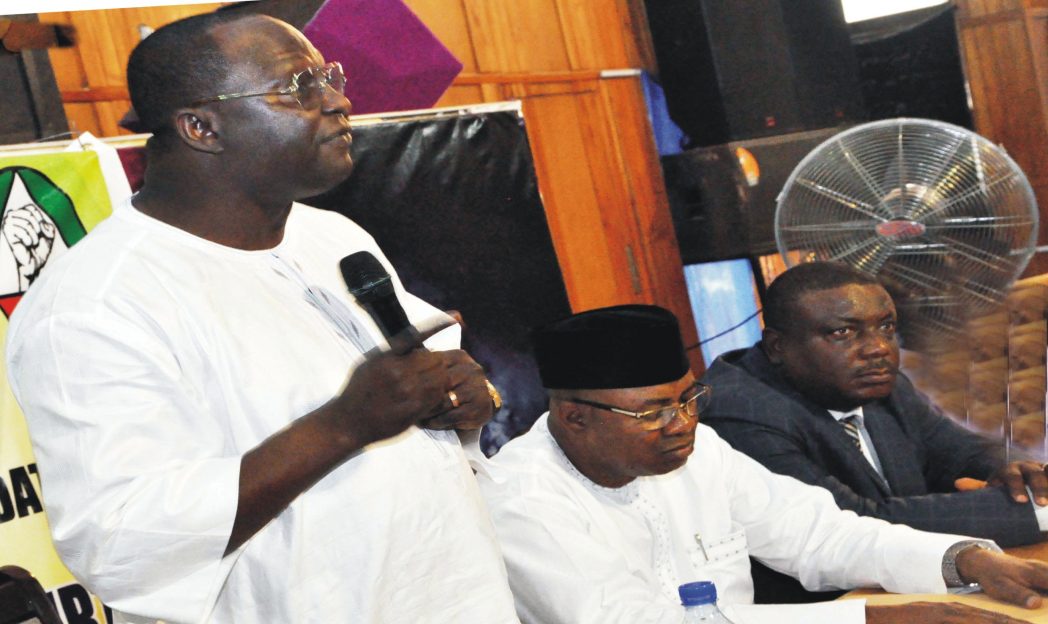
From Right: Nlc President, Comrade Ayuba Wabba, Deputy President, Comrade Peters Adeyemi and Secretary, May Day Organising Committee, Mr Benson Upah, at the 2015 May Day Symposium in Abuja on Thursday



The Rivers State Commissioner for Education, Dr. Peters Nwagor, has commended the orderly conduct of the ongoing 2026 West African Senior School Certificate Examination in the state and urged schools to sustain the standard.
Dr. Nwagor gave the commendation on Tuesday during a monitoring tour of selected secondary schools in Port Harcourt and environs where the WAEC exam is ongoing.
The commissioner, who was accompanied by directors and monitors from the Ministry of Education, said he was impressed with the peaceful atmosphere at the centres visited.
“The students conducted themselves properly and wrote their papers under conducive conditions. Invigilators and supervisors also performed their duties professionally,” he stated.

Nwagor noted that the Rivers State Government had invested heavily to ensure the smooth and credible conduct of the examination across the state
He urged candidates to reciprocate government’s effort by shunning all forms of examination malpractice and focusing on their studies.
“Government has done so much to ensure successful examinations in our schools. Students should take advantage of it by remaining focused,” the commissioner said.
While no case of malpractice was recorded in the centres inspected, Dr. Nwagor warned that any principal, teacher, invigilator, or official caught aiding malpractice would face strict sanctions in line with regulations.
He also commended school administrators, teachers, WAEC officials, and security personnel for upholding the integrity of the process.
Centres visited included County Grammar School, Ikwerre/Etche; Government Comprehensive Secondary School, Borokiri; Government Secondary School, Borokiri; and Pabod Model Secondary School.

Rivers State University and the Otonti Nduka Foundation for Values Education jointly hosted a two-day National Conference on 8 and 9 May 2026 to examine the state of values in Nigeria.
The two days conference held at Rivers State University convocation arena brought together academics, policymakers, legal experts and education leaders under the theme _“Trends and Challenges in Upholding Values in Nigeria.”_
The gathering focused on policy gaps, curriculum reform, and the role of ethics in public service and education.
The event opened on Friday with remarks from Vice Chancellor Prof. Chief Isaac Zeb-Obipi, who stressed the need to address declining moral and civic values across Nigeria’s education and public sectors. A book of abstracts for the plenary sessions was also presented to participants.
Key speakers included former Attorney General Chief Dr Kanu Agabi, SAN; NERDC Executive Secretary Prof. Shehu Salisu; Prof. Hauwa Imam, FNAE, of the University of Abuja; former Rivers SUBEB Chairman Ven Dr Fyneface Akah, ; former NIMASA DG Dr Hon. Dakuku Adol-Peterside; and RSU Director of ICT Prof. Sunny Orike.
Discussions centered on integrating values education into schools, tertiary institutions and public institutions, alongside the impact of technology on moral development among young Nigerians. Panel and plenary sessions produced practical recommendations for curriculum and policy reform.
On Saturday, the foundation marked its centenary with the unveiling of the book _Otonti Nduka in History_, launched by Chief Engr. Grant Offor, FNSE. The Nigerian Academy of Education held a ceremonial procession led by its President Prof. Olu Jegede and the Ikwerre Professors Forum.
In a communiqué, participants called for stronger collaboration between government, civil society and academia to mainstream values education nationwide. They recommended reviewing teacher training curricula and expanding digital platforms to promote ethical civic engagement, with the foundation pledging to share the outcomes with education authorities for implementation.
Dignitaries present included Ogbakor Ikwerre Worldwide as Chief Host, Prof. Emeritus Chief T. Uzodimma Nwala, the Ikenga 1 of Mbaise and first philosophy student of Prof. Otonti Nduka, alongside scholars and community leaders.
Amadi Akujobi

