
Politics
INEC: The Row Over New Polling Units

About six months to the
2015 elections, politicians have began for a attention and relevance and in some cases exchanging political missiles designed to shut down their opponents’ using subtle and direct campaigns even when the umpire, the Independent National Electoral Commission (INEC) has not officially flagged off campaigns. The INEC, which has not denied that there are mistakes and lessons to be learnt from previous conduct of elections especially the last three Anambra, Ekiti and Osun governorship polls, is however, hopeful that it would improve in its subsequent conduct of elections.
This dictates the commission’s decision for constant re-examination to see whether it is still on the path of reforming and improving the electoral process that will promote free, fair and credible elections.
The fallout of INEC’s strategy to reform the electoral process in line with international best practices is the creation of 30,000 polling units(PUs), bringing the total number to 150,000 nationwide from 119,973 that had existed since 1996. Out of the 30,000 PUs, the North got 70 per cent of the new units (more than 21,000 units) while the balance of a little more than 8,000 polling units were allocated to the South. The wide disparity int he collection has therefore sparked up a row. The commission is accused of shortchanging other parts of the country in favour of the North in terms of the new polling units.
The South East region under the aegis of the South East Leaders of the Peoples Democratic Party rejected the recent allocation of the new polling units, describing the allocation as “a gross injustice against Ndigbo.”
“We reject entirely the allocation of polling booths by INEC. We view it as a great disservice to the unity and progress of this country if the entre South will have 8,000 polling booths and the North gets 21,000. We demand that the issue be suspended forthwith. This is a prelude to undermine the interest of the zone in the 2015 elections. It is completely against the spirit of one Nigeria and progress of the country,” the PDP National Publicity Secretary, Olisa Metuh declared while briefing the Press at the end of the zone’s meeting at Abia State Government House, Umuahia.
Ogun State PDP chairman, Bayo Dayo expressed similar dissatisfaction with the allocation of the additional PUs. He is worried about the lopsidedness in the allocation.
He said, “Professor Attahiru Jega is an intelligent and honest man but if his honesty is not in the best interest of the South West, we will react and if need be, we will seek redress in court.”
Though civil rights activist, Comrade Moshood Erubami said it would be premature to fault INEC’s wisdom in the distribution of the PUs when we don’t know the criteria used, Afenifere chieftain, Chief Supo Shonibare agreed that the distribution was lopsided.
“I am not aware that INEC is an authorized body on population census. If it is based on estimate, it is wrong to give a section of the country more polling units at the expense of the other,” Shonibare said.
Another body that did not spare INEC over the allocation of the additional PUs is the Electoral Integrity Network.
Apart from doubting the operations of the commission in the electoral process, the Network was categorical that the exercise was a calculated move to favour certain section of the country, and malign others in the electoral process. The Network which also accused the commission of playing the script of powerful political individuals, also insisted that INEC’s new move is capable of inducing acrimony and hatred in the system which if not properly managed could trigger off crisis before, during and after polls.
The Plateau State Leaders said the political interest of the State has been undermined by INEC’s new allocation of PUs. In their press statement, the leaders asked the commission to re-visit the exercise as a whole, saying that in the spirit of national unity, no section of the country should be short- changed in any socio-political and economic process.
However, Attahiru Jega-led INEC, while absolving itself of what it called “spurious allegations”, explained the rationale for the creation of the new polling units which it argued were meant to facilitate ease access of voters to polling units in the forthcoming elections. INEC also justified the current move from past exercise and structure.
How did it all start?
The defunct National Electoral Commission of Nigeria (NECON), in 1996, created the present structure of polling units. INEC, inherited this structure but in 2010 went further to verify them and their locations. It ascertained a total of 119,973 units. Quite revealing was the fact that substantial number of the identified PUs are located in public buildings (primary and secondary schools, recreation centres/packs, community halls etc). Yet, there are some other PUs located in public open spaces (village /town/market squares, community grounds) and the remaining ones located in the premises of traditional rulers, places of worship, frontage of private houses, compounds etc).
The decision to align with global best practice, the electoral body argues, informed its plan to situate polling units within enclosures in public institutions and buildings, and where this is not possible, in places where tents / canopies’ can be erected for greater convenience of everyone involved in the electoral process.
When the current polling units were put to use in 1996, the estimated population of Nigeria was put at about 110 million, and by 2011, when INEC conducted the general voters registration exercise, the population was estimated at 160 million. Presently, this figure has grown to an estimate of 175 million.
Apart from the issue of population growth, INEC’s move may have been influenced by “severe demographic shifts”. According to INEC advertorial, there has been a notable growth in the number and sizes of new settlements across the country, especially in urban centres.
INEC argues that the reconfiguration of the PUs is apparently a strategy to break large polling units into manageable structures known as voting points and this increased the number from the present 119,973 units to 150,000 PUs. Under this arrangement, large polling units are disaggregated into multiples of 300 registered voters per voting point-with a polling unit having multiples of voting points, depending on the overall population of voters. The voting points are not autonomous units, per se; they remained integral to respective polling units.
The usage of these units may have elicited suspicions from interest groups and some political parties who accused the electoral body of secret agenda in the operations of the units. Whereas the electoral law provides for every political party to have one polling agent each at a PUs, some parties demanded to have polling agents at every voting point.
Also significant is the decision of the INEC to increase the technology content of the electoral process. For the 2015 elections, the commission intends “to use chip-embedded smart-card (as voter cards)and companion smartcard readers. Using the voting points as presently constituted, the commission said it will “require some 250,000 units of the smartcard readers to operate.” This has high cost implication to the economy.
As far as addressing electoral challenges are concerned, INEC believes that reconfiguration of the polling units is the answer, and the guiding principles for the reconfiguration include that polling units will now be located as much as possible in enclosure such as classrooms and halls of public schools, institutions, community centre, town halls, and where they are to be situated in open spaces, tents or canopies will be erected.
Furthermore, a public institution that accommodates more than one polling unit will be designated as a polling station and polling units will be located within a reasonable distance to voters at least a maximum radius of one kilometer in urban areas and two kilometers radius in rural areas. Each polling unit will have a maximum of 500 registered voters.
Proportional distribution of the newly created 150,000 polling units, however, shows that Lagos state has the highest number with 2,870 to bring the total number of its polling units to 11,565 to serve its 5,426,391 registered voters, while Kano State with 4,751,818 registered voters got additional 2,053 polling units to bring its total number to 9,809. Kaduna State, with registered voters of 3,743,815 benefitted additional 2,878 polling units to bring the total number of polling units in the state to 7,485. Bayelsa State, which has the lowest voting strength of 590,679 in the country got additional 121 polling units, making a total of 1,925 voting centres in the state.
The concern of the critics over of the allocation of additional 21,000 polling units to the North as against 8,000 allocated to the South may have been prompted by unsavory reports emanating from polling units during electoral activities.
A member of Delta PDP, Col Joseph Achuzia (rtd), described INEC’s allocation of the new PUs as illogical and wondered the rationale behind the move. The inference from the INEC move, he said, is that majority of the voters in the country are in the North, whereas the cleaning up of the voters register done recently by INEC has belied that notion.
He recalled that enumerators who registered voters in the North usually based their figures on estimates by virtue of their inability to get into certain areas to carry out the national assignment because of Islamic restriction. According to him, this Northerners always use the Islamic restriction as an excuse to stage-manage enumerations in their favour.
The decision of the electoral commission may sound logical especially when it is viewed against the background that the new polling units were previously known as voting points and were appendages of existing polling units. What this means is that INEC only acted from existing structures. But the people have the right to know the details of the reconfiguration so as to rebuild their confidence that were shattered overtimes by previous electoral mistakes.
On its part, the electoral body should consider it necessary to embark on massive sensitization and enlightenment programme for the citizens to allay their fears and educate them that its move has best intentions to ease the logistic challenges confronting electoral activities.
Another option of defence open to INEC in the creation of more polling units is the 2010 Electoral Act which provides that each polling units shall not have more that 500 voters. The need to comply with the provision of the Act, it would be argued, puts the commission on a sound footing for its action.
Samuel Eleonu
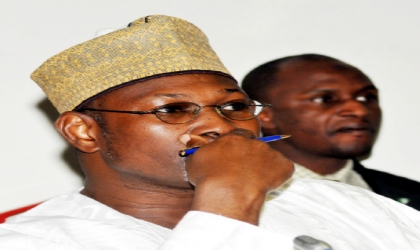
INEC Chairman, Prof Attahiru Jega

Politics
Alleged Coup: Protests Rock N’Assembly As Detained Officers’ Children, Wives Demand Justice

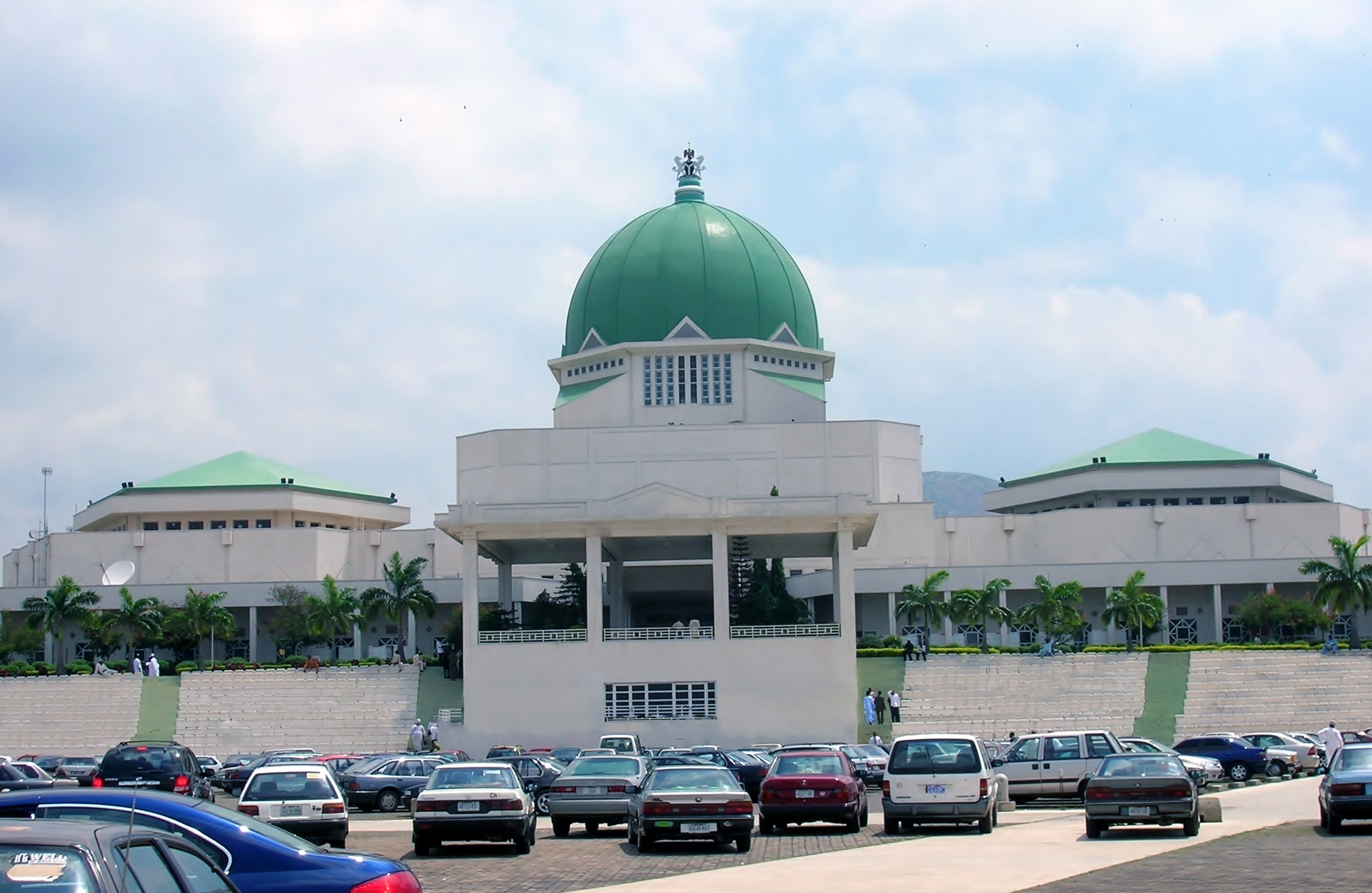
Scores of children and wives of military officers detained over an alleged coup plot yesterday staged a peaceful protest at the National Assembly, demanding a speedy trial and the release of the accused officials.
The protesters who gathered at the entrance of the National Assembly complex, moved in a slow procession while clutching placards with inscriptions such as “Don’t Kill Our Daddies,” “Detention Without Trial is Injustice,” and “Six Months of Torture: Enough Is Enough.”
Amid tears and trembling voices, the children appealed for justice and access to their detained fathers, many of whom they said they had not seen for months.
The appeal was made during a press briefing in Abuja attended by no fewer than 20 wives and several children of the detained officers, including a two-month-old baby.
The families were accompanied by human rights lawyer, Deji Adeyanju and activist Omoyele Sowore.
At the briefing, the families lamented that the officers had been held for over 160 days without trial or contact with their relatives, describing the situation as a violation of their fundamental rights.
Speaking on behalf of the families, Memuna Bashiru said the prolonged detention had thrown their households into uncertainty and emotional distress, noting that while allegations had been widely publicised, families remained in the dark about the fate of their loved ones.
The arrest of the indicted officers was first announced on October 4, 2025, by the then Director of Defense Information, Brigadier General Tukur Gusau, who disclosed that 16 officers were taken into custody for alleged breaches of military regulations and acts of indiscipline.
However, an interim investigation later suggested the existence of a clandestine network of officers, allegedly coordinated by a senior Army officer, which had begun preliminary planning for a coup.
According to the report, the alleged plot involved surveillance of key national assets, including the Presidential Villa, Armed Forces Complex, Niger Barracks in Abuja, and major international airports, with October 25, 2025, cited as the planned date for the operation.
Those reportedly in custody include Brig Gen M. A. Sadiq, Col M. A. Maaji, Lt Col S. Bappah, Lt Col A. A. Hayatu, Lt Col P. Dangnap, Lt Col M. Almakura, Maj A. J. Ibrahim, Maj M. M. Jiddah, Maj M. A. Usman, Maj D. Yusuf, Capt I. Bello, Capt A. A. Yusuf, Lt S. S. Felix, Lt Cdr D. B. Abdullahi, Sqn Ldr S. B. Adamu and Maj I. Dauda.
The alleged plot, according to findings, targeted senior government officials, including President Tinubu and Vice President Kashim Shettima.

In a statement issued yesterday, the party’s National Publicity Secretary, Mr Felix Morka, said the exercise would take place in all wards and designated centres nationwide.
He called on existing members to update their records, while encouraging new entrants to join the party through the digital platform.
“As the electronic membership registration exercise resumes in all wards and designated locations nationwide, we urge existing members to validate their membership while new members are encouraged to register and join the progressive family,” Mr Morka said.
According to him, eligibility for registration is limited to individuals aged 18 and above who possess a valid National Identification Number (NIN).
The party said the initiative is part of efforts to modernise its operations by transitioning to a digital database that would enhance record accuracy and accessibility.
Mr Morka noted that the e-registration would “digitise the party’s membership register, ensure the integrity of records, and enhance efficient access to membership data for planning and management decisions.”
He added that the move is also aimed at promoting internal democracy within the party and strengthening its commitment to democratic innovation.
The APC had previously introduced electronic registration as part of broader reforms to streamline its membership system and improve organisational efficiency.
-
News4 days ago
Decentralizing Pipeline Surveillance Poses Greater Dangers To Niger Delta …. Group Warns
-
 Politics4 days ago
APC Resumes Electronic Membership Registration Nationwide
-

 Rivers4 days ago
Court Rules Out Interim Administration In Jumbo House, Bonny
-
 Business4 days ago
33 Banks Raise N4.65tn As Recapitalisation Ends
-
 Politics4 days ago
Alleged Coup: Protests Rock N’Assembly As Detained Officers’ Children, Wives Demand Justice
-

 Nation4 days ago
Nile University Hosts ICA Nigeria First National Confab On Global Communication
-
Sports4 days ago
Lewandowski Leads Top Stars Missing From W/Cup Roll Call
-

 Sports4 days ago
Para Games: Team Rivers Wins 53 Medals On Day 5 … Director Praise Athletes