Connect with us

Business

Tariff Increase: Vehicle Importers To Pay 25% More

Published

on

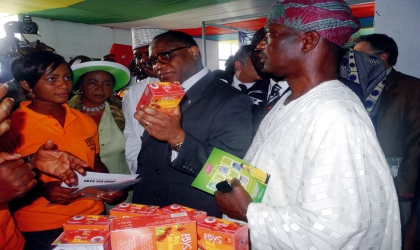
 Minister of Trade and Investment, Dr Olusegun Aganga (middle), inspecting a product at one of the exhibition stands, during the opening ceremony of Lagos International Trade Fair in Lagos,  last Friday. With him is the representative of the Governor, Mr Wale Raji (right).

Minister of Trade and Investment, Dr Olusegun Aganga (middle), inspecting a product at one of the exhibition stands, during the opening ceremony of Lagos International Trade Fair in Lagos, last Friday. With him is the representative of the Governor, Mr Wale Raji (right).

The Director-General,
National Automotive Council, Mr. Aminu Jalal, has said that all importers of new vehicles into Nigeria are to pay at least 25 per cent more on tariff.
This, he said, was meant to discourage the importation of fully built unit vehicles.
The move, according to him, is part of measures to develop the Nigerian automotive industry.
The Federal Executive Council had on October 2 approved a new automotive policy that would compel all government agencies and ministries to buy made-in-Nigeria vehicles.
This was also an initiative to encourage vehicle manufacturers to establish production lines/assembly plants in Nigeria.
In a telephone interview with our correspondent on Tuesday, Jalal said Nigeria was on the path of rejoining the league of auto producing countries.
It was learnt that before now, the import tariff differential between FBU and Completely Knocked Down vehicles was about five per cent.
Auto manufacturers had often complained that the gap was too close and made it cheaper to import fully built vehicles than to produce locally.
Jalal said many international automotive manufacturers such as Toyota, Nissan, Renault and GM, had indicated an interest to invest in Nigeria with the announcement of a comprehensive automotive development plan.
He said, “Nissan, Toyota and others are now conducting feasibility studies on vehicle assembly in Nigeria.
“The elements of the plan, which will ensure competitiveness and increase productivity of the sector, are: industrial infrastructure improvements (automotive supplier parks and clusters), skills development, standards, investment promotion, market development and anti-smuggling measures.”
Jalal lamented that the nation was wasting N400bn on the importation of 200,000 used vehicles and 80,000 new ones annually even when it had the capacity to produce 150,000 vehicles, which could fetch a total of N550bn.
He added that the fact that the policy would be subject to periodic reviews would enable the automotive industry to achieve its potential for the Nigerian economy.
He, however, stressed that the policy would not result in the banning of the importation of vehicles.
“At full capacity, the Nigerian automotive industry has the potential to create 70,000 skilled and semi-skilled jobs along with 210,000 indirect jobs in the SMEs that will supply the assembly plants. 490,000 other jobs will also be created in the raw materials supply industries,” he noted.
He said dealers could still clear imported vehicles at the old rates until February 28, 2014, provided “they can prove that they had opened a Letter of Credit for the vehicles before October 3, 2013.”
The Minister of Industry, Trade and Investment, Mr. Olusegun Aganga, had similarly said the new automotive policy would create significant employment and a wide range of technologically advanced manufacturing opportunities.
He said, “In many countries around the world, the automotive industry plays both strategic and catalytic roles in economic development, particularly in employment creation and wealth generation; small and medium enterprises development (as it relates to auto parts components and services); skills development and technology acquisition.”
According to him, this industrial base can then form the foundation for other modern advanced manufacturing activities.
“For example, commercial vehicle production will lead to the manufacture of agricultural, mining and railway equipment, military hardware and transport,” he added.
industrialised.
Many years ago, Nigeria had about 10 functional assembly plants for different categories of vehicles.
Out of the six of the firms that were privatised recently, only four are struggling to keep afloat the murky waters of business.

Continue Reading

Business

NCDMB Signs Mgt Deal With Radisson, Edison…As Board’s 204 Rooms Hotel Open December 2026

Published

on

The Nigerian Content Development and Monitoring Board (NCDMB), on Monday signed an international management agreement (IMA), with Radisson Hospitality, Belgium and Edison Hotel and Property Development Company with respect to the Board’s 204 rooms hotel and conference center, developed adjacent to the Content Tower, headquarters of the NCDMB in Yenagoa, the Bayelsa State.
A statement by the Board’s Directorate of Corporate Communications says the management agreement was signed in Durban, South Africa by the Executive Secretary of NCDMB, Engr. Felix Omatsola Ogbe, Executive Chairman of Edison Corporation, Mr. Vivian Reedy and Director of Radisson, Mr. Garnier Erwan.
Giving assent to the agreement, Ogbe affirmed that discussions, reviews, and compliance requirements have lasted for over two years, and that the Board secured the approval of all key stakeholders, including the Attorney?General of the Federation and Minister of Justice, Lateef Olasunkanmi Fagbemi, SAN.
“The support of stakeholders ensured that the Agreement meets Nigeria’s legal and regulatory standards.The aspiration of the NCDMB is to deliver a world?class hotel in Yenagoa, Bayelsa State with a fully equipped conference centre—designed to serve the oil and gas industry stakeholders and the Nigerian public”, he said.
He pledged the NCDMB’S commitment to completing the hotel on schedule time and achieving the opening in December, 2026.
“We appreciate our responsibilities—construction quality, pre?opening readiness, funding, safety and security compliance, and maintaining Radisson’s global standard. We will do our best to meet our obligations”, Ogbe added.
The Board’s Scribe charged the  Hospitality firm to bring its expertise, systems, and brand strength to deliver a hotel that offers excellent service and guest experience, expressing hope that the partnership with Edison Hotels will create a facility that reflects global quality and supports Bayelsa’s position as an oil and gas hub.
“This project reflects NCDMB’S commitment to using strategic investments to boost productivity, attract investment, build local content, and expand opportunities for business and tourism in Nigeria when completed.
“Radisson Hotel and Conference Center Yenagoa will stand not only as a hotel, but also as a symbol of what strong partnerships can achieve”, Ogbe noted.
In his remarks, Executive Chairman of Edison Corporation, Vivian Reedy described the organisation’s  role as a bridge between the owner and the operator, highlighting the group’s intensive experience in the hotel industry, and determination to ensure alignment, transparency, accountability and performance.
“We understand that a successful hotel is not just about buildings. It is about disciplined management, strong oversight, brand integrity, and a shared commitment to excellence.
“Part of our firm’s responsibility is to ensure that the hotel is delivered, operated, and managed in a manner that protects and announces the owner’s investment, while fully supporting Radisson in achieving operational excellence”, he said.
The Edison boss assured that working closely with Radisson and NCDMB’s team, the Radisson Hotel and Conference Center, Yenagoa will become the leading hospitality and conference destination in Bayelsa State, saying it is catalyst for business and investment, and a symbol of quality professionalism and international standards.
He emphasized that the firm has had wonderful successes with Radisson in other locations, even achieving 95% occupancies, noting that the company’s approach is to strengthen governance, support performance, and ensure the interests of the owners are always safeguarded.
“This project represents more than a hotel. It represents a partnership, a trust, and a long-term vision for sustainable value creation. We thank Radisson for its global expertise and operational excellence.
“Edison is fully committed to ensuring that the asset performs strongly, operates efficiently, and delivers lasting value to its owner”, the firm said.
In his speech, the Attorney-General of the Federation Chief Lateef Fagbemi, SAN, representative by Mr. Wada Ahmed Wada described the signing ceremony as historic and wished the parties success in their business relationship.
By Ariwera Ibibo-Howells, Yenagoa
Continue Reading

Business

FG engages foreign investors at PEBEC Roundtable on business environment reforms

Published

on

Senior government officials and foreign investors operating in Nigeria met in Abuja on Thursday as the Presidential Enabling Business Environment Council (PEBEC) convened the Third Existing Foreign Direct Investors (FDI) Roundtable to address challenges affecting the country’s investment climate.
The high-level engagement, held at the Banquet Hall of the Presidential Villa, brought together top policymakers and representatives of foreign companies for discussions aimed at improving Nigeria’s business environment and strengthening investor confidence.
The roundtable forms part of PEBEC’s efforts to deepen collaboration between government institutions and the private sector while ensuring that ongoing reforms translate into tangible improvements for investors already operating in the country.
Opening the session, Senator Ibrahim Hadejia, Deputy Chief of Staff to the President, welcomed participants on behalf of the Vice President and Chairman of PEBEC, reiterating the Federal Government’s commitment to maintaining a stable and transparent business environment that supports investment and economic growth.
In her remarks, the Director-General of PEBEC, Princess Zahrah Mustapha Audu, said the council remains committed to sustained engagement with investors and coordinated implementation of reforms across government agencies.
She noted that existing foreign investors play a critical role in Nigeria’s economic development through job creation, capital investment, technology transfer, and supply chain development.
According to her, PEBEC’s engagement strategy prioritises listening to investors already operating in the country in order to identify and address operational challenges affecting their businesses.
The roundtable featured presentations and interactive discussions with senior government officials responsible for regulatory and policy frameworks affecting investors.
Among them were the Executive Chairman of the Nigeria Revenue Service, Dr. Zacch Adedeji; the Comptroller-General of the Nigeria Customs Service, Bashir Adewale Adeniyi; and the Inspector-General of Police, IGP Olutunji Rilwan Disu.
Also participating virtually was Mr. Taiwo Oyedele, Chairman of the Presidential Committee on Fiscal Policy and Tax Reforms and Minister of State for Finance-designate, who spoke on ongoing fiscal and tax reform initiatives aimed at improving tax certainty and strengthening revenue administration.
During the discussions, investors raised technical questions and shared insights on issues relating to security, tax administration, customs procedures and fiscal policy reforms.
Continue Reading

Business

MAN warns against illegal recycling of File photo

Published

on

The Manufacturers Association of Nigeria has warned against the illegal destruction and recycling of returnable packaging materials belonging to beverage companies, following a recent police crackdown on illegal factories in Anambra State.
Earlier in February, the Nigeria Police Force, working with beverage manufacturers, reportedly raided several illegal facilities in Onitsha and surrounding areas, where individuals allegedly destroyed returnable glass bottles and plastic crates belonging to beverage companies.
In a statement on Friday, the Director-General of the Manufacturers Association of Nigeria, Segun Ajayi-Kadir, condemned the destruction of these packaging materials as unauthorised and economic sabotage against businesses, and hailed the efforts of the police and regulatory agencies.
“The recent raid is the outcome of sustained engagements and intelligence-led investigations and represents a decisive step by authorities to protect legitimate business operations, uphold environmental standards, and deter further illegal activity,” Ajayi-Kadir said.
The MAN DG described the practice “as criminal and a serious economic sabotage… as assets remain the property of beverage companies that have invested heavily in these sustainable packaging materials to protect the environment”.
According to a Vanguard News report, the Executive Secretary of the Beer Sectoral Group of the Manufacturers Association of Nigeria, Abiola Laseinde, commenting on the February crackdown on alleged factories in Anambra, stated that, “The recent raid is the outcome of sustained engagements and intelligence-led investigations… a decisive step by authorities to protect legitimate business operations, uphold environmental standards and deter further illegal activity.”
Ajayi-Kadir confirmed the earlier news reports, affirming that the police acted on credible intelligence to dismantle illegal operations involving the theft, destruction, and unauthorised recycling of companies’ returnable packaging materials.
He stated that the association received reports from member companies that some factories were destroying company-owned bottles and crates for resale as raw materials, resulting in businesses losing millions of naira in investments.
“The police, working with member companies, acted on credible intelligence and stormed the factories to crack down on illegal disposal, theft, and unauthorised recycling of the returnable packaging materials of the affected companies, notably returnable glass bottles and plastic crates,” Ajayi-Kadir said.
Ajayi-Kadir added that investigations revealed that large quantities of bottles and crates were diverted from legitimate channels into informal recycling networks across the South-East.
“Member companies identified multiple illegal locations in the South-East where they crush our bottles and crates for resale as raw materials, while police investigations showed that significant quantities were being diverted from legitimate channels into informal recycling networks,” MAN’s DG said.
He noted that in several cases, reusable bottles were deliberately broken and plastic crates shredded and sold as raw materials, thereby undermining beverage companies’ circular packaging model.
He remarked, “These Returnable Packaging Materials are company-owned assets designed for multiple reuse cycles and form a critical part of their sustainability, cost-efficiency, and product quality systems. It’s a criminal activity to destroy them.”
Meanwhile, Ajayi-Kadir warned those involved in the illegal practice to desist, stressing that the association would continue to collaborate with law enforcement agencies to ensure offenders face the full weight of the law.
He added that beyond the direct loss of assets, the activities disrupt supply chains, raise operational costs and pose environmental and safety risks due to unsafe recycling practices.
MAN urged relevant government agencies to intensify efforts against the illegal diversion and destruction of returnable packaging materials outside the beverage industry’s value chain.
MAN’s DG also called on members of the public to report suspicious activities to the police or to the consumer care lines of beverage companies.
Continue Reading

Trending