Business
C’River Votes N1.7bn For Food Bank Commission

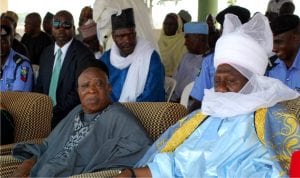
President, National Agricultural Foundation/Chairman Senate Committee on Agriculture, Senator Abdullahi Adamu (left) with Sarkin Keffi III, Alhaji Shehu Yamusa, at the 2016 National Agricultural show in Keffi, Nasarawa orecently.
The Cross River Gov
ernment has budgeted the sum of N1.7 billion for the establishment of a food bank commission in the state.
This was disclosed by the State Governor, Professor Ben Ayade, while receiving a delegation from HB Heritage Bank led by its Coordinator of the Home Grown School Feeding Programme, Mr. Godwin Ukwat on a courtesy visit in his office in Calabar, Monday.
Ayade said that the Food Bank Commission is structured in a manner that each local government will have a director.
He expressed the willingness of the state government to key into the Home Grown School Feeding Programme on the condition that it is given the free hand to run it.
The governor decried the fact that the practice of agriculture in the country was still at the subsistence level; stating that it was time the country embraced the use of technology in farming.
“We are at a time where agriculture is driven by technology in developed countries; where farming is in the hands of big farmers and infrastructure such as roads, water and power are provided,” he stated.
He argued that it would be counterproductive to encourage farmers to continue with “stone-age” agricultural practices which do not even provide insurance cover for the farmers.
In his presentation, the HB Heritage Bank, Head of Agric-Finance, Mr. Gbenga Awe, said that the home grown school feeding programme is one of the social safety nets of the Federal Government, which seeks to employ 300,000 youths in the country.
He disclosed that the programme is meant to feed school pupils from primary one to six with the aim to encourage learning, asserting that it is usually difficult for a child to concentrate and learn with an empty stomach.
Awe further explained that the scheme would be funded on the basis of 60 per cent for the federal government and 40 per cent for the state governments.
He outlined the benefits to states to include a boost to Internally Generated Revenue as it brings a large population of persons from the informal sector to the formal sector thereby expanding the state access to the tax base.
He listed states that are already signed on to the programme to include, Kaduna, Zamfara, Osun, Oyo, Jigawa, Benue and Enugu states.

Business
FIRS Clarifies New Tax Laws, Debunks Levy Misconceptions
Business
CBN Revises Cash Withdrawal Rules January 2026, Ends Special Authorisation
The Central Bank of Nigeria (CBN) has revised its cash withdrawal rules, discontinuing the special authorisation previously permitting individuals to withdraw N5 million and corporates N10 million once monthly, with effect from January 2026.
In a circular released Tuesday, December 2, 2025, and signed by the Director, Financial Policy & Regulation Department, FIRS, Dr. Rita I. Sike, the apex bank explained that previous cash policies had been introduced over the years in response to evolving circumstances.
However, with time, the need has arisen to streamline these provisions to reflect present-day realities.
“These policies, issued over the years in response to evolving circumstances in cash management, sought to reduce cash usage and encourage accelerated adoption of other payment options, particularly electronic payment channels.
“Effective January 1, 2026, individuals will be allowed to withdraw up to N500,000 weekly across all channels, while corporate entities will be limited to N5 million”, it said.
According to the statement, withdrawals above these thresholds would attract excess withdrawal fees of three percent for individuals and five percent for corporates, with the charges shared between the CBN and the financial institutions.
Deposit Money Banks are required to submit monthly reports on cash withdrawals above the specified limits, as well as on cash deposits, to the relevant supervisory departments.
They must also create separate accounts to warehouse processing charges collected on excess withdrawals.
Exemptions and superseding provisions
Revenue-generating accounts of federal, state, and local governments, along with accounts of microfinance banks and primary mortgage banks with commercial and non-interest banks, are exempted from the new withdrawal limits and excess withdrawal fees.
However, exemptions previously granted to embassies, diplomatic missions, and aid-donor agencies have been withdrawn.
The CBN clarified that the circular is without prejudice to the provisions of certain earlier directives but supersedes others, as detailed in its appendices.
Business
Shippers Council Vows Commitment To Security At Nigerian Ports
-
Featured4 days agoOil & Gas: Rivers Remains The Best Investment Destination – Fubara
-
Nation4 days ago
MOSIEND Calls For RSG, NDDC, Stakeholders’ Intervention In Obolo Nation
-
Nation5 days ago
Hausa Community Lauds Council Boss Over Free Medical Outreach
-
Nation5 days agoOgoni Power Project: HYPREP Moves To Boost Capacity Of Personnel
-
Nation5 days ago
Association Hails Rivers LG Chairmen, Urges Expansion Of Dev Projects
-
Nation5 days ago
Film Festival: Don, Others Urge Govt To Partner RIFF
-
News4 days agoNDLEA Arrests Two, Intercepts Illicit Drugs Packaged As Christmas Cookies
-
News4 days agoTroops Rescue 12 Abducted Teenage Girls In Borno