
Nation
THE STATES

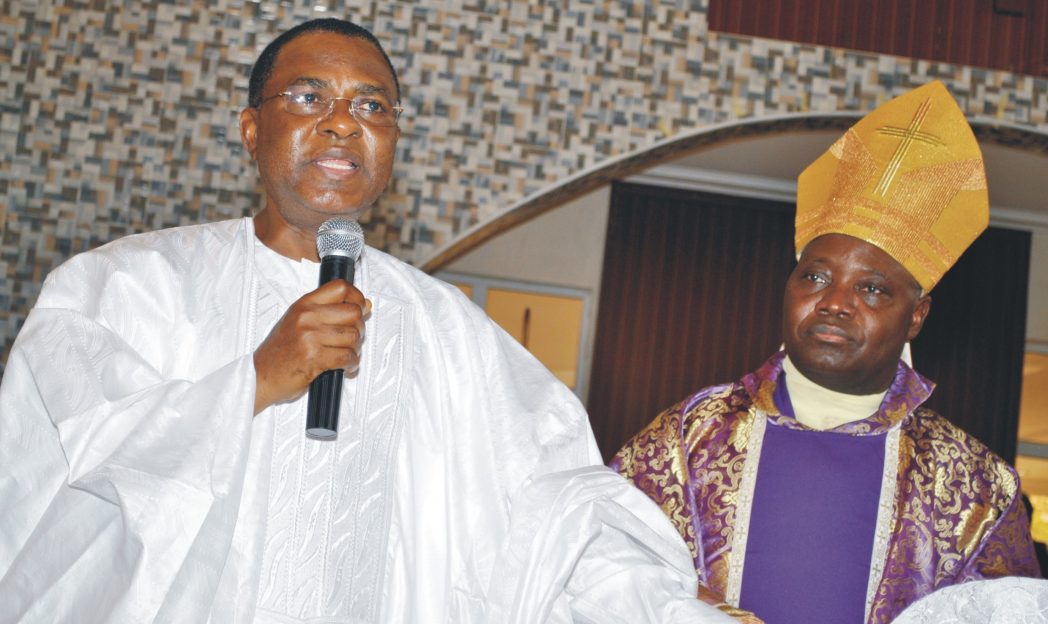
Gov. Isa Yuguda of Bauchi State (left) with Catholic Archbishop of Jos Diocese, Archbishop Ignatius Kaigama, at the Funeral Mass in Honour of 2nd Bishop of Catholic Diocese of Bauchi, Late Bishop John Malachy at St. John Catholic Cathedral in Bauchi yesterday.
Adamawa
The Adamawa State command of the Nigeria Immi
gration Service last Wednesday, met with the leaders and representatives of ECOWAS and other African nationals in the state over Saturday’s elections.
Addressing the leaders, the Comptroller, Mr Ubi Nkanu, urged them to warn their members to steer clear of the elections.
Nkanu said any foreigner caught trying to vote or participate in the election would be dealt with, adding that some illegal aliens were recently caught with voters’ cards and had since been deported.
He said that the command had mobilised its men to ensure that no foreigner voted during the elections.
Nkanu said Nigeria’s borders would remain closed during the elections and urged everyone to remain calm, peaceful and law-abiding.
Benue
The Benue State Police Command has denied ar
resting innocent citizens ahead of the March 28 and April 11 elections.
The Police Public Relations Officer, ASP Austin Ezeani, made the denial in an interview with newsmens in Makurdi.
The spokesman, who was responding to complaints by residents over alleged arbitrary arrest by the police, said the raid was targeted at criminals and not to victimise anybody.
According to him, the raid is based on privileged information and innocent persons would be released after thorough screening.
“The operations has yielded positive results as the police have recovered arms and illicit drugs, especially cannabis sativa, charms and stolen vehicles”.
Borno
Senator Mohammed Ndume has expressed optimism
that the military will liberate Gwoza from Boko Haram insurgents very soon.
Ndume (APC-Borno South) stated this during a chat with newsmen in Maiduguri.
He said the military had demonstrated high sense of patriotism in its recent anti-terrorism war.
“In the last five weeks, the military had performed creditably by reclaiming 22 communities from the insurgents.
“I believe that the remaining communities will be reclaimed in the shortest possible time.
“Gwoza, which is the strong hold of the insurgents, will be reclaimed any moment from now, going by recent developments.
“I think that the soldiers deserve commendation for what they are doing’’, Ndume said.
Ekiti
Ahead of the elections, traditional rulers in Ekiti on
Wednesday assured NYSC members to be used as INEC ad-hoc staff of their safety.
The monarchs gave the assurance when a team of the NYSC management led by the State Coordinator, Mr Chidube Ibeh, visited some of the monarchs.
Our correspondent reports that NYSC team visited the Ewi of Ado-Ekiti, Oba Rufus Adejugbe, Arinjale of Ise-Ekiti, Oba Adetunji Ajayi, and the Elemure of Emure, Oba Adebowale Adebayo.
Other monarchs visited were the Oluyin of Iyin-Ekiti, Oba Ademola Ajakaye, and the Regent of Ikere-Ekiti, Ayooye Adegboye.
Addressing the team in their palaces, all the monarchs visited described Ekiti people as peace-loving who would never do anything that would endanger the lives of the corps members.
FCT
Director-General, Nigerian Meteorological Agency
(NiMet), Dr Anthony Anuforom, said the agency was committed to building climate knowledge required for action through the automation of its climate observatories.
Anuforom said this while addressing newsmen during activities marking the 2015 World Meteorological Day with the theme, ‘Climate Knowledge for Climate Action’ in Abuja, recently.
He said that NiMet had embarked on the automation of its observatories around the country, to enable it to provide climate knowledge for climate action, with six locations currently on the test run.
Anuforom said the theme of the year was timely and apt, following the completion and inauguration of NiMet’s Information and Communications Technology (ICT) centre.
Gombe
The Minister of Transport, Sen. Idris Umar, has called
on the electorate in Gombe state to eschew violence in the upcoming elections.
Umar made the appeal while speaking with newsmen in Deba, headquarters of Yamaltu/Deba local government area of the state on Wednesday night.
He advised the electorates to conduct themselves orderly to have peaceful polls.
“Well, we thank God, the elections are here on Saturday the 28th of March this year and of course, on the 11th of April of this year.
“My message to the people of Gombe state and Nigeria as a whole is that we should conduct ourselves orderly during the elections so that have peaceful conduct of the elections,” he urged.
Lagos
Lagos State Governor Babatunde Fashola, has urged
voters not to make trouble as they wait behind to defend their votes after casting their ballots.
Fashola spoke at the All Progressives Congress (APC) campaign rally in Somolu area of the state.
He emphasised that there was no law prohibiting the electorate from staying behind at the polling units after voting.
“Some people have said that you should not stay near the polling units after voting; that is untrue.
“Let me tell you something, election is governed by law; I am saying this because I am not just a lawyer but a leader in the legal profession.
“There is nothing in the electoral law that stops you or prohibits you from staying at the polling units to defend your votes.
Ogun
A 23-year-old taxi driver, Tosin Olayinka, has been arraigned before an Abeokuta Chief Magistrates’ Court for allegedly stealing the belongings of his passenger and a tyre.
The Police Prosecutor, Insp. Sunday Eigbejiale told the court that the accused committed the offences on February 26 and on March 4 at 66 Majekodunmi Street, Iberekodo, Abeokuta.
He said the accused stole the handbag of one Felicia Obasa containing N58,000 when she (Obasa) boarded Olayinka’s taxi on her way to Moshood Abiola Polytechnic.
Eigbejiale said the accused also stole the front tyre of a taxi owned by one Dauda Fasasi.
He said the tyre cost N8, 000.
The prosecutor said: “the accused is a habitual criminal who disguises as a taxi driver; he is fond of carrying passengers to different destinations after assessing their belongings.
Plateau
The Pankshin local government council in Plateau said
it had executed projects worth more than N500 million since its inception last year.
The Supervisory Councilor of Works, Mr. Emmanuel Danboyi said this in an interview with newsmen in Pankshin.
“I assure the people of this area that with more funds, the council would execute more projects, “ Danboyi said.
He listed some of the projects to include: a Township Stadium; boreholes/hand Pumps and roads/culverts.
Others are: 23km Mile V-Nyelleng-Wuseli road; 10 km Llankan-Abwor Dyis road and Wuseli and Tal bridges.
Sokoto
The Assistant Inspector-General of Police (AIG) in
charge of Zone 10, Alhaji Bala Hassan, has said that the police are ready to provide security during Saturday’s presidential election in the zone.
The zone comprises Sokoto, Kebbi and Zamfara states.
Hassan told newsmen in Sokoto that an effective operational order on how to provide security at each of the polling units had since been made and issued to the commissioners of police in the area.
He said that the police commands had embarked on “operation show force” with other security agencies to show their preparedness for the elections.



As the world marked the 2026 International Day of the Girl Child on Sunday, October 11, 2026, a non-governmental organisation, Stand Up for Women Society (SWS) has intensified its campaign against child marriage, urging schoolgirls to prioritise education, protect their rights and develop skills for a better future.
The organisation joined the global observance of the day under the theme, “International Day of the Girl Child: End Child Marriage and Invest in Girls’ Rights,” with a sensitisation programme at Government Girls Secondary School, Oromenike, D-Line, Port Harcourt, Rivers State.
Led by its Vice Chairperson, Daba Benebo, the group engaged the students in discussions on the dangers of early marriage, teenage pregnancy, sexual abuse and other challenges that threaten the education, safety and development of the girl child.
Speaking during the programme, Benebo urged the students to reject early marriage and remain focused on their studies, stressing that education would empower them to make informed decisions about their lives and future.
She cautioned the girls against allowing anyone to deprive them of their right to education and dignity, advising them to report cases of harassment, abuse and other violations of their rights to the appropriate authorities.
Benebo assured the students that SWS remained available to support them whenever they encountered violations of their rights.
She also encouraged them to maintain discipline and responsible conduct while avoiding behaviours that could expose them to negative influences and jeopardise their future.
Beyond formal education, the SWS vice chairperson urged the students to acquire vocational skills that could provide additional opportunities for economic independence and help them navigate future challenges.
The sensitisation programme, enlivened by singing, dancing and to share their views and experiences on issues affecting the girl child interactive sessions, provided an opportunity for the students to share their views and experiences on issues affecting the girl child.
One of the major issues raised during the discussion was the appropriate age for marriage. While some participants maintained that 18 years was the constitutionally approved age, the discussion highlighted the need to consider not only age but also the maturity, preparedness and responsibilities associated with marriage.
The speaker stressed that marriage required adequate mental and emotional preparation, as well as the capacity to shoulder its responsibilities.
She therefore advised the students to concentrate on acquiring a sound education before considering marriage, noting that education would equip them with the knowledge and skills needed to make responsible decisions and manage family life.
The issue of teenage pregnancy also featured prominently during the question-and-answer session.
In addressing the subject, the speaker explained that pregnancy could occur even at the age of 12, using the example to underscore the vulnerability of young girls to the consequences of early sexual activity.
She advised the students to avoid sexual intercourse and prioritise their education, personal safety and future aspirations.
The discussion also examined the difficulties some girls encounter when living with hostile spouses, relatives or guardians.
Benebo encouraged the students to cultivate patience, humility and diligence, noting that these qualities could help them navigate difficult situations and build a brighter future.
However, she warned that patience and humility should never be interpreted as an obligation to endure violence, abuse or degrading treatment.
She urged girls experiencing hostile or abusive living conditions to seek help from their parents, trusted adults or appropriate support services rather than remain in environments that could expose them to physical or emotional trauma.
“When such happens, please return to your parents and engage in petty trade or learn a skill to support your education rather than stay in a hostile environment,” Benebo stressed.
The programme also underscored the importance of protecting girls from early marriage and other harmful practices that can disrupt their education, compromise their well-being and limit their opportunities in life.
It also reinforced the need for families, schools, communities and relevant organisations to work together to ensure that girls have access to education, vocational training, protection and the support they need to realise their potential.
For SWS, the message was clear: empowering the girl child begins with protecting her rights, investing in her education and equipping her with the confidence and skills to make informed choices about her future.
Stories by Kevin Nengia
The Egberipapa Foundation has unveiled a mass transit scheme aimed at easing transportation difficulties and improving connectivity among communities in the three Kalabari local government areas of Asari-Toru, Degema and Akuku-Toru in Rivers State.
The initiative, established by former Caretaker Committee Chairman of Akuku-Toru Local Government Council, High Chief Sobomabo Jackrich, popularly known as Egberipapa, is designed to make transportation more accessible and affordable for residents across the Kalabari area.
The scheme was launched on Monday, October 12, 2026, and is expected to address longstanding transportation challenges confronting residents, particularly those in riverine and hard-to-reach communities.
Communities expected to benefit from the initiative include Krakrama, Minama, Angulama, Sangama, Omekwe-Tariama and Omekwe-Ama.
The project is expected to ease movement within and beyond the Central Group area, while providing residents with a more convenient means of transportation for their daily activities.
For decades, transportation difficulties have posed significant challenges to several Kalabari communities, making movement between settlements both cumbersome and expensive. These challenges have also affected commercial activities, social interactions and access to essential services.
The introduction of the mass transit scheme is therefore expected to provide relief to residents, strengthen inter-community connections and stimulate economic activities across the benefiting communities.
Beyond improving mobility, the initiative could contribute to community development by facilitating the movement of people and goods, supporting local businesses and enhancing social and economic interactions within the Kalabari area.
As the scheme gets underway, attention will be focused on its implementation, accessibility and sustainability, as well as its capacity to deliver lasting transportation benefits to the target communities.
The initiative represents a potentially significant step towards addressing transportation challenges and promoting grassroots development across the Kalabari Kingdom.

The Amaewhule family of mbodo Aluu in Ikwerre Local Government Area of Rivers State has cautioned members of the public against entering into any land transaction involving a disputed property known as “Ada Oro Fam Land,” located behind the OPM Church along Airport Road.
The family, through its legal counsel, Barrister Ndubuisi Agumagu, issued the warning amid an ongoing legal dispute over the ownership and control of the property, which is said to comprise more than 900 plots of land.
The matter is currently before the Isiokpo High Court of Rivers State in a suit numbered IHC/246/CS/2026, presided over by Justice Sobere Biambo.
The claimants in the suit include Chief Green Amaewhule and others, while Fabulous Amaewhule and Odibola Properties are listed among the respondents.
Counsel to the Amaewhule family, Barr Ndubuisi Agumagu, advised prospective land buyers and members of the public to exercise caution and refrain from purchasing any portion of the disputed property pending the determination of the case by the court.
According to the legal counsel, the property is a family estate belonging collectively to the Amaewhule family, and no individual member of the family has the authority to unilaterally dispose of portions of the land.
The counsel specifically maintained that Fabulous Amaewhule, one of the respondents in the suit, does not have the legitimate authority, according to the family’s position before the court, to sell portions of the disputed property.
The family further warned that anyone who proceeds to purchase land from the respondents while the matter remains before the court would be doing so at their own risk.
It stressed that such buyers could potentially lose their investments should the court eventually deliver judgment against the validity of the transactions.
The legal team said the warning became necessary to prevent unsuspecting members of the public from committing their resources to a property whose ownership and right of disposition are currently the subject of judicial determination.
The family also urged prospective investors, developers and land buyers to conduct proper legal inquiries and obtain independent verification of the status of the property before committing funds to any transaction relating to it.
The Amaewhule family said its position was intended to protect members of the public from possible financial losses and further legal complications while the case remains sub judice, stressing that interested parties should await the final determination of the court.
Akujobi Amadi
-

 Niger Delta10 hours ago
Diri Restates Stance On Lagos-Calabar Coastal Highway
-

 Niger Delta10 hours ago
C’River, NUJ Pay Tribute To Late Guardian Editor
-

 News11 hours ago
NDLEA Recovers Tons Of Illicit Drug Consignments In Nine States
-

 Opinion9 hours ago
Checking Voter Apathy In Nigeria’s Electoral Process
-

 Sports7 hours ago
Nigerian Trio Target Titles At PFL Africa Finals
-

 Education7 hours ago
FCE Yola Graduates 3,555 Teachers , Seeks Upgrade to University
-

 Politics7 hours ago
2027: DICKSON’S EX-ALLY VOWS TO WORK AGAINST NDC INTEREST IN BAYELSA
-

 Politics7 hours ago
2027: GROUP PLEDGES 40,000 SUPPORTERS FOR COALITION CANDIDATES IN RIVERS