
Nation
THE STATES

Bauchi
The Bauchi State Government has designed a quick
response mechanism to assist victims of religious, communal and other disasters in the state. The measure followed the influx of more victims from the crisis prone areas to the state due to insurgency and other disasters.
Stakeholders at a meeting in Bauchi designed a framework on how to effectively manage the programme and resolved to conduct a feasibility study at the places the displaced persons were residing to ascertain the number of the victims for necessary assistance.
Speaking, a representative of the International Resolve Committee, Mrs. Elizabeth Bawu, said the programme would focus attention on rendering support to health, education and social needs of victims.
Bawu said: “Statistics has shown that more than five million insurgency victims were displaced to Bauchi State and some neighbouring states, hence there is the need to provide support and intervention from government and development partners”.
Benue
Benue State Governor, Gabriel Suswam, has assured the
people of the state that the state government is taking precautionary measures to ensure there is no outbreak Ebola disease in the state.
Suswam, who spoke to newsmen yesterday, hinted that already, the state Ministry of Health had sent doctors to the Federal Ministry of Health in Abuja to get the kits in case of any outbreak in the state.
While appealing to the people of the state to be calm and go about their normal activities without fear, the governor said even though the disease is highly contagious, it is not airborne and could not be contacted unless one came in direct contact with an infected person.
Reminded that there are thousands of bats daily hovering over the Government House in Makurdi, Governor Suswam said the bats had been there even before the state was created and had not caused any problem.
“The bats have been here before Aper Aku became governor and we have not had any case of Ebola in the state. Even those who eat bats, so long as they cook it well, I don’t think it can cause any problem for them,” he said.
FCT
The Chairman, Black Creations International, a Pan African
trade and investment organisation based in the United States, Dr Joseph Brown-Diogo, says the organisation has discovered a rock with a replica of Nigeria’s physical map.
He said in a statement in Abuja last Tuesday that the rock was discovered on July 7, 2013 by a team called the “Destination Nigeria”, sponsored by the organisation.
Brown-Diogo claimed that “the spectacular rock formation in Rayfield Jos, Plateau State, depicts the geographical map of Nigeria. This eighth wonder of nature signifies nature’s replica of God’s divine plan for Nigeria, displayed on a rock formation of more than 10,000 years old”.
He said the organisation had named it “Unity Rock” with a view to solidifying the unity of Nigeria and packaging it as a potential tourist site that could boost Nigeria’s image and generate income for the tourism sector.
Kebbi
The Bill and Melinda Gates Foundation, an NGO, last
Tuesday said it would train 5,000 rice farmers in Kebbi State on modern methods and technology of rice production.
The Chairman, Rice Farmers Association of Nigeria, Alhaji Sahabi Augie, said in Birnin Kebbi that the training was part of the NGO’s efforts to boost commercial rice production and contribute to food security in the country.
He said the association had shortlisted farmers from Bagudo, Suru, Jega, Bunza and Argungu Local Government Areas as potential beneficiaries of the training.
Augie said after the training, the NGO would provide farmers with improved seedlings, fertilizer, pesticides, water pumping machines and qualified extension workers, among other logistics support.
He called on the selected farmers to make judicious use of the knowledge they would acquire from the training and commended the NGO for choosing Kebbi as one of the two states to host the pilot programme.
Kwara
Tragedy struck, yesterday morning in Ilorin, when a Pastor
who was a volunteer member of his Community Development Association, was drowned in a flood while creating pathway for the water’s free flow in front of his house. The over 10-hour rain in the state capital started about midnight lasting till about 11am, yesterday.
The deceased, according to residents in Kilanko area of the state capital, where the incident happened, used to create water channels whenever there was such heavy rain.
The pastor whose name was yet to be ascertained at press time, was going about his past time when he slipped and fell into the gutter and the flood carried him away. Unfortunately, there was nobody to rescue him.
It was when the rains subsided some 30 minutes later that the residents discovered that the pastor was missing. A search party was quickly set up which later found him dead inside a gully, about 500 metres from his house. Contacted, the state Police Public Relations Officer, PPRO, Ajayi Okasanmi, confirmed the incident. He said his remains had been deposited at the University of Ilorin Teaching Hospital, UITH, morgue.
Lagos
The Lagos State Government has started compiling a
comprehensive list of all persons who may have had contact with the female doctor infected with Ebola Virus Disease (EVD).
The doctor contracted the disease from the Liberian national, Mr. Patrick Sawyer, when she battled to save his life at the First Consultants Medical Centre, a Lagos-based hospital, before his death two weeks ago.
Speaking at a press briefing yesterday in Lagos, the state Commissioner for Health, Dr. Jide Idris, said the contact tracing was part of measures to contain the spread of the dreaded virus.
Idris, who addressed the conference alongside his Special Duties counterpart, Dr. Wale Ahmed, urged members of the public to be vigilant and careful in relating with people who are facing health challenges.
Jigawa
The Jigawa State Command of Nigeria Security and Civil
Defence Corps, (NSCDC), has returned N495,000 recovered from an alleged 75-year-old fraudster, Alhaji Aliyu Yahaya, in Ringim Local Government Area of the State, to the owners.
The suspect, alleged to have defrauded 11 unsuspecting graduates who wanted to work as task force officers with the state government, was arrested by officers of NSCDC following a tip off.
The suspect had confessed during interrogation that the money he collected was remitted to one retired police officer in Kaduna State after taking his commission of N5,000 per person.
The Jigawa Commandant of the NSCDC, Dr. Mohammed Gidado, said the suspect would face prosecution and warned that extortion of the people would not be tolerated in the state.
Nasarawa
The Minority Leader, Nasarawa State House of Assembly,
Mr. Tanko Maikatako, says President Goodluck Jonathan’s efforts to amicably settle the dispute between the lawmakers and Governor Umaru Al-Makura were rejected.
“The President’s efforts toward peace were not successful due to selfishness among the lawmakers,” Maikatako, a member of the All Progressives Congress, who represents Lafia Central Constituency, said last Wednesday in Lafia.
According to him, Jonathan had appealed to the lawmakers to opt for dialogue rather than impeaching Al-Makura, but that the legislators insisted on removing the governor.
“The President met with us and appealed to us to go back and meet with the governor to iron out the issues, but the members refused.We don’t know why it happened that way. If the President himself, the PDP leader in the country, appeals to his colleagues to return to Nasarawa, meet the governor to iron out issues, they should have come back,” he opined.
Osun
Former Osun State Governor, Olagunsoye Oyinlola sealed
yesterday his renunciation of the People Democratic Party (PDP), which he urged the people to reject at the poll on Saturday.
Oyinlola, now of the APC, was all smiles as he danced and sang at the party’s rally ahead of the governorship election. He said the electorate should not vote PDP’s candidate Iyiola Omisore.
Clad in complete All Progressives Congress (APC) customised agbada at the party’s mega rally at Osogbo Township Stadium, the former governor said there was no project the ruling party at the federal level had executed in Osun to deserve the people’s vote.
In a speech brimming with anecdotes, Oyinlola, an Okuku prince, swore with sanctity of the royal crown to further authenticate his claims, as he tasked would-be voters to cast their votes wisely.
Oyo
Head of Service of Oyo State, Mr Williams Adesoji Eniade,
whose appointment was recently approved by the state governor, Senator Abiola Ajimobi, has resumed duties. Eniade was the Permanent Secretary in the Ministry of Youths and Sports.
Eniade appointment was made public by the Special Adviser to the Governor on Media, Dr Festus Adedayo. He succeeded Alhaji Tajudeen Aremu.
Born on April 31, 1959, Eniade obtained a Bachelor of Science degree in Geography from the University of Ibadan in 1981 and a Master of Public Administration (MPA) from the Obafemi Awolowo University, Ile-Ife in 1997.
Eniade, a 2012 graduate of the National Institute for Policy and Strategic Studies, joined the services of the Oyo State Government on February 8, 1983 as Administrative Officer II and rose through the ranks to become a Permanent Secretary on July 3, 2009.
Congratulating him on the appointment, Governor Ajimobi charged him to discharge his duties with integrity dedication, diligence and professionalism.
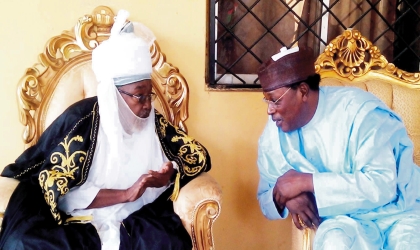
Jigawa State Deputy Governor, Alhaji Ahmed Mahmoud (right), with Emir of Ringim, Alhaji Sayyadi Mahmoud, during his visit to the Emirate over flood disaster last Sunday.



The Hydrocarbon Pollution Remediation Project (HYPREP) has commemorated the 15th anniversary of the release of the United Nations Environment Programme (UNEP) Environmental Assessment Report on Ogoniland, reaffirming its commitment to restoring the environment and improving the livelihoods of affected communities.
In a statement signed by the Project Coordinator, Prof Nenibarini Zabbey, to commemorate the anniversary, HYPREP described the anniversary as a significant milestone in Nigeria’s environmental restoration efforts, noting that the project has made remarkable progress in implementing the recommendations of the landmark UNEP report released on August 4, 2011.
The UNEP report had revealed extensive oil pollution across Ogoniland, severe environmental degradation, and serious public health risks resulting from decades of petroleum operations. It also recommended an initial $1 billion fund to commence the cleanup of the affected communities.
According to HYPREP, the Federal Government formally launched the Ogoni clean-up in 2016, while the Project Coordination Office was established in 2017 to drive the implementation of UNEP’s recommendations.
Zabbey said the current administration has continued to prioritise the project under the Renewed Hope Agenda.
Providing an update on the cleanup, the Project Coordinator disclosed that 30 of the 65 contaminated sites identified by UNEP have been fully remediated, while work is ongoing at several medium- and high-risk locations. It also stated that more than 1.5 million mangrove seedlings have been planted as part of what it described as the world’s largest restoration of oil-degraded mangroves, with over 1,000 hectares of shoreline already rehabilitated.
Zabbey further revealed that 49 Ogoni communities have been connected to potable water schemes through multiple water projects and booster stations aimed at providing safe drinking water across the region.
In the health sector, he said the 100-bed Ogoni Specialist Hospital in Kpite and the 43-bed Cottage Hospital in Buan are nearing completion, adding that several existing health facilities have been upgraded with modern medical equipment, while five ambulances have been donated to improve emergency healthcare services. The Project Coordinator also disclosed that a three-year human health biomonitoring study is being conducted in collaboration with the World Health Organization’s International Agency for Research on Cancer (IARC).
On economic empowerment, Zabbey stated that the Project has created more than 8,000 direct jobs and trained thousands of Ogoni youths and women in various vocational and technical skills, including software development, cybersecurity, aviation, commercial diving, seafaring, mechatronics, and creative arts. The project also reported awarding scholarships to more than 1,000 students, providing grants to small businesses, and supporting persons living with special needs through skills acquisition programmes.
The statement further highlighted ongoing legacy projects, including the Ogoni Power Project and the Centre of Excellence for Environmental Restoration, which it said is about 96 per cent complete. HYPREP also welcomed the recent designation of the Ogoni Wetland as a Ramsar Site of International Importance and pledged to continue promoting biodiversity conservation and sustainable management of the ecosystem.
Marking the anniversary, Zabbey said the progress achieved over the past 15 years demonstrates the collective commitment of government, development partners, stakeholders, and local communities to restoring Ogoniland. He called for renewed collaboration to sustain the cleanup effort, promote environmental sustainability, and support the long-term development of the region. 3
-

 News2 days ago
RSG Targets Nine Million Residents in Mosquito Net Distribution Campaign
-

 Oil & Energy2 days ago
Aiyedatiwa Signs New Electricity Bill
-

 Maritime2 days ago
Marine Minister Commends President Tinubu On NPERA Bill Assent
-

 Oil & Energy2 days ago
NLNG Commissions Research And Innovation Centre In RSU
-

 News2 days ago
KenPoly Holds Eight Convocations, August 29
-

 News2 days ago
RSG Begins Another Phase of Projects Commissioning Today
-

 News2 days ago
RMAFC Completes Revenue Sharing Review, Proposes New Pay
-

 Maritime2 days ago
NAGAFF Petitions IGP Over Alleged Maritime Police Harassment