
Business
PENGASSAN Rejects IPPIS, Suspends Strike

The Petroleum and Natural Gas Senior Staff Association of Nigeria (PENGASSAN) has rejected its members’ inclusion in the Integrated Payroll and Personnel Information System (IPPIS).
The union also suspended its planned strike over oil theft, vandalism and state of the nation’s refineries, among others.
Speaking to The Tide in Port Harcourt, the National Industrial Relations Officer of the union, Comrade Chika Onuegbu said IPPIS would compromise effectiveness and efficiency if introduced into the oil and gas sector.
Onuegbu who is also the Chairman of Trade Union Congress (TUC) in Rivers State said the union leadership had made it clear to the authorities that the oil and gas industry thrives on performance evaluation, therefore, introducing a system that is not based on deliverable should be discouraged.
He said the union’s president, Comrade Babatunde Ogun had also said that the union would go on strike if the Federal Government stopped the salaries of the union’s members in government agencies, as threatened by the Head of Service of the Federation.
He listed the affected IPPIS agencies as the Department of Petroleum Resources (DPR), Petroleum Products Pricing and Regulatory Agency (PPPRA), Nigeria Content Development Board (NCDB), Nigeria Nuclear Regulatory Authority (NNRA) and Petroleum Training Institute (PTI).
The labour leader said the national leadership of the union would go on strike if its members were not exempted from the scheme immediately.
He said the union has expressed its dissatisfaction with the government threats of the union members’ with an ultimatum in spite of the union’s protest letters to it against the union members enrolment into the IPPIS.
Also, The Tide learnt from a reliable source in the union that following a meeting with officials of the Federal Government, leaders of PENGASSAN have suspended its planned nationwide strike action scheduled to begin on May 15.
The union had on April 9th and 22nd petitioned the Minister of Labour and Productivity, Chief Emeka Nwogu, detailing some issues of concern to the union and its members.
The union demanded that the Federal Government address the issues raised before May 15 or it would declare a nationwide strike.
The Tide was informed that the union’s issues centred on execution of the refineries maintenance and joint ventures counterpart funding, among others.
Philip Okparaji
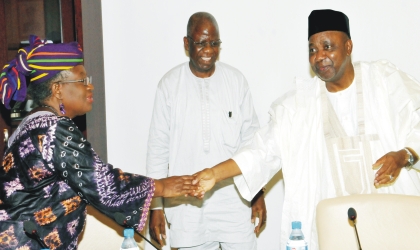
L-R: Minister of Finance, Dr Ngozi Okonjo-Iweala, former Head of Civil Service of the Federation, Mr Stephen Oronsaye and Vice President Namadi Sambo, during the meeting of Financial Action Task Force Committee in Abuja last Friday.



-

 Niger Delta18 hours ago
Diri Restates Stance On Lagos-Calabar Coastal Highway
-

 Niger Delta18 hours ago
C’River, NUJ Pay Tribute To Late Guardian Editor
-

 Sports15 hours ago
Nigerian Trio Target Titles At PFL Africa Finals
-

 News19 hours ago
NDLEA Recovers Tons Of Illicit Drug Consignments In Nine States
-

 Opinion17 hours ago
Checking Voter Apathy In Nigeria’s Electoral Process
-

 Education15 hours ago
FCE Yola Graduates 3,555 Teachers , Seeks Upgrade to University
-

 Politics15 hours ago
2027: DICKSON’S EX-ALLY VOWS TO WORK AGAINST NDC INTEREST IN BAYELSA
-

 Politics15 hours ago
2027: GROUP PLEDGES 40,000 SUPPORTERS FOR COALITION CANDIDATES IN RIVERS