
Nation
THE STATES

Bauchi
The Peoples Democratic Movement (PDM) has an
nounced the suspension of its ongoing registration exercise in Bauchi State due to the death of its chairman, Alhaji Abdullahi Jibo.
Speaking to newsmen recently, the National Vice Chairman of the party, Alhaji Muslihu Maigari, said the death came as a shock to the party.
According to him, Jibo’s death was a serious loss to the party not only in the state but in the country.
Also speaking, the deceased’s brother, Alhaji Umar Jibo, said Abdullahi died at the National Hospital, Abuja while on official assignment.
FCT
The Nigerian Security and Civil Defence Corps
(NSCDC) has advised the warring people of Guari and the Fulani communities in the Bwari Area Council, to learn to live in peace.
NSCDC commandant in the area, Mr John Efere, gave the advice in an interview with newsmen in Bwari.
Speaking over the crisis between the Guari and Fulani people residing in Geram community, he said that there was need for the people to live in harmony.
Efere, a Chief Superintendent of NSCDC, also spoke of the necessity of the people to develop the attitude of staying vigilant and to report suspicious movements in the community.
Gombe
Gombe State Government said it had installed 20 fire
hydrant in Gombe, the state capital, to assist fire fighters with water to combat fire outbreaks.
Alhaji Isa Mohammed, General Manager of the state Water Corporation, made the disclosure in an interview with newsmen recently.
He said that officials of the ministry would accompany fire fighters round the metropolis to show them the locations of the fire hydrant.
“We will soon take them (fire fighters) round the city to show them the locations of the fire hydrant”.
Kaduna
The Kaduna State Government said it had placed se
curity agencies on alert to avert any breakdown of law and order in the state. The Commissioner for Information in the state, Mr Ben Bako, made the call in a statement in Kaduna.
Bako urged the residents to be vigilant, support security agencies and report suspicious movements around them to relevant authority.
“This call became necessary to assure citizens of government’s continuous vigilance on happenings within the state”.
Katsina
The Health Reform Foundation of Nigeria
(HERFON), an NGO, has urged the Katsina State Government to dedicate 25 per cent of its annual budget for the health sector to malaria control.
Chairman of the foundation in the state, Alhaji Ibrahim Kurfi, made the call in Katsina during an advocacy visit to the State House of Assembly. The chairman said “malaria constitute majority of health problems in hospitals in the state, hence the need for allocating 25 per cent of health sector budget to ensure effective malaria control.’’
He urged the lawmakers to support the NGO in its malaria control efforts and always involve health professionals during their oversight visits to health facilities in the state.
Kwara
An expert on Family Medicine, Dr Esther Bankole,
has warned homosexuals and those practising oral sex of the dangers of contracting hepatitis.
Bankole, a staff of the University of Ilorin Teaching Hospital (UITH), gave the warning at the Lenten season programme organised by the wife of the state’s governor, Mrs Omolewa Ahmed.
She said those at risk were people with unusual sexual orientation such as homosexuals, those practising oral sex and the sexually promiscuous.
Bankole, who described hepatitis as the inflammation of the liver tissue, said it may also be caused by toxins, drugs, radiation or a virus.
Lagos
There was a mild drama at an Oshodi Magistrates’
Court in Lagos as an ex-convict, Segun Olanrewaju, changed his guilty plea as he was being sentenced.
Our correspondent reports that Olanrewaju had earlier pleaded guilty to the theft of two mobile phones worth N80, 000.
Olanrewaju, 24, who resides at 23, Olufemi St., Yaba, was arraigned on March 4 and remanded him in Kirikiri Prisons after admitting the charge of theft.
The case was scheduled for facts and sentencing on Tuesday.
However, when the Magistrate, Akeem Fashola, was about to sentence him, he changed his plea, saying:“ I earlier pleaded guilty because I did not understand the charge.”
Nasarawa
A Grade One Area Court in Mararaba, Nasarawa
State has discharged a 19-year-old student, Emmanuel Ebuka, charged with assaulting his colleague, Umoh Kelvin.Our correspondent reports that Ebuka was arraigned on five counts of criminal conspiracy, trespass, intimidation, mischief and theft.
The presiding judge, Mr Albert Maga, discharged the accused, after the prosecutor, PC Friday Adaji, told the court that both parties had settled their differences “amicably”. Maga therefore struck out the case, and said “it is always good for parties in a matter to iron out their differences.
Ondo
The Nigeria Union of Journalists (NUJ) has condemned
in strong terms the manhandling of two of its members in Ado Ekiti, Ekiti State, by suspected political thugs.
This is contained in a statement issued in Akure by the Zone ‘B’ Vice-President, Mr Dele Atunbi. The union described the attack on its members covering the Peoples Democratic Party (PDP) secretariat that was gutted by fire in Ado-Ekiti as debasing and dehumanising. “We at the NUJ frown at a development where thugs have constituted themselves as lords in Ekiti State under a democratically elected government.
Osogbo
The Chairman, Osun State Broadcasting Corporation
(OSBC), Mr Kola Akanji has promised that the corporation would be fair to all political parties ahead of the August 9 governorship election in the state.
Akanji made the promise in Osogbo in an interview with newsmen. He said that both the National Broadcasting Commission (NBC) and the Broadcasting Organisations of Nigeria (BON) had always been in the vanguard of fair hearing.
“As the governorship election approaches in Osun, the corporation is aware that there would be increased political activities from the parties, individuals and stakeholders.
Ogun
The Principal Dental Officer, Ogun State Dental Clinic,
Ijebu-Ode, Dr David Ogunba,has advised residents to go for regular dental check-up to prevent tooth decay and mouth odour.
Ogunba gave the advice in an interview with newsmen in Ijebu-Ode.
According to him, decay often set in when acid by bacterial fermentation of food debris accumulates in the tooth and destroys its hard tissues. Ogunba said refined sugars found in confectioneries such as candies, chocolates, cakes, ice-cream, jams and peanut butter were often responsible for tooth decay.
Taraba
The Taraba Board of Internal Revenue has registered
over 5,000 eligible tax payers in the state from 2009 to date, its Chairman, Alhaji Yusuf Galadima, has said.
Galadima told newsmen in Jalingo that the registration captured both private individuals and civil servants. He said that all the registered persons had been issued Tax Identification Number (TIN) as directed by the National Joint Tax Board.
The chairman said the TIN would enable the board develop a data base that would assist in checking tax evasion.
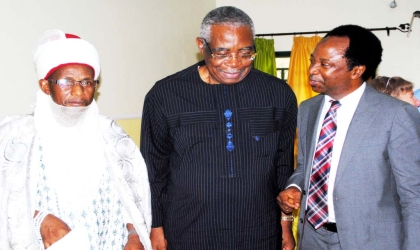
L-R: District Head of Barnawa, Alhaji Kabir Zubairu, Chairman, TY Danjuma Foundation, Gen. Theophilus Danjuma (rtd) and President, Civil Rights Congress, Comrade Shehu Sani, at the graduation of participants of TY Danjuma Foundation vocational skills acquisition in Kaduna State, last Wednesday. Photo: NAN.




The Hydrocarbon Pollution Remediation Project (HYPREP) has commemorated the 15th anniversary of the release of the United Nations Environment Programme (UNEP) Environmental Assessment Report on Ogoniland, reaffirming its commitment to restoring the environment and improving the livelihoods of affected communities.
In a statement signed by the Project Coordinator, Prof Nenibarini Zabbey, to commemorate the anniversary, HYPREP described the anniversary as a significant milestone in Nigeria’s environmental restoration efforts, noting that the project has made remarkable progress in implementing the recommendations of the landmark UNEP report released on August 4, 2011.
The UNEP report had revealed extensive oil pollution across Ogoniland, severe environmental degradation, and serious public health risks resulting from decades of petroleum operations. It also recommended an initial $1 billion fund to commence the cleanup of the affected communities.
According to HYPREP, the Federal Government formally launched the Ogoni clean-up in 2016, while the Project Coordination Office was established in 2017 to drive the implementation of UNEP’s recommendations.
Zabbey said the current administration has continued to prioritise the project under the Renewed Hope Agenda.
Providing an update on the cleanup, the Project Coordinator disclosed that 30 of the 65 contaminated sites identified by UNEP have been fully remediated, while work is ongoing at several medium- and high-risk locations. It also stated that more than 1.5 million mangrove seedlings have been planted as part of what it described as the world’s largest restoration of oil-degraded mangroves, with over 1,000 hectares of shoreline already rehabilitated.
Zabbey further revealed that 49 Ogoni communities have been connected to potable water schemes through multiple water projects and booster stations aimed at providing safe drinking water across the region.
In the health sector, he said the 100-bed Ogoni Specialist Hospital in Kpite and the 43-bed Cottage Hospital in Buan are nearing completion, adding that several existing health facilities have been upgraded with modern medical equipment, while five ambulances have been donated to improve emergency healthcare services. The Project Coordinator also disclosed that a three-year human health biomonitoring study is being conducted in collaboration with the World Health Organization’s International Agency for Research on Cancer (IARC).
On economic empowerment, Zabbey stated that the Project has created more than 8,000 direct jobs and trained thousands of Ogoni youths and women in various vocational and technical skills, including software development, cybersecurity, aviation, commercial diving, seafaring, mechatronics, and creative arts. The project also reported awarding scholarships to more than 1,000 students, providing grants to small businesses, and supporting persons living with special needs through skills acquisition programmes.
The statement further highlighted ongoing legacy projects, including the Ogoni Power Project and the Centre of Excellence for Environmental Restoration, which it said is about 96 per cent complete. HYPREP also welcomed the recent designation of the Ogoni Wetland as a Ramsar Site of International Importance and pledged to continue promoting biodiversity conservation and sustainable management of the ecosystem.
Marking the anniversary, Zabbey said the progress achieved over the past 15 years demonstrates the collective commitment of government, development partners, stakeholders, and local communities to restoring Ogoniland. He called for renewed collaboration to sustain the cleanup effort, promote environmental sustainability, and support the long-term development of the region. 3
-

 News2 days ago
RSG Targets Nine Million Residents in Mosquito Net Distribution Campaign
-

 Oil & Energy2 days ago
Aiyedatiwa Signs New Electricity Bill
-

 Maritime2 days ago
Marine Minister Commends President Tinubu On NPERA Bill Assent
-

 Oil & Energy2 days ago
NLNG Commissions Research And Innovation Centre In RSU
-

 News2 days ago
KenPoly Holds Eight Convocations, August 29
-

 News2 days ago
RSG Begins Another Phase of Projects Commissioning Today
-

 News2 days ago
RMAFC Completes Revenue Sharing Review, Proposes New Pay
-

 Maritime2 days ago
NAGAFF Petitions IGP Over Alleged Maritime Police Harassment