Connect with us

Editorial

The Coup In Mali

Published

on

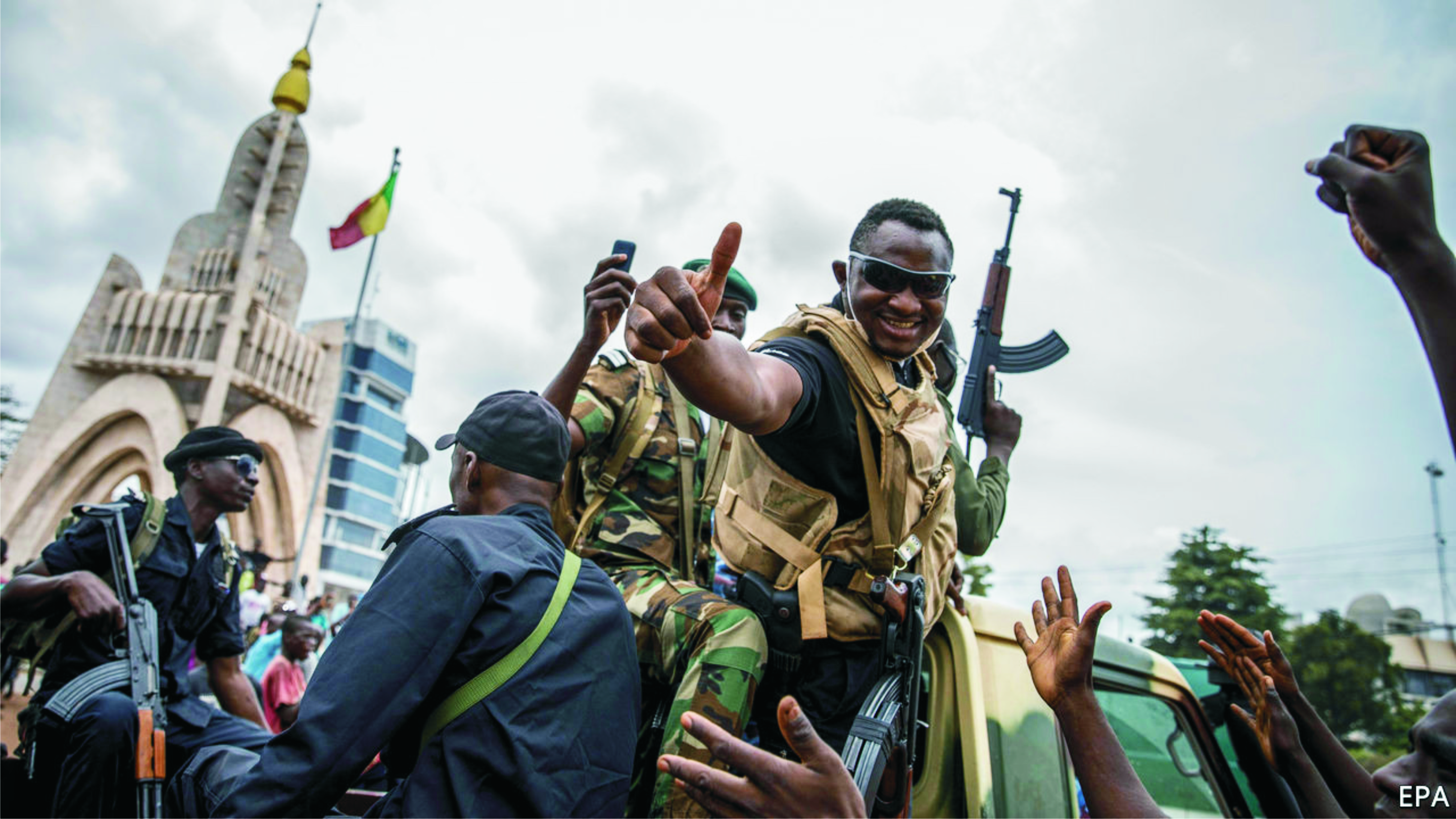
On August 18, a military junta led by 37-year-old new strongman, Colonel Assimi Goita, under the National Committee for the Salvation of the People (NCSP), toppled the democratically elected civilian government in Mali. While executing the coup, the Kati-based rebel commanders swooped on the nation’s capital, Bamako, and arrested its 75-year-old President, Ibrahim Boubacar Keita; his Prime Minister, Boubou Cisse; Army and Air Force chiefs; top ministers and a number of other government officials, after the president had failed to comply with their ultimatum to resign following weeks and months of protests over poor governance and lack of political will to crush belligerent Islamic insurgents.
About 24 hours after the mutiny, the president appeared on live national television to announce his resignation, saying he had no other choice, but to avoid “bloodshed”. But following pressure, the junta, last Thursday, released the president to return to his home with the security appropriate to his rank as a former head of state, as well as the possibility of having the doctor of his choice and of travelling abroad for medical checkups.
Spokesman for the junta, Ismael Wague, said, “We understand that heads of state, like Ivory Coast’s Alassane Ouattara, are working for an easing of tensions, for a peaceful solution, even if they have firmly condemned our seizing power. We are open to discussion (negotiations). A transitional council, with a transitional president who is going to be either military or civilian would be appointed. The transition will be the shortest possible.” The junta also promised that they would enact a political transition and stage elections within a “reasonable time” but has failed to spell out any details.
Speaking after Keita’s release, President Mahamadou Issoufou Keita of Niger, who currently chairs the ECOWAS, said, “If we consider that the question of (Keita’s) release is resolved, it is not the same concerning the return to constitutional order, which pre-supposes that all troops return to their barracks”. We agree with the Nigerien president completely. This is why we join the African Union, European Union, the United States and UN Security Council to condemn the coup and demand a “speedy, peaceful and democratic” resolution of the crisis, which we see as “dangerous for democracy in Africa.”
No doubt, the August 18 coup — the second in eight years — deals a deadly blow to Mali still struggling with a jihadist insurgency, moribund economy and deep public resentment over its government. We recall that the first putsch in 2012 was followed by an insurrection in the north which developed into a terrorists’ insurgency that now threatens neighbouring Niger, Burkina Faso, and extending to Nigeria, Chad and Cameroun. Thousands of UN and French troops, along with soldiers from five Sahel countries, have since been deployed to try to stem the bloodshed while a multinational military task force is also waging war against the Islamic State in West Africa Province and Boko Haram terrorists in Nigeria’s North-East and elsewhere.
We further reckon that Keita had won election in a landslide in 2013, by putting himself forward as a unifying figure in a fractured country; and was re-elected in 2018 for another five-year term with a pledge to pursue economic recovery and prosperity, and annihilate Islamic jihadists. But he failed to show commitment to fight against the jihadist revolt that has left swathes of the country in the hands of armed bandits, which had ignited ethnic violence in most parts of the country. Consequently, thousands of people have died and hundreds of thousands have fled their homes, creating a horde of internally displaced persons (IDPs) and a humanitarian crisis. That devastation has also compounded the damage to an already fragile economy in a nation with large number of unemployed young people.
Obviously, the pent-up discontent dragged on till this year, and was exacerbated following the disputed outcome of last April’s legislative elections, which had created an anti-Keita protest coalition: “the June 5 Movement”, which had organised most of the anti-government protests, including August 28 rallies to “celebrate the victory of the Malian people.”
Addressing thousands of supporters, last Friday, a key player in the mass opposition protests and influential opposition figure in Mali, Mahmoud Dicko, told the new military rulers to ensure they kept to their words because they do not have “carte blanche” to govern the country.
“I have asked everyone to come together for Mali. I am still asking this, but that does not mean the military has a carte blanche. We will not give a blank cheque to anyone to run this country, that’s over… a radical change of governance is needed. We led the fight. People have died and the soldiers who have completed (this fight) must keep their word”, to return Mali to civil rule as soon as possible, he said.
While we agree with the majority views of Malians that change in government is needed to restore the dignity and prosperity of the country, we, however, believe that this sordid development is disturbing and creates an unnecessary distraction for leaders in Africa and around the world.
We support ECOWAS call for an interim government, “headed by a civilian or retired military officer, to last for six or nine months, and maximum of 12 calendar months”. We also agree with the 15-nation ECOWAS sanctions on Mali, including the closure of borders and ban on trade and financial flows. We support the sustenance of international pressure to restore order, and the United States Government’s suspension of military aid to Mali, with no further training or support of the country’s armed forces. We insist that the diplomatic and economic pressure be maintained to compel the junta to retrace their steps, and expedite action to return the beleaguered nation to democratic governance.
We, therefore, urge ECOWAS chief envoy and former president, Dr Goodluck Jonathan, and his team, to accept the military junta’s commitment, last Monday, to a 12-month transitional government to be run by a civilian team. ECOWAS negotiators must ensure that the military leaders work with their civilian counterparts, including the Constitutional Court “to ensure the immediate return of constitutional order” and acceptable timetable for fresh elections. We agree with Jonathan, Dicko and other stakeholders that the only plausible option going forward is the return to civilian rule. This is why we urge the military leaders to respect their calling and return to the barracks, while allowing civilians, dedicated to democratic ethos, run the government and bring the dividends of democracy to Malians. They should not be tempted to interfere in democratic governance in future, but allow politicians disagree to agree, because it is the nature of man.

Continue Reading

Editorial

FG’s LIN Policy: The Missing Link

Published

on

For decades, Nigeria’s education sector has lurched from one grand initiative to the next, each announced with fanfare and abandoned in frustration. The latest proposal, the Learners’ Identification Number (LIN) for primary and secondary pupils, has been presented as a solution to the chronic problem of school dropouts, particularly in the North. Yet before any new system is rolled out, citizens are right to pause and ask: have we not seen this play before?
The Minister of Education, Dr. Tunji Alausa, deserves some credit for acknowledging a genuine crisis. According to UNESCO data, Nigeria has an estimated 10.5 million children out of school, the highest number in the world, with the northern region accounting for over 60 per cent of that figure. The idea of tracking individual pupils from admission through to graduation is not, in principle, unreasonable. However, the gap between a sound principle and workable implementation has historically been a chasm in this country.
Consider the fate of previous education policies. The Universal Primary Education (UPE) programme of the 1970s collapsed under poor planning, inadequate teacher training, and a lack of sustained funding. The 6-3-3-4 system, introduced in the 1980s to emphasise vocational skills, never achieved its objectives because laboratories and workshops remained empty. More recently, the National Teacher Education Policy (NTEP) introduced in 2014 ran aground due to inconsistent enforcement and low morale among instructors. And presently the Universal Basic Education (UBE). Each policy promised a transformation; each delivered frustration.
The proposed LIN system raises a basic logistical question: does any school today admit a child without recording that admission? Every primary and secondary school already maintains enrolment registers. The challenge is not the absence of identity numbers but the absence of a functional national data collation system, reliable electricity for digital records, and administrative accountability in remote areas. Introducing a new number without fixing these foundations will merely add another layer of paperwork.
Furthermore, the Minister’s plan to phase out the common entrance examination in favour of Continuous Assessment (CA) requires careful scrutiny. While CA can reduce examination pressure, it demands well-trained teachers, standardised evaluation criteria, and rigorous oversight. In many public schools today, class sizes exceed 60 pupils per teacher, and marking is irregular. Without massive investment in teacher quality, CA will become as unreliable as the examination it replaces. Good intentions do not fill gaps in competence.
We must also confront the risk of financial exploitation. Nigeria’s history shows that every new education policy tends to generate new fees: registration fees for identity cards, processing fees for data entry, and renewal fees each term. The Federal Government must give an unequivocal guarantee that the LIN will cost parents and guardians nothing. Given the current economic hardship, with inflation standing at over 28 per cent and food prices soaring, any additional levy, no matter how small, would push more children out of school, not fewer.
The Minister states that the LIN will help identify dropouts. Yet we do not need a complex numbering system to calculate dropout rates. Simply comparing enrolment figures at the start of Primary 1 with attendance at the end of Junior Secondary School 3 would reveal the attrition rate. The real need is not more numbers but more action on the root causes: poverty, child labour, early marriage in some regions, and the poor quality of schooling that makes parents see education as a waste of time.
This brings us to the most direct solution, one the government continues to avoid: free, compulsory basic education nationwide. Section 18 of the 1999 Constitution and the Universal Basic Education Act already mandate free and compulsory education for the first nine years. Yet many states still charge levies for uniforms, parent-teacher association fees, and examination costs. Instead of introducing a tracking number, the government should enforce existing laws, fully release UBEC matching grants, and hold state governors accountable for out-of-school children.
The previous administration’s free school feeding programme showed what is possible when a policy addresses immediate material need. The programme increased enrolment by roughly 15 per cent in targeted areas, according to World Bank monitoring reports. However, it also demonstrated the nemesis of Nigerian policy: corruption. Food quality declined, contractors inflated costs, and political loyalists were favoured over competent caterers. No new number will stop corruption; only transparent auditing and harsh penalties will.
We therefore advise the Federal Government to collapse its many overlapping initiatives into one coherent strategy. The education sector currently suffers from a cacophony of policies: the LIN, Continuous Assessment reform, teacher professional development schemes, digital literacy programmes, and adolescent girls’ education initiatives, among others. Each has its own bureaucratic structure, funding stream, and reporting requirements. Schools, especially in rural areas, cannot manage this chaos. A single, well-funded, long-term plan with clear targets for 2030 would achieve more than a dozen fragmented policies.
Until the government addresses the fundamentals—free tuition, adequate classrooms, and trained teachers—the LIN policy will be remembered as yet another well-intentioned distraction. No identity number ever kept a girl in school when her family could not afford transport. No database ever persuaded a hungry child to stay for afternoon lessons. The missing link in Nigeria’s education sector is not a digit; it is the political will to spend honestly and act decisively. Let the Minister drop this proposal and pick up the harder, older task of enforcing free education for every Nigerian child.
Continue Reading

Editorial

Domesticate FG’s Exit Benefit Scheme 

Published

on

The recent approval of the “Exit Benefit Scheme” by the Federal Executive Council (FEC) stands as a landmark achievement for the administration of President Bola Tinubu. For many observers, this remains one of the most impactful and compassionate policies introduced by the current government. By restoring a sense of financial dignity to those who have dedicated their lives to national service, the administration has demonstrated a clear commitment to the welfare of the Nigerian workforce.
Under this new framework, retirees of the Federal Civil Service are set to receive a gratuity equal to 100 per cent of their last gross annual pay upon retirement. This policy, which officially comes into effect on 1 January 2026, ensures that Federal civil servants are not left stranded the moment they exit the office. It provides a vital financial cushion that has been sorely missing from the lives of many public servants for over two decades.
The primary objective of this scheme is to bolster financial security by providing a significant lump sum payment to eligible employees who have served for at least 10 years. Crucially, this benefit does not exist in isolation; it is designed to work alongside the existing Contributory Pension Scheme (CPS). This dual-layered approach ensures that the immediate transition into retirement is as seamless as the long-term pension disbursements that follow.
It is important to clarify that this new benefit is intended to complement, rather than replace, the current CPS managed by Pension Fund Administrators (PFAs). For years, the pure contributory framework left a void where the traditional gratuity once stood. By reintroducing this payment, the Federal Government is addressing a long-standing grievance regarding the adequacy of the total retirement package available to civil servants.
This policy marks a historic return to gratuity payments for Federal Civil Servants after a lengthy hiatus. Since the pension reforms of the early 2000s, the focus has been strictly on contributions, often leaving retirees with a “waiting period” that can be financially devastating. The return of the gratuity signals a shift back toward a more holistic view of worker appreciation and social security.
Indeed, this payment comes exactly 22 years after the introduction of the Contributory Pension Scheme in 2004. The two-decade gap saw many retirees struggle to adjust to life after service without a substantial initial payout. This intervention demonstrates the Federal Government’s ongoing commitment to policies that promote improved welfare and secure the future of the civil service in a tangible, measurable way.
By reversing the lack of gratuity inherent in the previous purely contributory model, the government has earned the rare and resounding praise of organised labour. The Nigeria Labour Congress (NLC) has rightly described this move as a major welfare upgrade. This endorsement highlights the alignment between the government’s policy direction and the actual needs of the Nigerian worker on the street.
We commend President Tinubu for this watershed approval. The new gratuity payment is a sincere reflection of the administration’s recognition of the dedication, sacrifice, and professionalism inherent in the Federal Civil Service. It acknowledges that those who build the nation’s administrative backbone deserve more than just a handshake and a promise of future monthly stipends when they finally step down.
However, the pursuit of social justice must not end with Federal workers alone. We strongly advocate that this initiative trickles down to the various states. The Governor’s Forum should meet as a matter of urgency to approve and adopt the Federal Government’s template. If the central government can find the means to honour its retirees, the states—who are the primary employers of the bulk of the nation’s workforce—should follow suit.
It is a painful reality that many workers retire from service today with nothing to take home on their final day. Pensions frequently take months to process, and in many jurisdictions, gratuities take “forever” to be disbursed. This is why the Exit Benefit Scheme is the true embodiment of Tinubu’s “Renewed Hope Agenda.” There is perhaps nothing that offers more hope to a weary worker than the certainty of a dignified exit.
Shamefully, several state governments are still battling with legacy gratuity payments from years past. Adopting a scheme like this would serve as an essential cushion while long-term arrears are settled. No citizen should face destitution or death simply because they rendered service to their government. It is time to end the era where retirees survive on mere trickles; even a modest lump sum can be the difference between a dignified retirement and a tragic one.
Specifically, we call upon the Rivers State Government to adopt this scheme to give life to its pensioners. The Federal Government has already provided the successful template; there is no need to reinvent the wheel. We must ask: if political office holders are entitled to generous severance benefits after just four or at most eight years, why should civil servants who serve for 35 years go without a similar “severance” package?
In Rivers State, the need for clarity is urgent. Workers who left the service after June last year face the uncertainty of whether they fall under the Defined Benefit Scheme or the Contributory Pension Scheme. The state government must resolve this administrative ambiguity immediately to prevent a full-blown pension crisis. Domesticating the Federal “largesse” should be straightforward, as Rivers is a state blessed with the necessary resources.
Governor Siminalayi Fubara, a former civil servant, understands the plight of the worker better than most. While we commend his administration for paying one of the highest minimum wages in the country, he has the opportunity to go further by becoming the first governor to implement the 100 per cent Exit Benefit Scheme. With this, he can ensure that Rivers State workers, who deserve the best, are truly rewarded for their service.
Let Rivers lead where others have lagged.
Continue Reading

Editorial

Task Before New IGP 

Published

on

The appointment of Olatunji Disu as Inspector-General of Police following the resignation of Kayode Egbetokun marks a significant turning point for the Nigeria Police Force. Announced by President Bola Tinubu, the change in leadership comes at a time when the country is grappling with serious security concerns. Disu’s emergence has already drawn national attention, given both the urgency of the situation and the expectations placed upon him.
Upon confirmation of his appointment, Disu pledged to justify the confidence reposed in him. Central to his promise is a firm commitment to end impunity and enforce a zero-tolerance policy towards corruption within the force. Such assurances, though commendable, will ultimately be judged by the practical steps he takes in the coming months.
The new IGP also emphasised the importance of public cooperation in effective policing. He rightly noted that no police force anywhere in the world can succeed without the support of the people it serves. This acknowledgement highlights the critical relationship between law enforcement and the community, a relationship that has long been strained in Nigeria.
While congratulating Disu on his elevation, it is important to recognise the enormity of the task before him. He assumes office at a particularly difficult time, as underscored by the President during the decoration ceremony. Nigeria’s security landscape remains fragile, requiring decisive leadership and immediate action.
President Tinubu described the appointment as coming at a defining moment for national security. He urged the new police chief to restore public confidence and improve the institution he now leads. The expectation is not merely to maintain the status quo, but to leave the force better than he met it.
The security challenges confronting the nation are considerable. From banditry and terrorism to organised crime and communal conflicts, the threats are diverse and deeply entrenched. These issues have not only endangered lives and property but have also heightened public anxiety across the country.
Ironically, the police, who are meant to be at the forefront of restoring law and order, are themselves beset by internal challenges. Issues such as poor welfare, inadequate training, and systemic corruption have weakened the institution’s effectiveness. This dual burden makes Disu’s assignment even more complex.
A key priority for the new IGP must, therefore, be to restore peace and rebuild confidence, both within the force and among the general public. For many Nigerians, the police are no longer seen as protectors but as adversaries. This perception, whether wholly justified or not, must be urgently addressed.
Cleaning up the force and restoring its credibility will require more than rhetoric. Disu has already made the necessary commitments, but Nigerians will expect tangible results. Institutional reform must be thorough, transparent, and sustained if it is to yield meaningful change.
Equally important is the welfare of police personnel. Many officers operate under extremely poor conditions, with inadequate facilities and insufficient resources. Numerous police stations across the country are in a deplorable state, lacking basic equipment needed for effective policing.
No organisation can function optimally under such circumstances. If the police are to fulfil their constitutional mandate, they must be properly equipped and motivated. Addressing issues of welfare and infrastructure will go a long way in boosting morale and enhancing performance.
The list of challenges before the new police chief is extensive. From modernising equipment to improving training and discipline, the reforms required are wide-ranging. It is hoped that Disu will take the time to carefully assess these issues and implement practical solutions.
His appointment also comes amid growing calls for the establishment of state police. There is now a broad national consensus that the current centralised policing system is inadequate for addressing local security challenges. This debate has brought renewed attention to constitutional provisions governing policing in Nigeria.
While concerns about the potential pitfalls of state policing remain, its advantages appear increasingly compelling. Managing this transition, if it materialises, will be another critical responsibility for Disu. Ultimately, he assumes office with considerable goodwill, but his success will depend on his ability to translate promises into measurable improvements.
The success or failure of Olatunji Disu will be measured not by promises made but by results achieved. Nigerians yearn for a police force that is professional, accountable, and truly committed to their safety. If Disu can rise to this moment, confront entrenched challenges with courage, and drive meaningful reform, he will not only justify his appointment but also leave a lasting legacy in the annals of policing in Nigeria.
Continue Reading

Trending