
Nation
THE STATES

Adamawa
The Federal Government has expended over
N1.5billion on the provision of relief materials to people displaced by activities of insurgents in three states in Northern Nigeria, an official said recently.
The Coordinator, National Emergency Management Agency, North-East Zone, Alhaji Muhammed Kanar, told newsmen that the materials were distributed by the committee inaugurated by President Goodluck Jonathan.
He said that the agency had registered thousands of Internally Displaced Persons (IDP) affected by activities of insurgents in Adamawa, Borno and Yobe states.
The coordinator said that the agency and other appropriate ministries had met over displaced Nigerians who fled to Cameroun, Niger and Chad Republic, with a view to rendering some assistance to them.
Bauchi
The Chairman, Nigerian Medical Association
(NMA), Bauchi State chapter, Dr Muhammad Yusuf, says the association will provide free healthcare services on October 25.
Briefing newsmen recently, the physician said the gesture would be for residents as part of the 2014 annual Physicians Week in Bauchi.
According to him, the exercise will be conducted at Bununu community in Tafawa Balewa local government area, with 30 doctors from various departments.
“We will have medical caravan at Bununu, where we intend to bring more than 30 doctors of different specialities to render health care services.
Borno
Borno State Government says in Maiduguri that
public schools in the state would reopen in November. Committee on the Resuscitation of Primary School Education, Dr Mohammed Dongel, Chairman, who stated this at a meeting, said that the schools would reopen in the first or the second week of the month.
Our correspondent reports that public schools were closed down on March 14, after deadly attacks by suspected Boko Haram insurgents in schools in neighbouring Yobe.
“We hope to reopen all public schools by the first or second week of November, God willing.
“By then we hope to have put in place all necessary infrastructure and instruction materials for conducive teaching and learning,” he said.
FCT
FCT Chairman, Labour Party, Mr Felix Ashimole,
says a peaceful protest would be carried out by its FCT chapter to denounce the party’s national convention held in Akure, Ondo state.
He made this known while meeting with the members of the party in Gwagwalada in Abuja.
Ashimole said that the FCT chapter would soon march to the Nigeria Labour Congress head office for the peaceful protest, adding that the convention which was held in on October 11 was illegal and unconstitutional.
He said that article 13 of the party’s constitution was not followed as expected— it specifies that each state should provide 20 members to attend its convention.
“The article made the number of people to attend from each state clear, but this was not followed at the national level.
Gombe
The Broadcasting Organisation of Nigeria (BON), has
urged its members to sustain the enlightenment programmes on the fight against the deadly Ebola Virus Disease (EVD).
The call was contained in a communiqué signed by Jibrin Bello-Kwami and Ahazia Suleiman, issued at the end of BON’s 61st Annual General Assembly which ended on in Gombe last Saturday.
BON said broadcasters did very well in the containment of the scourge and assured Nigerians that its members would continue the enlightenment.
Our correspondent reports that the Assembly had “Broadcast as the Critical Mass in Healthcare Delivery’’ as its theme and featured Dr Sani Gwarzo, from the Federal Ministry of Health, who presented a paper entitled “Ebola: Scare or scourge?’’.
Kano
No fewer than 6,620 women have benefitted from the
Women Empowerment Programme of the Kano State government within 10 months of the commencement of the programme.
The state’s Commissioner for Women Affairs, Dr Binta Tijjani, stated this in an interview with newsmen in Kano recently.
She said beneficiaries of the programme included less privileged women, those who tested positive to HIV, divorcees, widows, VVF patients, as well as those deserted by their husbands due to economic hardship.
“The programme, among other things, provides for training, aimed at making the women to be self-reliant in the society.
“They were trained on liquid soap making, shampoo, baking, spices making, and tie and dye,’’ Tijjani said.
Lagos
A governorship aspirant of the All Progressives Con
gress (APC) in Lagos State, Dr Leke Pitan, says the fee charged for party nomination form is not exorbitant and is needed to fund the party.
Pitan told newsmen in Lagos that fees paid by aspirants could not in any way encourage corruption.
Our correspondent reports that governorship aspirants in the APC paid N500,000 for expression of interest forms and N5 million for nomination forms.
Pitan said that the party initially proposed a fee of N10 million but this was later reviewed downwards to N5 million.
“The aim is to help fund the party, which to my mind is necessary, there is need to help fund the party”, he said.
Niger
Alhaji Yahaya Daudu, a governorship aspirant in Niger
State, has promised to provide gainful employments for the teeming youth in the state within six months if he became the governor.
The aspirant, who said he would seek nomination on the platform of Labour Party (LP) during the 2015 general elections, made the promise in an interview with newsmen Abuja last Saturday.
Daudu said that if the young men were gainfully engaged, they would shun violence and other social vices.
He said that the state had enough potential to provide jobs for young graduates so as to turn around the socio-economic activities in the state.
The aspirant said that although LP might not be as popular as the ruling Peoples Democratic Party (PDP) in the state, he had confidence that his credibility and popularity would sell him.
Oyo
All Progressives Congress (APC) aspirant in Oyo
State, Mr Gbolagade Rahman, has commended the efforts of the state governor, Abiola Ajimobi, in transforming the state.
In an interview with newsmen in Ibadan, Rahman, who is aspiring to represent Ido/Ibarapa Federal Constituency, observed that Ajimobi had contributed meaningfully to the development of the state through his urban re-newal projects.
He said that the governor deserved a second chance to continue the good work he had started in the state.
He admonished the people of the state, not to sell their conscience, but should instead, vote for the right candidate.
Sokoto
The International Northern French Conference
(NORFCON), has commended the efforts of northern governors for encouraging the teaching of French language in their states.
The commendation is contained in a communiqué issued at the end of NORFCON’s sixth conference in Sokoto, signed bythe Head of the French Unit, Usmanu Danfodiyo University Dr Umar Dogon-Daji.
The conference particularly commended the Sokoto State Government, under the leadership of Governor Aliyu Wamakko, for its commitment to revitalising French language and other disciplines by sponsoring the state’s indigenes to study within and outside Nigeria.
It said participants at NORFCON acknowledged the 17 indigenes of the state being sponsored to study French at the Usman Danfodiyo University, Sokoto.
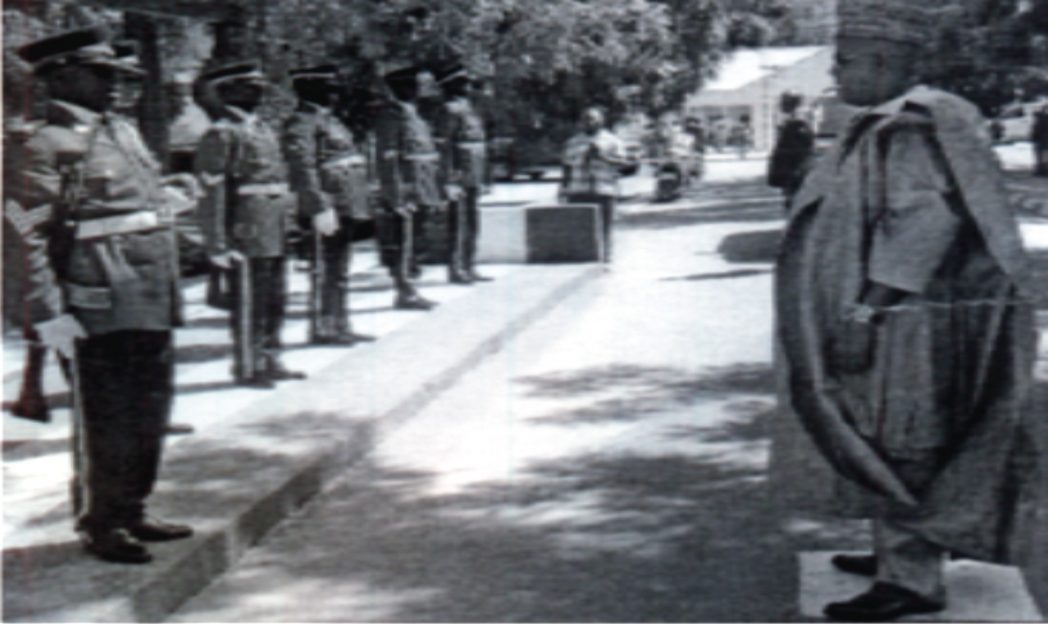
Governor Kashim Shettima of Borno State, inspecting a guard of honour at the Government House in Maiduguri,, recently. Photo: NAN



The Hydrocarbon Pollution Remediation Project (HYPREP) has commemorated the 15th anniversary of the release of the United Nations Environment Programme (UNEP) Environmental Assessment Report on Ogoniland, reaffirming its commitment to restoring the environment and improving the livelihoods of affected communities.
In a statement signed by the Project Coordinator, Prof Nenibarini Zabbey, to commemorate the anniversary, HYPREP described the anniversary as a significant milestone in Nigeria’s environmental restoration efforts, noting that the project has made remarkable progress in implementing the recommendations of the landmark UNEP report released on August 4, 2011.
The UNEP report had revealed extensive oil pollution across Ogoniland, severe environmental degradation, and serious public health risks resulting from decades of petroleum operations. It also recommended an initial $1 billion fund to commence the cleanup of the affected communities.
According to HYPREP, the Federal Government formally launched the Ogoni clean-up in 2016, while the Project Coordination Office was established in 2017 to drive the implementation of UNEP’s recommendations.
Zabbey said the current administration has continued to prioritise the project under the Renewed Hope Agenda.
Providing an update on the cleanup, the Project Coordinator disclosed that 30 of the 65 contaminated sites identified by UNEP have been fully remediated, while work is ongoing at several medium- and high-risk locations. It also stated that more than 1.5 million mangrove seedlings have been planted as part of what it described as the world’s largest restoration of oil-degraded mangroves, with over 1,000 hectares of shoreline already rehabilitated.
Zabbey further revealed that 49 Ogoni communities have been connected to potable water schemes through multiple water projects and booster stations aimed at providing safe drinking water across the region.
In the health sector, he said the 100-bed Ogoni Specialist Hospital in Kpite and the 43-bed Cottage Hospital in Buan are nearing completion, adding that several existing health facilities have been upgraded with modern medical equipment, while five ambulances have been donated to improve emergency healthcare services. The Project Coordinator also disclosed that a three-year human health biomonitoring study is being conducted in collaboration with the World Health Organization’s International Agency for Research on Cancer (IARC).
On economic empowerment, Zabbey stated that the Project has created more than 8,000 direct jobs and trained thousands of Ogoni youths and women in various vocational and technical skills, including software development, cybersecurity, aviation, commercial diving, seafaring, mechatronics, and creative arts. The project also reported awarding scholarships to more than 1,000 students, providing grants to small businesses, and supporting persons living with special needs through skills acquisition programmes.
The statement further highlighted ongoing legacy projects, including the Ogoni Power Project and the Centre of Excellence for Environmental Restoration, which it said is about 96 per cent complete. HYPREP also welcomed the recent designation of the Ogoni Wetland as a Ramsar Site of International Importance and pledged to continue promoting biodiversity conservation and sustainable management of the ecosystem.
Marking the anniversary, Zabbey said the progress achieved over the past 15 years demonstrates the collective commitment of government, development partners, stakeholders, and local communities to restoring Ogoniland. He called for renewed collaboration to sustain the cleanup effort, promote environmental sustainability, and support the long-term development of the region. 3
-

 News2 days ago
RSG Targets Nine Million Residents in Mosquito Net Distribution Campaign
-

 Oil & Energy2 days ago
Aiyedatiwa Signs New Electricity Bill
-

 Oil & Energy2 days ago
NLNG Commissions Research And Innovation Centre In RSU
-

 Maritime2 days ago
Marine Minister Commends President Tinubu On NPERA Bill Assent
-

 News2 days ago
KenPoly Holds Eight Convocations, August 29
-

 News2 days ago
RSG Begins Another Phase of Projects Commissioning Today
-

 News2 days ago
RMAFC Completes Revenue Sharing Review, Proposes New Pay
-

 Maritime2 days ago
NAGAFF Petitions IGP Over Alleged Maritime Police Harassment