
Connect with us

Business

RSG Tasks PHCCIMA On SMEs Funding

Published

on

Rivers State Government has urged the Port Harcourt Chamber of Commerce Industry, Mines and Agriculture (PHCCIMA) to ensure that its Small and Medium Enterpreneurs (SMEs) scheme does not end in the city, but spread to the grass roots of the 23 Local Government Areas of the State.
The deputy governor of the State, Engineer Tele Ikuru, who gave the charge during the launch of PHCCIMA’s Credit Support Scheme for SMEs in Port Harcourt on Wednesday, said that the state government has established a number of schemes to empower people and develop capacity even at the grass roots, especially through its agencies like the RSSDA.
Ikuru who was represented by the Governor’s Special Adviser on Aquaculture, Mr Alapuye Corttrell, also urged PHCCIMA to provide adequate management for the small businesses where owners should be separated from the business.
With the driving force of employment generation, the deputy governor, said that the scheme should be extended to palm wine tappers, bread sellers and fish traders in the rural areas.
He however commended PHCCIMA for the Free Collateral loan scheme which he said is unusual, stressing that such will boost business and productivity.
Earlier in his speech, the President of the Chamber, Emeka Unachukwu stated that PHCCIMA is interested in small businesses, giving instance of a Uniport student who needed N150,000 to fund his insecticide business, but had no access to funds.
The PHCCIMA president said that the primary objective of the chamber has been to provide support for member organisations, adding that PHCCIMA has devised a new structured credit scheme that will allow organisations access to good funding with low interest and relatively long-term duration.
Highlight of the occasion was the unveiling of the scheme by the deputy governor’s representative in support of other past leaders of PHHCIMA.
The gathering was withnessed by the sho-is-who in business in the state, including representatives of various banks, organizations and industries, including the RSSDA boss, Nobble Pepple who was inducted by the chamber.
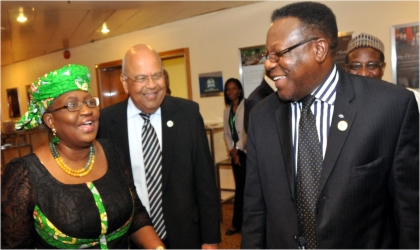
 

L-R: Co-ordinating Minister of the Economy, Dr Ngozi Okonjo-Iweala,  South African Minister Of Finance, Mr Pravin  Gordhan and Executive Secretary,  African Capacity Building Foundation (ACBF), Prof. Emmanuel Nnadozie, during the  African Ministers of Finance meeting in Abuja last Saturday.

L-R: Co-ordinating Minister of the Economy, Dr Ngozi Okonjo-Iweala, South African Minister Of Finance, Mr Pravin Gordhan and Executive Secretary, African Capacity Building Foundation (ACBF), Prof. Emmanuel Nnadozie, during the African Ministers of Finance meeting in Abuja last Saturday.

Corlins Walter

Continue Reading

Business

FIRS Clarifies New Tax Laws, Debunks Levy Misconceptions

Published

on

The Federal Inland Revenue Service has said that Nigeria’s newly enacted tax laws are designed to strengthen economic competitiveness, attract investments, and improve long-term fiscal stability.
The agency also clarified that the much-debated four per cent development levy on imported goods is not a new or additional tax burden, but a streamlined consolidation of several existing levies.
According a statement released Wednesday, one of the most misunderstood elements of the new tax framework is the four per cent development levy with the agency explaining that the levy replaces a range of fragmented charges — such as the Tertiary Education Tax, NITDA Levy, NASENI Levy and Police Trust Fund Levy — that businesses previously paid separately.
This consolidation, it said, reduces compliance costs, eliminates unpredictability and ends the era of multiple agency-driven levies. The law also exempts small businesses and non-resident companies, offering protection to firms most vulnerable to economic shocks.
Another major clarification relates to Free Trade Zones. Earlier commentary had suggested that the government was rolling back the incentives that have attracted export-oriented investors for decades. However, the reforms maintain the tax-exempt status of FTZ enterprises and introduce clearer guidelines to preserve the purpose of the zones.
“Under the new rules, FTZ companies can sell up to 25 per cent of their output into the domestic market without losing tax exemptions. A three-year transition period has also been provided to allow firms to adjust smoothly.
“Government officials say the reforms aim to curb abuses where companies used FTZ licences to evade domestic taxes while competing within the Nigerian market”, it said.
With the new measures, Nigeria aligns with global FTZ models in places like the UAE and Malaysia, where the zones function primarily as export hubs for logistics, manufacturing and technology.
The introduction of a 15 per cent minimum Effective Tax Rate for large multinational and domestic companies has also been met with public concern. But the FIRS notes that this policy aligns with a global tax agreement endorsed by over 140 countries under the OECD/G20 framework.
Without this adoption, Nigeria risked losing revenue to other countries through the “Top-Up Tax” mechanism, where the home country of a multinational collects the difference when a host country charges below 15 per cent. By localising the rule, Nigeria ensures that tax revenue from multinational operations remains within its borders.
Continue Reading

Business

CBN Revises Cash Withdrawal Rules January 2026, Ends Special Authorisation

Published

on

The Central Bank of Nigeria (CBN) has revised its cash withdrawal rules, discontinuing the special authorisation previously permitting individuals to withdraw N5 million and corporates N10 million once monthly, with effect from January 2026.

In a circular released Tuesday, December 2, 2025, and signed by the Director, Financial Policy & Regulation Department, FIRS, Dr. Rita I. Sike, the apex bank explained that previous cash policies had been introduced over the years in response to evolving circumstances.

However, with time, the need has arisen to streamline these provisions to reflect present-day realities.

The statement said the new set of cash-related policies is designed to reduce the cost of cash management, strengthen security, and curb money laundering risks associated with the economy’s heavy reliance on physical currency.

“These policies, issued over the years in response to evolving circumstances in cash management, sought to reduce cash usage and encourage accelerated adoption of other payment options, particularly electronic payment channels.

“With the effluxion of time, the need has arisen to streamline the provisions of these policies to reflect present-day realities,”

“Effective January 1, 2026, individuals will be allowed to withdraw up to N500,000 weekly across all channels, while corporate entities will be limited to N5 million”, it said.

According to the statement, withdrawals above these thresholds would attract excess withdrawal fees of three percent for individuals and five percent for corporates, with the charges shared between the CBN and the financial institutions.

Daily withdrawals from Automated Teller Machines (ATMs) would be capped at N100,000 per customer, subject to a maximum of N500,000 weekly stating that these transactions would count toward the cumulative weekly withdrawal limit.
The special authorisation previously permitting individuals to withdraw N5 million and corporates N10 million once monthly has been discontinued.

The CBN also confirmed that all currency denominations may now be loaded in ATMs, while the over-the-counter encashment limit for third-party cheques remains at N100,000. Such withdrawals will also form part of the weekly withdrawal limit.

Deposit Money Banks are required to submit monthly reports on cash withdrawals above the specified limits, as well as on cash deposits, to the relevant supervisory departments.

They must also create separate accounts to warehouse processing charges collected on excess withdrawals.

Exemptions and superseding provisions
Revenue-generating accounts of federal, state, and local governments, along with accounts of microfinance banks and primary mortgage banks with commercial and non-interest banks, are exempted from the new withdrawal limits and excess withdrawal fees.

However, exemptions previously granted to embassies, diplomatic missions, and aid-donor agencies have been withdrawn.

The CBN clarified that the circular is without prejudice to the provisions of certain earlier directives but supersedes others, as detailed in its appendices.

Continue Reading

Business

Shippers Council Vows Commitment To Security At Nigerian Ports

Published

on

The Nigerian Shippers Council (NSC)has restated its commitment towards ensuring security at Nigerian seaports.
Executive Secretary/Chief Executive Officer of the Council, Dr Pius Akuta, said this in Port Harcourt, while declaring open a one day workshop organized by the Nigerian Shippers Council in collaboration with the Nigerian police( Marin Division).
Theme for the workshop was ‘Facilitating Port Efficiency; The strategic Role of Maritime police “
Akuta who was represented by the Director, Regulatory Services, Nigerian Shippers Council, Mrs Margeret Ogbonnah, said the workshop was to seek areas of collaboration with security agencies at the Ports with a view to facilitating trade
Akuta said the theme of the workshop reflects the desire of the council and the Nigerian police to build capacity of police officers for better understanding and administration of their statutory roles in the Maritime environment.
He said Nigerian seaports has constantly been reputed as one of the Port with the longest cargo dwell in the world, adding,”This is so, because while it takes only six hours to clear a containerized cargo in Singapore Port, seven days in Lome Port, it takes an average of 21 days or more in Nigerian Ports” stressing that this situation which has affected the global perception index on Ease of Doing Business in Nigerian seaports must be addressed.
Akuta said NSC which is the economic regulator of the Ports has the responsibility of ensuring that efficiency is established in the Ports inorder to attract patronages.
“Pursuant to its regulatory mandate, the NSC has been collaborating with several agencies to ensure the facilitation of trade and ease of movement of cargo outside the Ports to avoid congestion”he said.
Also speaking the commissioner of police, Eastern Port Command, Port Harcourt, CP Tijani Fakai, said Maritime police has played some roles in facilitating Ports efficiency.
He listed some of the roles to include ensuring security and crime prevention at the Ports, checking of illegal fishing activities at the Ports, checking of human trafficking and drug smuggling and prevention of fire incident at the Ports.
Represented by ACP, Rufina Ukadike, the CP said police at the Ports have also helped in the decongestion and prevention of unauthorized Anchorage.
He commended the Nigerian Shippers Council for the workshop and assured of continuous collaboration.
Speaking on the dynamics of cargo handling, Deputy Controller of customs, Muhydeen Ayinla Ayoola, said the launching of electronic tracking system and dissolution of controller General Taskforce has helped to ensure efficiency at the Ports.
Ayoola who represented the custom Area Controller Port Harcourt 1 Area command, however raised concerned over rising national security threat , which according to him has affected efficiency at the Ports.
John Bibor
Continue Reading

Trending











