
Nation
THE STATES

Bauchi
Some groups and individuals in the North-East geo-political have kicked against the use of ethnic nationalities as representatives at the proposed National Dialogue.
They made their opinion known at the North-East Public Hearing on the conference, organised by the Presidential Advisory Committee on National Dialogue said such representation would defeat the purpose for which the conference was convened.
In his presentation, Governor Isa Yuguda of Bauchi State, is saying that the use of ethnic nationalities was not feasible.
“Bauchi State alone has over 50 ethnic groups and a state like Taraba, among others, has over 100. ‘Therefore, it is not possible to have every tribe represented, as this can create room for chaos,’’ he said.
Borno
The Borno State Government on Monday, expressed delight over Federal Government’s promise of a possible assistance to victims of Boko Haram insurgency attacks in the country.
Governor Kashim Shettima who stated this in a statement signed by his Special Adviser on Communications, Mallam Isa Gusau, in Maiduguri said he “received with cheers” the announcement by Jonathan that government would soon provide assistance to victims of Boko.
The governor said he was excited on hearing the news that the presidency was working toward setting up a committee to work out modalities for assisting Boko Haram victims.
“The victims of the crisis, especially those residing in Borno who were worst hit by the insurgency, deserve all forms of support from government and the private sector. This is because no material assistance can adequately replace their loses,” he said.
Ekiti
Afenifere chieftain and Peoples Democratic Party governorship aspirant in Ekiti State, Prince Dayo Adeyeye, has warned the state government against any plan to frustrate the trial of suspects in the murder of Foluso Ogundare in Emure-Ekiti.
Ogundare, a supporter of House of Representatives member and All Progressive Congress governorship aspirant, Opeyemi Bamide, was shot by suspected political hoodlums on Sunday, November 3, 2013 in Emure Ekiti at the meeting of Opeyemi loyalists.
The police in Ekiti last week said they had arrested the suspected killers. Adeyeye alleged that the government was planning to make a “no-case” submission through the state Ministry of Justice when the suspects get to court.”
In a statement on Monday by the Director General of Adeyeye’s campaign organisation, Bisi Kolawole, the PDP chieftain said, “Chief Adeleye Awolumate, Kehinde Fajuyi, Michael Ipinlaye, Ayo Murphy Jeje, Mrs Juliana Adewumi and Foluso Ogundare are all victims of political violence.
FCT
President Goodluck Jonathan last Monday in Abuja decorated his Aide De Camp (ADC), Ojogbane Adegbe, with a new rank of Colonel
At the ceremony held at the Presidential Villa, Abuja, the president charged Adegbe to do more to justify his promotion in the Nigerian Army.
“When you are given higher authority you are expected to perform according to your status. “We hope that whatever you have been doing very well you will even do more.We wish you success in your career.You are a privileged colonel, otherwise, they would not be here.”
Speaking with State House correspondents at the end of the ceremony, Adegbe thanked God for the opportunity and the promotion.
Oyo
Governor Abiola Ajimobi of Oyo State on Monday in Ibadan swore in 12 newly-appointed commissioners, urging them to exhibit high level of integrity, commitment and service to humanity.
Oyo State House of Assembly had on Thursday ratified the list of the 12 commissioners sent to it by the state governor. The commissioners comprised five members of the former cabinet and seven new ones.
One of the new commissioners, Oyefunke Oworu, was a former Special Adviser to the Governor on Trade, Investment and Cooperative, while Gbade Lana was the former Chairman of the state Library Board.
Those recalled include Adebayo Ojo, Dapo Lam-Adesina, Zacheaus Adelabu, Dr. Muyiwa Gbadegesin and Adetutu Adeyemi-Aigbe, while the five new ones are Prof. Solomon Olaniyonu, Adewale Olujide, Adedeji Akande, Umar Alao and Abiodun Atanda.
Lagos
Governor Babatunde Fashola of Lagos State has called on the Federal Government to do all it can to improve the funding of Nigerian prisons.
The governor made the call in Ikeja while handing over four buses to the Nigerian Prisons Service, to enhance its operational efficiency.
Controller of the Prisons Command in the state, Mrs Kate Ononye, led other officials to receive the State Government’s donation.
The governor said that proper funding of the prisons was imperative to strengthen criminal justice administration in the country.
Kaduna
Some groups in the North West have called for a Sovereign National Conference (SNC), saying it was the best option in the search for a new Nigeria.
The groups made the call in separate presentations at the public sitting of the Presidential Advisory Committee on National Dialogue in Kaduna.
One of them, The Katsina Group said the SNC would afford Nigerians the opportunity to take ownership of the conference and the decisions arrived at.
Its spokesman, Alhaji Kabiru Yahaya said the group was dissatisfied with the current state of the nation and would welcome open, frank and engaging discussions to move the country forward.
Katsina
The National Emergency Management Agency (NEMA) has presented relief materials worth millions of naira to Katsina State Government for distribution to flood victims in the state.
The Coordinator of the agency for North-West zone, Alhaji Musa Ilallah, presented the materials to the Katsina State Emergency Management Agency (SEMA) in Katsina.
Ilallah, who was represented by Alhaji Mannir Gidado, an official of the Agency, said the relief materials were meant for distribution to flood victims in the local government areas that were affected by the disaster.
Responding, , Executive Secretary, SEMA, Alhaji Hassan Rawayau who received the items on behalf of the state government, commended NEMA for the support.
Kebbi
The Federal Ministry of Environment says it will train unemployed youths as forestry guards in Kebbi state as part of measures to protect the 100 kilometre shelter belt project in the state.
The ministry’s controller of environment in the state, Mr Ijioye Adekunle, said in Birnin Kebbi that the shelter belt project was established in Arewa and Dandi local government areas of the state.
He said that the engagement of the youths as forestry guards was in line with the Federal Government’s shelter belt programme adding that the second phase of the project would involve the provision of perimeter fence, water and security along the stretch of the belt.
He said the project which would involve 130 kilometres of five rows of trees with an interval of three metres was conceived to encourage planting of trees in the desert-prone areas to curtail environmental degradation and boost livestock development.
Kogi
The Minister of Information, Mr Labaran Maku, has urged political leaders in Kogi to adopt proactive measures to address any breakdown of law and order in the state.
Maku made the call at a Town Hall Meeting in Lokoja to end the tour of projects in Kogi by the National Good Governance team.
The minister stressed the need for leaders in the state to support the peace efforts by government to douse tension often generated as a result of political activities.
He advised that security must not be taken for granted, stressing that Kogi is the heart of the nation and we must not tolerate any disruption of peace in the state.
Plateau
Lecturers at the University of Jos have voted for continuation of the on-going strike by the Academic Staff Union of University (ASUU) in the country.
Chairman of the chapter, Dr. David Jankam who made this known last Monday while speaking shortly after the congress of the chapter said members did not see any substance in the dialogue with the federal government to warrant calling off the strike.
Sokoto
A Sokoto-based “large scale” water vendor, Chairman of the Katsina State Indigenes Association ( KTSIA) Alhaji Aliyu Daura, has introduced a scholarship scheme for youths in Sokoto city and its environs.
Daura said on Sunday in Sokoto that the first batch of 30 beneficiaries, all of them indigenes of Sokoto State, received N5,000 each.
According to him, beneficiaries of the gesture need only to be students of tertiary institutions of learning who have duly registered in their respective schools.
“These are indigent youths in the Universities, Polytechnics and Colleges of Education, across Nigeria. I always tell them the importance of education, as well as maintaining law and order so as to have lasting peace in Nigeria,” he said.
Zamfara
The Zamfara State Command of the Nigeria Security and Civil Defence Corps (NSCDC) lastTuesday said it had registered 36 private security guard companies across the state for training.
The Head of the command’s Department of Private Guard Companies Training, Mr Aroworo Michael, disclosed this in an interview with our correspondence in Gusau.
“Two of the 36 registered outfits are indigenous while the remaining 34 have their headquarters outside the state,’’ he said.
The NSCDC official said the exercise was part of the agency’s mandate to register, train, supervise and monitor private security guard companies in the country.
“As part of our office activities, we have a dog section where we train dogs in various security techniques,” he said.
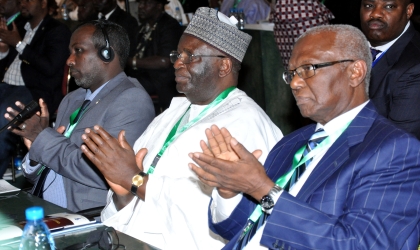
L-R:1st Vice President, National Assembly of Djibuti, Mr Mohamed Hoomed, former UN Undersecretary, Prof. Ibrahim Gambari and former President, African Development Bank, Dr Babacar Ndiaye, at the 1st Africa Legislative Summit in Abuja last Monday. Photo NAN




The Hydrocarbon Pollution Remediation Project (HYPREP) has commemorated the 15th anniversary of the release of the United Nations Environment Programme (UNEP) Environmental Assessment Report on Ogoniland, reaffirming its commitment to restoring the environment and improving the livelihoods of affected communities.
In a statement signed by the Project Coordinator, Prof Nenibarini Zabbey, to commemorate the anniversary, HYPREP described the anniversary as a significant milestone in Nigeria’s environmental restoration efforts, noting that the project has made remarkable progress in implementing the recommendations of the landmark UNEP report released on August 4, 2011.
The UNEP report had revealed extensive oil pollution across Ogoniland, severe environmental degradation, and serious public health risks resulting from decades of petroleum operations. It also recommended an initial $1 billion fund to commence the cleanup of the affected communities.
According to HYPREP, the Federal Government formally launched the Ogoni clean-up in 2016, while the Project Coordination Office was established in 2017 to drive the implementation of UNEP’s recommendations.
Zabbey said the current administration has continued to prioritise the project under the Renewed Hope Agenda.
Providing an update on the cleanup, the Project Coordinator disclosed that 30 of the 65 contaminated sites identified by UNEP have been fully remediated, while work is ongoing at several medium- and high-risk locations. It also stated that more than 1.5 million mangrove seedlings have been planted as part of what it described as the world’s largest restoration of oil-degraded mangroves, with over 1,000 hectares of shoreline already rehabilitated.
Zabbey further revealed that 49 Ogoni communities have been connected to potable water schemes through multiple water projects and booster stations aimed at providing safe drinking water across the region.
In the health sector, he said the 100-bed Ogoni Specialist Hospital in Kpite and the 43-bed Cottage Hospital in Buan are nearing completion, adding that several existing health facilities have been upgraded with modern medical equipment, while five ambulances have been donated to improve emergency healthcare services. The Project Coordinator also disclosed that a three-year human health biomonitoring study is being conducted in collaboration with the World Health Organization’s International Agency for Research on Cancer (IARC).
On economic empowerment, Zabbey stated that the Project has created more than 8,000 direct jobs and trained thousands of Ogoni youths and women in various vocational and technical skills, including software development, cybersecurity, aviation, commercial diving, seafaring, mechatronics, and creative arts. The project also reported awarding scholarships to more than 1,000 students, providing grants to small businesses, and supporting persons living with special needs through skills acquisition programmes.
The statement further highlighted ongoing legacy projects, including the Ogoni Power Project and the Centre of Excellence for Environmental Restoration, which it said is about 96 per cent complete. HYPREP also welcomed the recent designation of the Ogoni Wetland as a Ramsar Site of International Importance and pledged to continue promoting biodiversity conservation and sustainable management of the ecosystem.
Marking the anniversary, Zabbey said the progress achieved over the past 15 years demonstrates the collective commitment of government, development partners, stakeholders, and local communities to restoring Ogoniland. He called for renewed collaboration to sustain the cleanup effort, promote environmental sustainability, and support the long-term development of the region. 3
-

 News2 days ago
RSG Targets Nine Million Residents in Mosquito Net Distribution Campaign
-

 Oil & Energy2 days ago
Aiyedatiwa Signs New Electricity Bill
-

 Oil & Energy2 days ago
NLNG Commissions Research And Innovation Centre In RSU
-

 Maritime2 days ago
Marine Minister Commends President Tinubu On NPERA Bill Assent
-

 News2 days ago
KenPoly Holds Eight Convocations, August 29
-

 News2 days ago
RSG Begins Another Phase of Projects Commissioning Today
-

 News2 days ago
RMAFC Completes Revenue Sharing Review, Proposes New Pay
-

 Maritime2 days ago
NAGAFF Petitions IGP Over Alleged Maritime Police Harassment