Connect with us

Environment

Commissioner Tasks Media On Envrionmental Issues

Published

on

The Delta Commissioner for
Environment, Chief Frank Omare, has charged the Nigerian media on the need for
early and grass-roots reportage of environmental challenges across the country.

Omare gave the charge recently
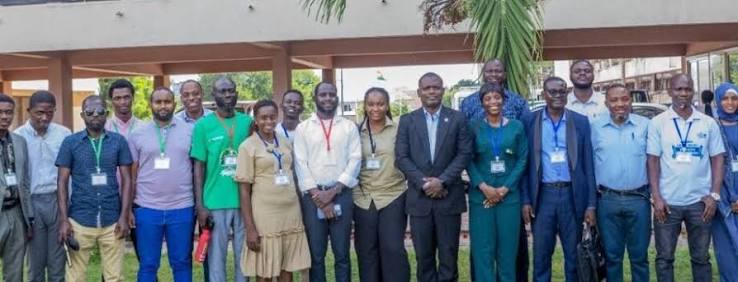
at a one-day capacity building workshop for media practitioners organised by
the United Nation Development Programme (UNDP) in collaboration with the Delta
Government.

He said that early and
grass-roots report of environmental challenges would inform relevant government
agencies, as well as enable such agencies take appropriate intervention
measures.

He said that environmental
challenges such as climate change, flooding, soil erosion, coastal erosion,
indiscriminate poaching for games, forest depletion, oil spill, pollution,
contamination and solid waste were increasingly and globally becoming
worrisome.

The commissioner, who was
represented by the acting Permanent Secretary in the ministry, Mr Khalil Okoro,
therefore, said that environmental information gathering and dissemination were
very vital to sustainable national development.

He also said that the present
administration in the state was very keen in addressing the various environment
challenges across the state, but added that this could only be achieved through
partnership with the media.

Delivering a paper entitled
“Environmental challenges in Delta and the media’’, Prof. Valerie Nnodu, of the
Faculty of Environmental Sciences, Nnamdi Azikiwe University, Awka, urged the
media to be part of early signal of environmental emergencies.

Nnodu said that environmental
problems and the challenges emanating from them were multifaceted, adding that
any successful remedial action required a multifaceted approach.

She said that typhoon, super
storm, Sandy and flood were not accidents but environmental issues that had to
be tackled.

“There is no doubt, the
climate is changing and we have to tackle them,” she said.

She, therefore, advocated for
media personnel to be exposed to frequent training, since environmental issues
and challenges were dynamic.

The resource person also said
that environmental advocacy should be introduced in tackling some of the
predisposing conditions like flooding, soil erosion and coastal flooding.

Also speaking, Mr Goodluck
Enaini of NTA, said that representative of media should form part of national
disaster preparedness committees alongside government officials and civil
society leaders.

Enaini said that strong
working relationship between the media and disaster relief organisations, with
regular interaction between them, would help everyone understand each other’s
roles and needs.

He said that such interaction
before disasters was the groundwork for an effective working relationship in
its aftermath.

He, therefore, urged the media
to intensify their efforts at public enlightenment by presenting environmental
information in local languages to remove the language barrier.

In the same vein, Mr Eric
James, Former General Manager, Delta Broadcasting Service, Warri in Delta, said
that media must begin to design specific programmes solely devoted to
environmental issues.

James said that selected
journalists from each media organisation should be given specialised training
in environmental reporting to be able to exhibit high level of professionalism.

He said that the absence of
sponsorship had contributed to the inability of the media to create the desired
programmes on environment.


Continue Reading

Environment

Lagos State  Government Refuted Resumed Monthly Sanitation 

Published

on

The Lagos State Government on Saturday refuted an online media report claiming that the state had resumed the monthly environmental sanitation exercise.
The Commissioner for the Environment and Water Resources, Mr Tokunbo Wahab, said no categorical statement had been made regarding the commencement date of the exercise.
Wahab explained that what he told newsmen after a project inspection tour last Sunday was that engagements with relevant stakeholders were still ongoing.
He said the state government had planned to begin with a sensitisation programme last week, but was constrained by logistics issues.
“The truth is, we were meant to start with a sensitisation programme last week, but we had a logistics issue. We need to find a day that is acceptable to all stakeholders,” he said.
He expressed optimism that the exercise might return very soon, adding that the official date would be communicated by the Governor, Mr. Babajide Sanwo-Olu.
The commissioner urged law-abiding residents to continue their lawful activities without hindrance, assuring them that adequate notice would be given before the exercise was reintroduced.
The monthly environmental sanitation, previously held on the last Saturday of every month between 7.00 a.m. and 10.00 a.m., was suspended in November 2016 following a legal pronouncement restricting movement during the exercise.
However, renewed waste management challenges, including clogged drainage channels and indiscriminate refuse disposal, have sparked calls from residents for its reinstatement.
Continue Reading

Environment

LAWMA Director Says Sweeping Reforms Have Improved Waste Collection 

Published

on

The Managing Director of the Lagos Waste Management Authority (LAWMA), Dr Muyiwa Gbadegesin, says sweeping reforms and infrastructure upgrades have significantly improved waste collection efficiency across the state.
Gbadegesin disclosed this to newdmen last week in Lagos state.
He said LAWMA expanded night cleaning operations and increased street sweeping coverage to 1,000 routes statewide.
He disclosed that 16,000 street sweepers were currently engaged across Lagos, supported by improved logistics and operational systems.
He said LAWMA acquired new equipment three years ago to complement Private Sector Participants (PSP) compactors and rehabilitated old trucks to strengthen fleet capacity.
He added that additional compactor trucks were expected in the coming months.
“Heavy-duty equipment is now deployed to clear legacy illegal dumpsites across communities,” he said.
Gbadegesin said LAWMA strengthened human capacity by expanding its advocacy department and deepening collaboration with Community Development Associations (CDAs) and local councils.
He revealed that each local government now operates a waste management task force, supported by LAWMA integration desks.
On waste-to-wealth initiatives, he disclosed that the Lagos State House of Assembly had ratified a concession agreement with ZoomLion to construct transfer loading stations and material recovery facilities.
The facilities, he said, would enable closure of the Olusosun and Solous landfills and process 4,000 tonnes of waste daily.
He said organic waste, which constitutes about 50 per cent of Lagos waste, would be converted into compost, while plastics would be recycled into waste bins.
Gbadegesin also disclosed plans for a 1,500-tonnes-per-day waste-to-energy plant in partnership with a Dutch firm, Harvest Waste.
He said the project was expected to generate 60 megawatts of electricity to support emerging industrial zones.
He further highlighted a pilot biogas plant at the Epe Food Market, which processes 500kg of organic waste daily to generate electricity for market operations.
He called for stronger media collaboration to enhance public awareness and behavioral change.
“Waste management is not just about equipment; it is about human behaviour, enforcement and strong regulatory systems,” he said.
He urged residents to utilise LAWMA’s toll-free lines and digital platforms to report service gaps instead of resorting to illegal dumping.
Continue Reading

Environment

RIWAMA In Collaboration With Obio Akpo And Port Harcourt LGA Ban Dumping Of Refuse On  Road Side

Published

on

The Rivers State Waste Management Agency (RIWAMA) in Collaboration with Obio Akpor Local Government Council and Port Harcourt City LGA had advised the public not to dump refuse on the road side.
 In a statement signed by the Director of RIWAMA Dr Ibimina Wokoma, Mayor of Port Harcourt Sir Hon Allwell Ihunda and Obio Kpor local government Chairman Hon  Dr,  Gift  Worlu made available to Tide news stated that dumping of refuse on road medians is banned in Obio Akpor LGA, Port Harcourt City LGA, and the entire metropolis.
The statement said all waste is to be properly bagged and taken to the nearest RIWAMA-approved receptacle only between the hours of 6pm and 10pm daily.
“The use of cart pushers for waste collection, evacuation, and disposal is highly prohibited across Obio Akpor LGA and Port Harcourt City Local Government. Corporate organizations are requested to engage only Private Service Providers licensed by RIWAMA, in line with extant laws.
“Scattering of refuse bags at the receptacles or roadside by scavengers, individuals, and organizations engaged in illegal sorting or segregation of waste or recycling business is hereby banned, except as authorized or licenced by RIWAMA at the final dumpsites.
“The Thursday sanitation exercise by shop owners will continue alongside business activities without closing or locking up shops.
The statement also said  that , shop owners whose shop environment or surroundings are untidy will be arrested and prosecuted accordingly.
This notice applies to all residents, businesses, and organizations in Rivers State. Let’s work together to restore our “Garden City” status.
By: Kiadum Edookor
Continue Reading

Trending