
Oil & Energy
NNPCL, NLNG To Collaborate On De-Risking Critical Infrastructure, Boost Gas Supply

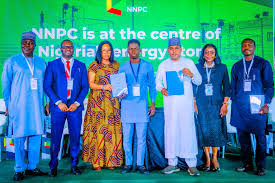
The Nigerian National Petroleum Company Limited (NNPCL) and the Nigeria LNG are in partnership talks to address the urgent need for deliberate investment in the gas sector to stabilise gas supply, de-risk critical infrastructure, and unlock upstream investments.
The Managing Director, NLNG, Philip Mshelbila, disclosed this while playing host to the Group Chief Executive Officer of the NNPCL, Engr. Bayo Ojulari, Thursday.
Welcoming the NNPCL team, Mshelbila, described NNPCL as a dependable shareholder company that is committed to the development of NLNG to secure the gas value chain and overcome the challenges experienced by the company in recent times.
Mshelbila, who noted the importance of synergy in delivering the national energy goal, stressed the need for deliberate investment in the gas sector to stabilise gas supply, de-risk critical infrastructure, and unlock upstream investments.
These efforts, he said, would be essential to sustaining momentum of growth, deepening value delivery, and exploring future opportunities.
Mshelbila insisted that NLNG would be better positioned to deliver consistent gas output, strengthen investor confidence, and enhance Nigeria’s competitiveness in the global energy marketplace.
In his response, Ojulari reaffirmed NLNG’s pivotal role in driving Nigeria’s energy transition, economic stability, and industrial growth.
He described NLNG as “a beacon of governance, performance, transparency, and sustainability” in the country’s dynamic energy sector.
He stated that the visit provided an opportunity to connect with the team, assess NLNG’s operational progress, identify opportunities to drive continuous improvement, enhance plant availability, and boost revenue generation for the nation.
Ojulari said plans are underway for a dynamic Gas Master Plan as well as exploring opportunities for hydrogen collaborations with NLNG, in preparation for a net-zero future.
The Permanent Secretary, Dr. Emeka Vitalis, emphasised NLNG’s strategic importance as a lever for energy transition, and a pillar of economic stability.
He underscored the critical role of Train 7 in achieving Nigeria’s export targets, and enhancing national resilience.
Stressing the need for a strong asset integrity, Vitalis stated that ensuring zero emissions across the gas supply chain would be vital to NLNG’s long-term success in the transition era adding that the company’s exemplary asset management remains a source of national pride.

Continue Reading


A leading indigenous oil & gas construction and servicing company, MJD Oilfield Services Limited, in partnership with the Nigerian Content Development and Monitoring Board (NCDMB) and Renaissance Africa Energy Company Limited, has officially commenced a comprehensive 12-month Nigerian Content Human Capital Development (NC-HCD) training programme.
The programme is designed to equip 33 Nigerian graduates in engineering and related disciplines with advanced technical competencies in pipeline pigging, corrosion control, and integrity monitoring, thereby strengthening local capacity within the oil and gas sector.
The intensive, year-long initiative integrates both theoretical instruction and practical, hands-on training, with the objective of developing highly skilled and industry-ready professionals capable of contributing meaningfully to Nigeria’s energy infrastructure.
Speaking at the official kick-off ceremony in PortHarcourt, the Managing Director, MJD Oilfield Services Ltd., Olayemi Familusi, emphasised the significance of the programme and urged participants to take full advantage of the opportunity.
He also commended the NCDMB for its sustained contributions to the growth and transformation of the Nigerian oil and gas industry.
“The Nigerian oil and gas industry has undergone remarkable development since the establishment of the NCDMB,” he stated. “We commend the Board for its unwavering commitment to the advancement of Nigerian talent and the industry at large. Beneficiaries are encouraged to apply these acquired skills within the country, where opportunities for growth and impact continue to expand.”
In his address, the Executive Secretary, NCDMB, Felix Omatsola Ogbe, described the initiative as a strategic investment in Nigeria’s energy security.
Represented by the Manager, Human Capital Development, NCDMB, Mrs. Tarilate Bribena-Teide, Ogbe highlighted the critical importance of pipeline integrity expertise, particularly for key national assets such as the 614-kilometre Ajaokuta–Kaduna–Kano (AKK) Gas Pipeline.
He further underscored the Board’s strict expectations regarding discipline and commitment, insisting that a minimum attendance rate of 99.9 per cent is mandatory.
Ogbe said “The Board will not hesitate to withdraw and replace any participant who demonstrates a lack of commitment. This programme requires full dedication and has the potential to significantly transform participants’ career trajectories.”
Also speaking at the event, representative of Renaissance Africa Energy Company Limited, Funso Alabi, reaffirmed the importance of strategic collaboration in developing a competent workforce capable of sustaining the long-term reliability and efficiency of Nigeria’s energy infrastructure.
The technical training partner, DORET Limited, presented an overview of the curriculum, which is aligned with the NCDMB Human Capital Development Implementation Guidelines (2020) and the Nigerian Oil and Gas Industry Content Development (NOGICD) Act.
The programme combines classroom-based learning with practical workshop sessions, with a strong emphasis on promoting local content development and technical excellence.
To ensure participants’ full engagement, the programme is fully supported with monthly stipends, meal allowances, mobilisation and demobilisation allowance, learning resources (including laptops and Personal Protective Equipment), health insurance coverage, and both local and international certifications upon successful completion.
The initiative further represents a critical pathway for young Nigerian graduates to transition into the oil and gas industry, reinforcing nation’s capacity to meet its complex technical demands with locally developed expertise.

The Nigeria Auto Journalists Association(NAJA ), has called on President Bola Ahmed Tinubu to take decisive steps toward stabilising Nigeria’s fuel market by guaranteeing the direct supply of crude oil to domestic refineries, particularly the Dangote Refinery, as global tensions continue to unsettle energy prices.
In a statement issued last Thursday, the association warned that the rising cost of petrol, exacerbated by the ongoing crisis in the Middle East, poses a serious threat to economic stability and the welfare of Nigerians already grappling with inflationary pressures.
NAJA argued that Nigeria must urgently insulate its downstream petroleum sector from external shocks by strengthening local refining capacity.
The association’s intervention comes amid heightened volatility in the international oil market, where geopolitical developments have continued to influence crude prices and, by extension, the cost of refined petroleum products.
NAJA noted that while recent policy measures by the federal government signal a willingness to address the crisis, more targeted interventions are required to achieve lasting stability. The group specifically referenced the government’s plan to distribute 100,000 Compressed Natural Gas (CNG) conversion kits nationwide, describing it as a commendable but insufficient response to the scale of the challenge.
According to the association, the CNG initiative represents a forward-looking approach to energy diversification, particularly within the transportation sector. However, it stressed that alternative fuel adoption alone cannot resolve the immediate pressures facing petrol consumers. Instead, NAJA maintained that ensuring the efficient operation of domestic refineries remains the most viable short-term solution.
Speaking on behalf of the association, its Chairman, Theodore Opara, urged the federal government to implement policies that would enable local refineries to access crude oil directly from the Nigerian National Petroleum Company Limited, preferably in naira. He argued that such a move would significantly reduce the exposure of domestic fuel production to fluctuations in the global oil market.
Opara, while noting that the current arrangement, under which the Dangote Refinery imports a substantial portion of its crude feedstock, undermines the refinery’s potential to stabilise local fuel prices explained that reliance on imported crude effectively ties domestic refining operations to international pricing dynamics, thereby limiting the benefits of local production.
“Dangote Refinery imports most of its crude, hence it is exposed to the effects of the ongoing crisis in the Middle East,” he said. “If the refinery gets direct crude supply from the NNPC, it will strengthen the country’s long-term energy diversification strategy and reduce exposure to international supply shocks.”
The NAJA chairman further noted that Nigeria’s continued dependence on imported refined petroleum products remains a major vulnerability, despite its status as Africa’s largest crude oil producer. He described the situation as economically unsustainable, particularly at a time when global uncertainties are driving up energy costs.
“If Nigeria’s major refineries, including Dangote, receive crude locally and transact in naira, the country will reduce its vulnerability to global market disruptions. It will also help stabilise the downstream petroleum sector,” he added.
While acknowledging the potential of the CNG programme to reduce dependence on petrol over time, NAJA insisted that the backbone of Nigeria’s energy strategy must remain anchored in efficient domestic refining. The association warned that failure to address crude supply constraints could undermine ongoing efforts to reform the sector.
“CNG is a good transition policy for transportation, but the backbone of Nigeria’s fuel supply must still come from efficient domestic refining,” Opara said.

The Federal Government said it has progressed in its plan on the proposed transcontinental gas pipeline aimed at delivering its vast natural gas to European markets.
The proposed pipeline, still at an early development stage, is being advanced by a consortium of global industry players and would be subject to extensive technical, commercial, and regulatory processes.
Minister of State for Petroleum Resources (Gas), Rt. Hon. Ekperikpe Ekpo, who spoke alongside key industry stakeholders, during discussions on the proposed pipeline, at a meeting in London, United Kingdom, described the engagement as both timely and historic, adding that Nigeria is poised to attract investors into its gas sector.
In his words “Nigeria is set for investors to take advantage of this natural gas. The Petroleum Industry Act and the executive orders by Mr President for the petroleum sector have set a conducive environment to attract investments to the sector.
“We must be intentional in the utilisation of our resources. So long as we have these reserves, we must take advantage of them and better the lives of those in the region,” Ekpo said.
The minister further noted that, with appropriate financial backing in place, he sees no obstacle to the project coming to fruition.
In a statement signed by the Spokesperson to the minister, Louis Ibah, Ekpo noted that the move is aimed at strengthening energy security and unlocking long-term economic value.
The proposed pipeline, described as a transformative gas corridor, is designed to transport up to 30 billion cubic metres of gas annually from Nigeria’s southern reserves through Chad and Libya, before extending subsea to Sicily, Italy, and into the broader European market.
According to the statement, stakeholders expressed optimism that the proposed pipeline project would redefine Nigeria’s role in the global energy market while deepening ties with Europe.
-

 News3 days ago
Nigeria Recorded Two World’s Deadliest Terror Attacks In 2025 –Report
-

 Politics3 days ago
Eid-el-fitr: INEC Urges Staff Discipline Ahead Ekiti, Osun Guber Polls
-

 Editorial3 days ago
Thumbs Up For Sit-At-Home Reversal
-

 News3 days ago
Perm. Sec Pats Rivers NUJ On The Back
-

 News3 days ago
Explosions Rock Lagos, C’River, Kill One, Injure 40
-

 News3 days ago
Fubara Hails Umah Ukpai’s Contributions To Global Christian Evangelism
-

 Education3 days ago
Opobo Kingdom moves to incorporate Ibani Language Into School Curriculum, Takes Off April
-
News3 days ago
Etche Monarch Alleges Death Threats, Assault