
Editorial
Fubara’s 2025 Budget Of Inclusive Growth

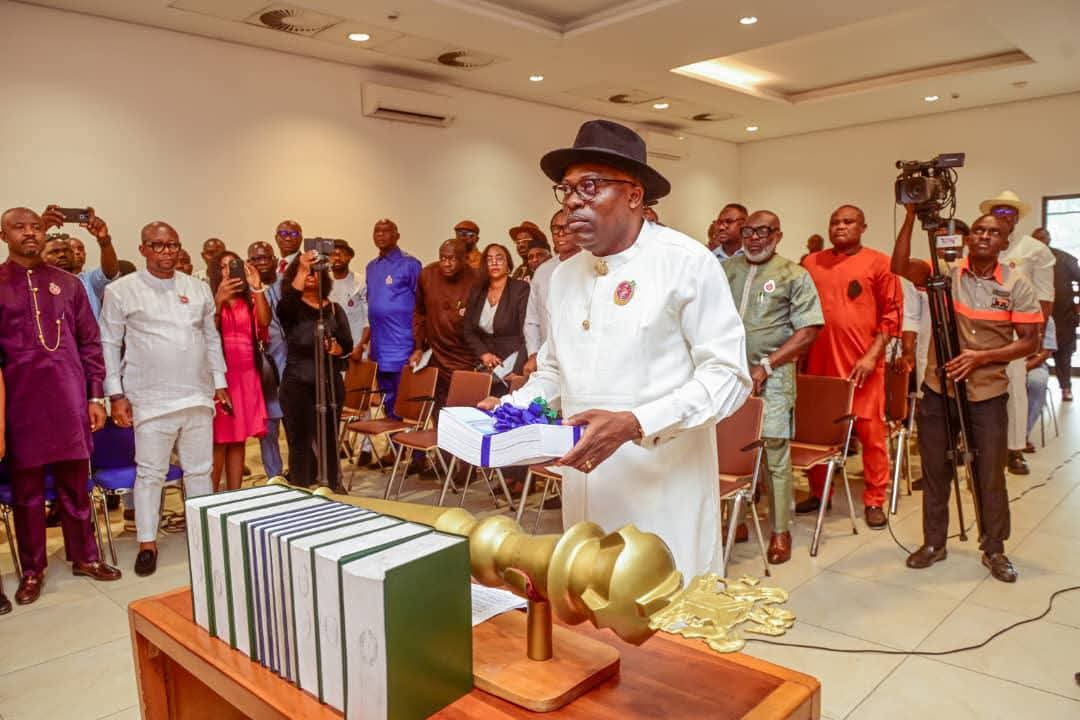
On December 30, 2024, Rivers State Governor, Sir Siminalayi Fubara, unveiled an ambitious budget proposal amounting to N1.188 trillion for the year 2025. This proposed budget, aptly termed the “Inclusive Growth and Development Budget,” seeks to address the socio-economic needs of the state while simultaneously fostering sustainable growth and development. This marked the second budget cycle under Governor Fubara’s administration. Fubara signed the budget into law on January 2, 2025, after the House of Assembly had passed it.
The 2025 budget builds upon the framework established by the previous year’s appropriation, which was themed “Renewed Hope, Consolidation, and Continuity.” That 2024 budget projected a total revenue of N800.392 billion, aiming to perpetuate the administration’s agenda focused on economic recovery, infrastructure development, and the enhancement of social welfare programmes. Moreover, it sought to stimulate economic growth, uplift the quality of life for citizens, and facilitate the overall sustainable development of the state.
The 2024 budget was a resounding success, surpassing both its revenue and expenditure targets and achieving its objectives concerning performance, expectation management, and project delivery. Remarkably, this was accomplished in the face of macroeconomic challenges, including prevalent high inflation rates, the devaluation of the naira, and a backdrop of political instability. Notably, this budget was financed without resorting to loans, achieving full implementation with a success rate of 100%. The growth in the Internally Generated Revenue (IGR) was especially impressive; by the end of November 2024, the IGR surged to N282.557 billion, surpassing the projected figure of N231.057 billion by more than N51 billion.
However, the 2025 budget reveals a more refined and methodologically sound financial strategy that places emphasis on both immediate operational needs and forward-thinking long-term investments. The breakdown shows Recurrent Expenditure totalling N462,254,153,418.98 alongside a Capital Expenditure of N678,088,433,692.03. Additionally, the budget establishes a planning reserve of N35.688 billion and anticipates a closing balance of N12.931 billion. In this way, Fubara’s administration reaffirms its unyielding commitment to expedite the development of Rivers State.
An important element of this budget is the ratio of Recurrent to Capital Expenditure, which stands at a notable 44:56%. This metric illustrates the administration’s deliberate allocation of funds, directing a substantial portion towards capital projects — vital components for fostering infrastructure and facilitating developmental goals. This balanced approach indicates a strong recognition of the need for investment in both immediate operational efficiency and sustainable long-term growth strategies.
Considering the contemporary economic complexities and pressing policy priorities, the 2025 appropriation estimate is a carefully calculated reflection of the state’s economic landscape. The budget’s stable assumptions and its intrinsic flexibility are designed to address the various financial challenges the state faces, thereby ensuring its ongoing relevance to current and future economic scenarios. These elements demonstrate a realistic and reliable approach in the projections of the N1.188 trillion budget, thereby enhancing the effectiveness of its implementation.
The estimate further acknowledges the complicated dynamics of the current economic climate and adjusts strategic plans to navigate unforeseen disturbances. By incorporating a degree of flexibility, the budget is designed to anticipate and mitigate potential economic shocks stemming from an array of domestic and international influences. This proactive posture enables the state to respond efficiently to economic downturns and explore avenues for growth.
In the allocation of funding, Governor Fubara emphasizes critical sectors such as infrastructure, health, education, agriculture, and social development, showcasing an understanding of the core challenges faced by Rivers State. The largest portion of the budget, amounting to N195.074 billion, has been specifically earmarked for infrastructure development, followed closely by allocations for health (N97.750 billion), education (N63.275 billion), agriculture (N30.954 billion), and social development (N15.477 billion).
The government’s commitment to infrastructure development is particularly commendable. Key projects such as the Port Harcourt Ring Road and the Trans-Kalabari Road remain essential drivers for economic expansion. The allocation dedicated to social development is a commendable move towards empowering the youth population. Investments in youth initiatives are integral for laying the groundwork for a more inclusive and equitable society.
Recognising that food security is a non-negotiable priority, the administration’s substantial commitment to the agricultural sector deserves praise. By supporting interventions aimed at agricultural development, the government is creating employment opportunities, fostering economic growth, and achieving necessary diversification and rural development. Moreover, the initiative to roll out a comprehensive agriculture transformation support programme geared towards youth in the upcoming fiscal year stands to tackle the challenges of youth unemployment, poverty, and food insecurity effectively.
In parallel, the budget emphasizes the administration’s intent to fortify health and educational institutions. It is paramount that primary healthcare systems and general hospitals receive the necessary investments to drive transformative outcomes, alongside substantial renovations of public schools. The government must remain focused on bolstering foundational sectors within the education system. Furthermore, the planned establishment of a college of education in Opobo is a welcome initiative that aligns perfectly with the need to enhance educational opportunities in the area.
In recognition of these concerted efforts, the Opposition Coalition, alongside the All Progressive Congress (APP) and the Human Rights Writers Association of Nigeria (HURIWA), has lauded Governor Fubara as an astute economic tactician whose leadership has seen Rivers State’s IGR increase by N100 billion. They further commended his administration for achieving the 2024 budget’s objectives without incurring debt, despite the ongoing attempts by various disgruntled elements to disrupt governance in the state.
A statement from the opposition emphasized, “This remarkable achievement is a testament to the economic acumen of Governor Fubara, who, despite distractions and provocations, has maintained his focus on the economic rejuvenation of the state following years of mismanagement. It is both reassuring and inspiring that even while the Federal Government grapples with domestic and foreign borrowings to fund its operations, the Rivers State Government has succeeded in financing the 2024 budget without resorting to borrowing.”
Governor Fubara’s pragmatic approach to fiscal management presents a remarkable opportunity to transform governance at the state level in Nigeria. If effectively executed, the 2025 budget could serve as a model for leveraging state governance to propel economic growth and enhance the quality of life for Rivers people. The successful implementation of the budget could redefine the role of state governments in Nigeria’s overall development trajectory, thereby paving the way for a more prosperous and inclusive future for all.

Continue Reading


For the first time in over five years, the bustling markets of Anambra State, particularly the sprawling Onitsha Main Market, opened for business on February 2, 2026, without the fear of coercion or violence. This development marks the definitive end of the illegal Monday sit-at-home order that has held the South-East region hostage since 2021. Governor Chukwuma Soludo has achieved what many thought impossible, finally laying to rest an obnoxious practice that has bled the region dry economically and psychologically.
The Monday sit-at-home order was first declared by the Indigenous People of Biafra (IPOB) on July 30, 2021. The proscribed organisation imposed the directive to pressure the Federal Government into releasing their detained leader, Nnamdi Kanu, and to advance their demand for the creation of an independent sovereign state of Biafra. What began as a protest mechanism quickly degenerated into a compulsory lockdown enforced through intimidation and violence.
For more than four years, the South-East had been crippled every Monday. Schools remained shut, businesses pulled down their shutters, and economic activity ground to a halt across the five states of Anambra, Abia, Enugu, Ebonyi, and Imo. Governor Soludo recently quantified the devastation, noting that every Monday lost represented about 20 per cent of the work week for the region’s informal economy. When calculated over 52 weeks annually for several years, the cumulative losses are truly staggering.
The economic cost to the region has been nothing short of catastrophic. Investors fled, businesses relocated to other parts of the country, and the South-East lost its competitive edge as West Africa’s premier commercial hub. The Onitsha Main Market, reputedly the largest market in West Africa, sat empty every Monday. Thousands of traders lost 52 working days every year, children missed countless hours of education, and families saw their incomes dwindle. The opportunity cost of this self-imposed isolation runs into hundreds of billions of naira.
Professor Soludo demonstrated exceptional leadership by taking the bull by the horns. His administration ordered the closure of the Onitsha Main Market for one week, sending a clear message that the era of economic sabotage was over. Following this decisive action, he engaged in meaningful dialogue with traders and stakeholders, reaching a consensus that markets must operate on Mondays like every other day of the week.
The results of this courageous stance are now visible for all to see. Over 45,000 shops at the Onitsha Main Market reopened for business, and traders turned out in their tens of thousands, jubilant that they could finally resume their livelihoods without fear. The atmosphere was reportedly electric, with over 100,000 people celebrating what many described as a liberation from years of economic captivity imposed by faceless enforcers.
Soludo deserves the highest commendation for confronting this age-long practice that isolated the South-East from the rest of Nigeria. It takes uncommon courage and determination to challenge an entrenched system enforced through fear and violence.
It is senseless for any group to impose such hardship on the very people it claims to be fighting to liberate. Perhaps IPOB thought they were punishing the Federal Government by shutting down the South-East every Monday. Little did they realise that they were inflicting the deepest wounds on their own people. The traders, the schoolchildren, the transporters, and the ordinary workers who lost income and opportunities were all Igbos, the very constituency IPOB professes to protect.
Can it be imagined what it takes to shut down an entire geopolitical zone every Monday for over four years? The mathematics of loss is simple but devastating: 52 Mondays annually means 52 lost working days per year. For a region built on commerce and entrepreneurship, this represented a self-inflicted wound that no external enemy could have achieved. The South-East was effectively closed for business one day every week while the rest of Nigeria moved forward.
Thankfully, IPOB has now officially endorsed the cancellation of the sit-at-home order once and for all. In a statement released, the group announced that Nnamdi Kanu had directed the “total cancellation” of the directive, urging residents to open their shops, go to work, and send their children to school without fear. This is a welcome development, though we must approach it with cautious optimism, as this is not the first time such announcements have been made.
Previous attempts to end the practice were frustrated by the activities of one Simon Ekpa, a self-styled disciple of the IPOB leader based in Finland. Whenever IPOB issued statements calling for a cessation of the sit-at-home, Ekpa would counter with orders for its continuation, creating confusion and perpetuating the cycle of fear. Now that Ekpa has been convicted and jailed in Finland for inciting terrorism and tax fraud, we hope there will be no further excuses to continue this damaging observance.
With the definitive end of the sit-at-home order, people in the South-East, as well as Nigerians travelling through the region, can finally heave a sigh of relief. The order caused immense apprehension for travellers who had to pass through the South-East to reach other parts of the country. Major highways were deserted on Mondays, creating security vulnerabilities and disrupting the flow of commerce and movement across the nation. This created countless problems for families, businesses, and national cohesion.
Now that this painful chapter has come to an end, we urge the proscribed IPOB not to renege on their decision. The South-East people, who were the greatest victims of this infamous order, can now return to doing what they do best: business. The resilience of the Igbo entrepreneur is legendary, and given the opportunity, the region will bounce back stronger than ever. However, this requires that the peace holds and the markets remain open every Monday without exception.
We urge everyone in the region—business owners, market leaders, transporters, stakeholders, and ordinary citizens—to cooperate fully to ensure that this new development is sustained. The government at all levels must also begin to address the underlying issues that led to this ugly incident. We cannot run away from the fact that there is a genuine feeling of marginalisation and oppression in the South-East that the Federal Government needs to look into.
Undoubtedly, Governor Soludo’s action has impacted positively on Anambra State and the entire region. It is a huge plus for the state’s economy, the security architecture of the South-East, and the confidence of investors who had written off the region as too risky for business. By restoring normalcy to Mondays, Soludo has given the people back their most valuable asset: the freedom to earn a living without fear. This is leadership, and this is progress.

On March 8, the world once again commemorated International Women’s Day (IWD) 2026, a global moment dedicated to celebrating the achievements of women and renewing commitment to gender equality. This year’s theme, “Give to Gain,” carries a simple but powerful message: when society gives support to women, society itself gains progress, stability, and prosperity.
International Women’s Day is observed annually to recognise the social, economic, cultural, and political achievements of women. It also serves as a reminder that, despite progress made over the decades, gender inequality remains a persistent global challenge that demands collective action.
The IWD 2026 “Give to Gain” campaign encourages a mindset of generosity and collaboration. It calls on governments, institutions, organisations, and individuals to support women’s advancement, recognising that empowerment grows when opportunities are shared and barriers are removed.
At the heart of the campaign is the principle of reciprocity. When people and institutions give generously—whether through opportunities, encouragement, or resources—the benefits multiply. Giving is not subtraction; it is intentional multiplication. When women thrive, families prosper, communities develop, and nations rise.
The concept of giving extends beyond financial assistance. Support for women can come through donations, knowledge, resources, infrastructure, visibility, advocacy, education, training, mentoring, and time. Each contribution strengthens the foundation for a more inclusive and interconnected world.
In this sense, “Give to Gain” is not merely a slogan; it is a global call to action. Every society, institution, and individual has a role to play in creating pathways for women and girls to realise their full potential.
For individuals, giving support means challenging harmful stereotypes and standing against discrimination wherever it occurs. It means questioning prejudices that limit women’s opportunities and celebrating the successes of women in every field of endeavour.
When people actively support gender equality, they reinforce a shared sense of purpose. This support produces a ripple effect: one act of advocacy encourages another, and collective effort spreads impact far beyond its original point.
The campaign, therefore, reminds us that empowerment is not a solitary journey. It is a shared responsibility that requires continuous commitment from communities across the globe.
Once again, the message is clear: everyone can give something. Through encouragement, advocacy, mentorship, or policy reform, society can help women and girls gain the opportunities they deserve.
In Nigeria, however, the message of “Give to Gain” resonates with particular urgency. Women’s rights remain constrained by deeply entrenched patriarchal norms that shape laws, politics, culture, and everyday life.
Despite decades of advocacy and repeated promises by leaders, the lived reality of many Nigerian women is still defined by systemic inequality, violence, and exclusion.
Statistics paint a troubling picture. Women hold only about 3.9 per cent of seats in Nigeria’s National Assembly, one of the lowest rates of female representation in the world. Nearly 43.4 per cent of Nigerian women aged 20–24 were married before the age of 18, while 13.2 per cent of women aged 15–49 report experiencing physical or sexual violence. These figures reveal the depth of gender inequality that still persists.
To realise the ideals of “Give to Gain” in Nigeria, deliberate action is required at all levels of government. The Federal Government must strengthen laws that protect women’s rights and ensure greater representation in governance. State governments should expand access to education, economic empowerment programmes, and protection against gender-based violence. Local governments must prioritise grassroots awareness, training, and opportunities that enable women to participate fully in community development.
Encouragingly, initiatives have begun to emerge. In Rivers State, Siminalayi Fubara used the 2026 celebration of International Women’s Day to reaffirm support for women’s empowerment, distributing N50,000 grants to 1,000 women. The First Lady, Valerie Fubara, also supported 20 women farmers with N10 million through the Renewed Hope Initiative Women Agricultural Support Programme, demonstrating how targeted support can improve livelihoods.
The responsibility for gender equality does not lie with governments alone. Individuals, organisations, and community groups must sustain the spirit of the IWD 2026 “Give to Gain” campaign throughout the year. By giving support, opportunity, and respect to women and girls, society gains a stronger, fairer, and more prosperous future for all.

The long-awaited inauguration of the Peter Odili Cardiovascular and Cancer Treatment Centre at Rumuokwuta in Obio/Akpor Local Government Area has been met with widespread relief and excitement by indigenes and residents of Rivers State, many of whom have spent years anticipating access to a facility built to preserve lives and curb the need for medical travel abroad.
Recall that the project was commissioned on November 14, 2022, only to be abandoned shortly afterwards. For a centre equipped to handle cardiovascular and cancer cases, this delay was not merely administrative; it carried real human costs in a country where non-communicable diseases account for about 29 per cent of all deaths, according to public health estimates.
The determination of Governor Siminalayi Fubara to get the centre started has now paid off. Without fanfares, the state-of-the-art hospital is quietly serving patients, proving that effective governance does not always need loud trumpets to announce its presence.
The governor deserves commendation for relentlessly reviving this critical health facility despite orchestrated attempts to clog the wheel of good governance in the state. In the same breath, kudos are due to the former Health Commissioner, Dr. Adaeze Oreh, whose professional input and persistence helped turn policy into practice.
However, this positive development also highlights the ongoing disappointment over the failure to put the Mother and Child Hospital into use nearly five years after it was commissioned. The frustration voiced by the Nigeria Medical Association (NMA) is justified, especially in Nigeria, where maternal mortality remains alarmingly high at about 512 deaths per 100,000 live births.
Although the Mother and Child Hospital was formally inaugurated in 2021, it has continued to remain completely non-functional in the years that followed. Reports indicate that the facility has stayed entirely sealed off and inaccessible to the public, with no signs of operational activity. This is despite renewed assurances given in early 2025 that the hospital would soon open its doors and begin serving the state — promises that have yet to materialise.
Beyond the health sector lies another deeply troubling example of public neglect: the second phase of the Rumuwoji Market, more popularly known as Mile One Market. This facility was completed nearly a decade ago, yet it remains entirely unused and dormant to this day — a situation that continues to baffle and worry a great many Rivers’ residents who had hoped it would serve the growing needs of their communities.
This phase of the market was built and completed by the immediate past administration of Chief Nyesom Wike. It followed the devastating fire that gutted the entire market during the tenure of Chibuike Rotimi Amaechi, whose government earlier completed and opened the first phase.
Sadly, the unused section of the market has begun to deteriorate, a clear waste of public funds. Traders who should be operating within the market now spill onto Afikpo Street, creating traffic bottlenecks, sanitation concerns, and general nuisances for residents.
We are compelled to ask why a market that has already been commissioned has remained unoccupied for so many years. If there are genuine issues preventing its use, then the government must put its foot down and address them squarely, with courage and determination rather than hesitation.
It is unacceptable that this phase of Mile One Market is allowed to decay after so much money has been sunk into it. Across Nigeria, abandoned public projects are estimated to have tied down trillions of naira, resources that could have transformed lives if properly utilised.
Additionally, the economic implications of leaving public infrastructure idle cannot be overstated. Markets are engines of micro and small-scale commerce, which account for over 80 per cent of employment in Nigeria’s informal sector. When facilities like the unused section of Mile One Market are left to rot, government inadvertently chokes livelihoods, reduces internally generated revenue, and deepens urban disorder. A functioning market would not only decongest surrounding streets but also restore dignity and safety to traders who currently operate under harsh and unsanitary conditions.
The government has expended substantial taxpayers’ money in the construction of these facilities, yet they sit idle and unused at a time when the people of the state should be directly benefiting from the services they were designed to provide. It raises a fundamental question that demands honest answers: what is the purpose of investing billions of naira in these projects if they are ultimately left dormant, abandoned, and to fall into a state of neglect? The people deserve better than empty infrastructure that serves no one.
While the political climate within the state has undoubtedly presented its share of challenges over time, that particular chapter now appears to be largely behind us. The focus must shift accordingly. The ball is firmly in the court of the administration to compose itself, buckle down, and get to work — ensuring that completed projects are delivered to the people they were intended to serve, without any further unnecessary delay.
Ultimately, governance is judged not by the number of projects commissioned but by how many are put to meaningful use. As the philosopher Edmund Burke once observed, “Bad laws are the worst sort of tyranny,” and by extension, abandoned projects are the worst form of waste. Rivers State has the opportunity to reverse this narrative. The administration must strike while the iron is hot, ensure that all completed facilities are activated, and prove that public resources are not poured into a bottomless pit but invested for the common good.
We therefore call on the government to redress these challenges with urgency. As the saying goes, “The best time to fix the roof is when the sun is shining,” and the time to act is now. Rivers people are watching, worried, and rightly expect their leaders to turn promises and investments into tangible public good.
-

 News3 days ago
Nigeria Recorded Two World’s Deadliest Terror Attacks In 2025 –Report
-

 Politics3 days ago
Eid-el-fitr: INEC Urges Staff Discipline Ahead Ekiti, Osun Guber Polls
-
 Editorial3 days ago
Thumbs Up For Sit-At-Home Reversal
-

 News3 days ago
Perm. Sec Pats Rivers NUJ On The Back
-

 News3 days ago
Explosions Rock Lagos, C’River, Kill One, Injure 40
-

 News3 days ago
Fubara Hails Umah Ukpai’s Contributions To Global Christian Evangelism
-

 Education3 days ago
Opobo Kingdom moves to incorporate Ibani Language Into School Curriculum, Takes Off April
-
News3 days ago
Etche Monarch Alleges Death Threats, Assault