
City Crime
We Execute, Deliver Strategic Projects To Improve People’s Lives

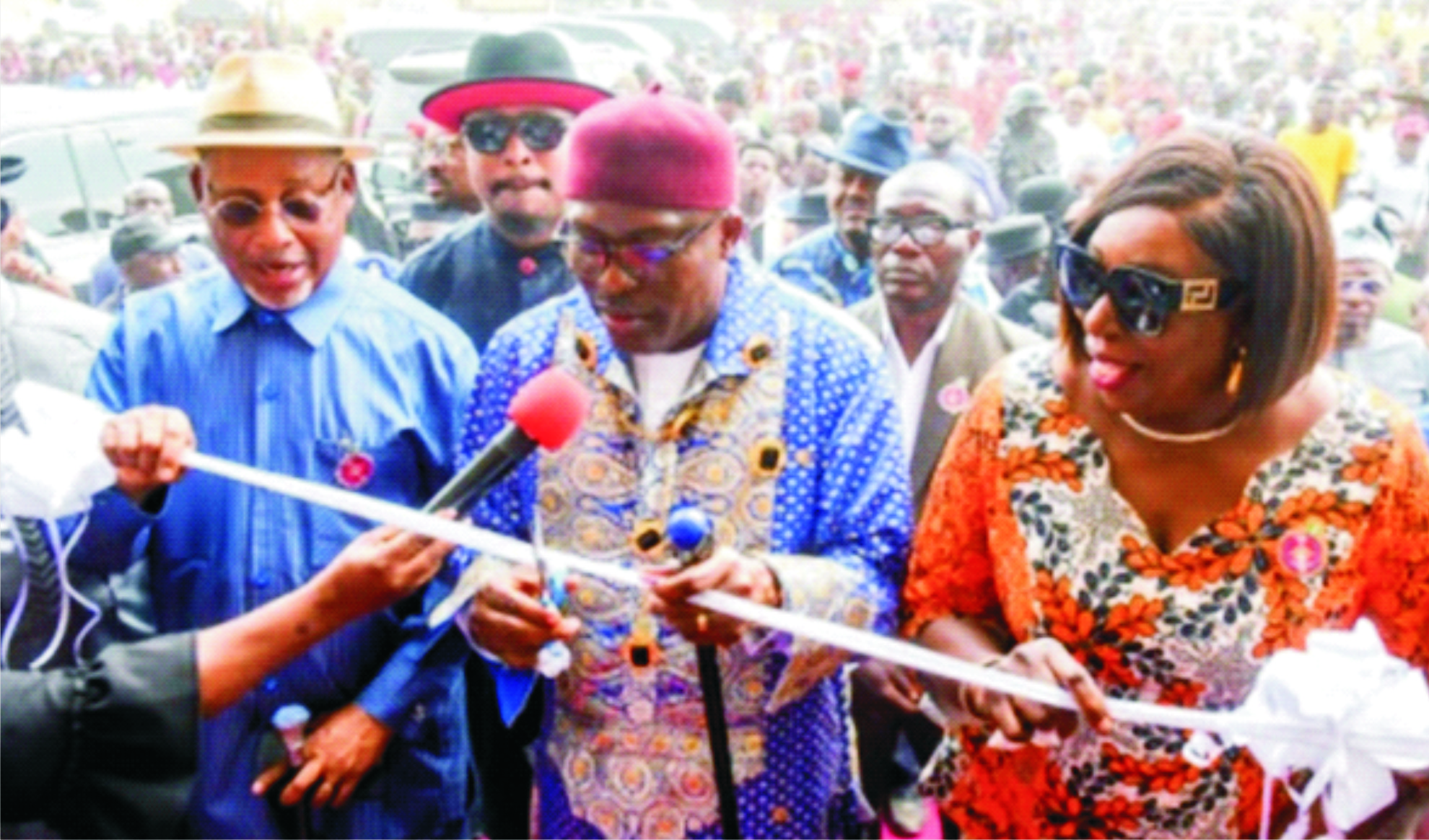
Rivers State Governor, Sir Siminalayi Fubara, has explained that he is guided by the commitment to deliver projects that are strategic and significant towards improving the lives of people in the State on an enduring scale.
The Governor made the explanation during the inauguration of the remodelled Government Girls’ Secondary School in Ahoada Town, Ahoada East Local Government Area on Friday.
At the event, Governor Fubara was conferred with the traditional title of Eze Yawe Ugo of Ekpeye land (The King who brings happiness and joy to Ekpeye land) by the Ekpeye Council of Traditional Rulers.
Governor Fubara stated that he inherited the school project when he assumed office on May 29, 2024, and decided to continue with the three contractors because education issue is a top priority in his administration.
He said that the investment made will definitely translate into providing quality educational training for the girl-child in the area to become bold, resourceful and responsible citizens.
The Governor noted, “So, we will not celebrate things that will not have meaning. That is why we are here today to inaugurate this school, a special school for people that are going to be mothers in this great nation.
“They are people that will be wives to great men. And if you don’t produce a quality girl-child, it means the nation is gone. So, you can see, everybody can attest that we are strategic; it is not just doing, but doing what is right.
“I assure our people that we will not do anything that we cannot stand and be proud of ourselves that we did something right.”
Governor Fubara said when he declared, last Wednesday, that he will be the first Governor, in the last eight years, to deliver pro-people projects in Omuma Local Government Area, most people did not understand the import of his revelation.
But Governor Fubara insisted that what his administration is doing is separate from what has happened in the past, as according to him, projects’ delivery is not for mere fanfare but strategically provided to address critical development needs of the people.
He added, “I stand here to say that even if there was a project commissioned at that time (in Omuma), it was a farm road. It has no connection to anything.
“The project we are commissioning has significance, and that is what we should be talking about… We are talking about projects that will add value to the lives of the people that you have decided to govern with the support of your people.”
Governor Fubara took a swipe at someone he described as ‘a data boy and an online dog seller’ who knows nothing about governance despite being close to a Governor for eight years.
He wondered the impetus of the ‘data boy’ who, reportedly, reacted to the projects delivered in Etche-Omuma, without understanding the overarching impact of the project on the people.
He said, “On Wednesday this week, we inaugurated a project: an 11.8km Okehi-Umuola-Eberi link road. It is a road that connects Omuma and Etche Local Government Areas.
“And we made very bold statement there to say that, very soon, we will be going to Omuma to also inaugurate another project. And we challenged them that the project we are going to commission in Omuma will be the first project that they are seeing.
“A few days later, those people who felt that the only thing that they can do to survive is social media and to sell dogs. I wonder why you will go to school, your parents will spend money, and the only profession you chose is to be a data boy and to sell dogs.
“If they love you, the appointment they gave to one boy the other day, if you were good, why didn’t they give you that appointment? Go and check yourself, something is wrong with you.
“It is not about coming (on social media) to abuse people; think about your life. Are you living a quality life? Even if you are asked to abuse people, at times, you should ask: what will people talk about me, knowing fully well that what I will say is not true?”
Governor Fubara expressed appreciation to Ekpeye people for their unalloyed support to his administration in the face of harassment and intimidation.
He said that some of their traditional rulers: Eze Ekpeye Logbo, His Imperial Majesty, Eze Kelvin Anugwo; and Eze Cassidy Ikegbidi were harassed and arrested while the Chief of Staff, Government House, Dr Edison Ehie, was declared wanted by the Nigeria Police Force on trumped up charges.
He said, “When the Eze Ekpeye was talking, a lot of you didn’t understand what happened. Because of their support for me, he was arrested, charged on false accusations. He stayed in police custody for more than four months; himself and Cassidy.
“We are not even talking about my Chief of Staff. Because of the support that he has publicly displayed, he was even declared wanted so that they can, maybe, reduce our influence.
“But the truth is always very clear: enemy has a time, his team cannot last forever. And I can assure you with all boldness today that they are gradually coming to an end.
“What we just need is to be patient. We have promised that our tactics will be following this process with patience and the fear of God. And we will get there.”
Governor Fubara promised to grant the request made by the Eze Ekpeye Logbo and other traditional rulers to recognise some designated traditional stools.
He also said that when he drove on the access road during project inspection tour, he decided to reconstruct the road, which has started, and assured that with availability of funds, the remaining 1km and the bridge will be attended to.
Governor Fubara said the contract for the internal roads will be revoked and re-awarded to a competent contractor who will deliver the project in line with the mantra of the administration.
Providing the project description, Rivers State Commissioner for Education, Dr Ovy Chinedum Chukwuma, said there are three distinct buildings handled separately by three contractors: Mcaretrace Nigeria Limited – Lot A; Azunda International Company Nigeria Limited – Lot B; and Ketdeg Ventures – Lot C.
Dr Chukwuma explained that there are two blocks of 12 classrooms, making a total of 24 classrooms; common rooms; science laboratories fitted with computers for chemistry, physics, agriculture and biology.
There is a library; he said, an Assembly Hall; offices; stores; Principal Quarters of 3-bedroom semi- detached bungalow; Vice Principal Quarters of 2-bedroom block of 4 flats of one-storey building.
Dr Chukwuma also listed an administrative block of offices, staff common rooms and conveniences, generator house with 2 nos 40KVA sound proof generator, gatehouse, roads and landscaping, perimeter fencing, overhead water tank for supply, and sports facilities.
In his welcome address, Executive Chairman of Ahoada East Local Government Area, Chibudom Ezu, said that as the only girls secondary school, it had suffered neglect over the years with the structures becoming dilapidated, hideout for miscreants and unfit for academic activities, and thanked the Governor for his intervention.
Speaking on behalf of the three separate indigenous contractors, Engr Azubuike Odum of Azunda International Company Nigeria Limited, said in October, 2023, Governor Fubara had charged them to speed up the work while adhering to agreed specifications, and thanked the Governor for the opportunity given them to serve the State.



City Crime
Women In STEAM: Overcoming underrepresentation: A Nigerian woman’s journey in Asian tech, design


In this episode of Women in STEAM, Nabhel Harmony, a Nigerian product designer living in Indonesia, reflects on her journey navigating the global tech industry as an African woman in the room.
Ms Harmony says underrepresentation is a major challenge, often leading to bias and underestimation.
PT: What inspired you to pursue a career in product design?
Ms Harmony: I began as a graphic designer in 2017, first learning CorelDRAW to help my mom with flyers, then building skills with Adobe Suite and working at a printing press. The real shift happened during my master’s programme when I came across a Microsoft UX video. That moment, along with learning Figma, inspired me to pursue product design. Since then, I have focused on creating intuitive, human-centred digital experiences, driven by the belief that design should be both impactful and useful.
PT: What experiences or skills do you think are essential to break into the field?
Ms Harmony: I think the essentials for breaking into design right now come in two layers. First, you still need a strong foundation in UX, understanding user needs, problem-solving, and being able to communicate ideas clearly. Tools like Figma are great, but more important is learning how to think like a designer: how to frame problems, test assumptions, and iterate.
The second layer is adaptability. With the rise of AI-powered tools like Stitch, Claude, Cursor, Lovable and others, the way we design is evolving. These tools can speed up workflows and even generate starting points for us, but they do not replace the need for critical thinking or empathy. I always encourage new designers to learn the traditional UX process and experiment with AI tools to see how they can supercharge creativity and productivity.
Finally, I would say, the designers who will thrive are those who are curious, willing to explore, and able to use both human insight and machine assistance to create experiences that feel truly meaningful.
PT: Can you share an example of a project that had a significant social impact, and how you approached designing for that specific challenge?
Ms Harmony: One project with real social impact was the redesign of iglooconnect, a platform that links smart locks with services like Airbnb. The old system was clunky and confusing, creating barriers for property managers, small businesses, and international users, sometimes even affecting safety and livelihoods. I approached it with empathy, becoming a user myself, gathering insights from support teams, and studying competitors.
We streamlined user flows, simplified navigation, and improved accessibility. The result was a platform that now supports thousands globally, helping property managers focus on hospitality, enabling small businesses to grow, and making the experience intuitive for international users. It reinforced for me that good design isn’t just about looks, it’s about equity, trust, and opportunity.
PT: As a senior product designer, what qualities do you look for in a design team, and how do you foster a collaborative and innovative environment?
Ms Harmony: As a senior product designer, I look for curiosity, empathy, and resilience in a design team. Curiosity drives exploration, empathy ensures we design for people and collaborate well, and resilience helps us embrace feedback and ambiguity. To foster collaboration and innovation, I focus on building trust, encouraging open dialogue, celebrating collective wins, and creating a safe space for experimentation and growth.
PT: As a design tutor, how do you approach mentoring junior designers, and what advice would you give to those looking to grow in their careers?
Ms Harmony: I mentor by focusing on mindset over tools. I encourage juniors to see design as problem-solving, not just screen-making. I give them small, real projects to build confidence, and I make feedback a two-way process so they learn to see critique as growth.
My advice is simple: stay curious, build portfolios that show your process (not just polished screens), and find a design community to learn with. Skills evolve, but curiosity, empathy, and resilience will always set great designers apart.
PT: Can you discuss your approach to designing accessible and user-centred solutions, and how you balance business needs with user requirements?
Ms Harmony: My approach to accessible, user-centred design starts with empathy. I focus on understanding user pain points, then simplify flows to make products clear, inclusive, and intuitive. To balance this with business needs, I connect user pain points to outcomes such as efficiency, adoption, and retention. For example, in one of my recent projects, I simplified access flows for property managers by creating an integrated dashboard which not only improved usability but also reduced support tickets, creating value for both users and the business.
PT: What challenges have you faced as a woman of African descent in the tech and design industries, and how have you overcome them?
Ms Harmony: One of the biggest challenges I have faced as a woman of African descent in tech and design is representation. Living in Asia, particularly here in Indonesia, I have often found myself as the only African woman in the room, which sometimes meant dealing with bias, being underestimated, or having to work harder to prove my expertise.
I have overcome this by leaning into resilience and community. I built networks with other designers and used those connections for support and growth. More importantly, I let my work speak for itself, focusing on delivering impact and creating meaningful solutions.
PT: How do you think designers can give back to the community, and are there initiatives you have been involved in to promote design education and awareness?
Ms Harmony: One of the most meaningful ways designers can give back is by creating access to knowledge, to opportunities, and representation. For many people, design may feel like an unfamiliar career path, especially now with the rapid rise of AI. And the first barrier is often simply not knowing where to start. By mentoring, sharing resources, and opening doors, we can demystify design and make it more inclusive.
ALSO READ: Women in STEAM: Excellence Joshua speaks on navigating motherhood, building a career
I have been mentoring women who are breaking into tech and design through She Code Africa. Additionally, I mentor on ADPList, guiding emerging designers worldwide on career growth. Last year, I partnered with the Interaction Design Foundation (IxDF) to provide free and discounted memberships, extending access to high-quality courses that many may not otherwise be able to afford. I also run a Telegram tech community of over 800 designers, where I regularly share opportunities like jobs, internships and courses that can help someone to take the next step in their career. Altogether, these efforts have allowed me to support hundreds of aspiring designers in building strong foundations and finding their place in the industry.
PT: How do you stay up-to-date with the latest design trends and technologies, and what resources would you recommend for others looking to do the same?
Ms Harmony: I stay up to date by staying active online, especially on Twitter (X). It may sound a little cheesy, but it genuinely works for me. I follow thought leaders and official design team accounts like Google Design, Microsoft Design, and tools like Figma and Framer on Twitter (X) and LinkedIn. I also make it a point to experiment with new tools as they are released, particularly AI-powered ones like Figma Make, Cursor, Lovable, and Stitch. From time to time, I complement this with online courses, which help me strengthen my foundation and stay adaptable.
For others, I would recommend a balance: structured learning through platforms like the Interaction Design Foundation or Coursera, paired with mentorship opportunities on ADPList or She Code Africa for aspiring African women in tech. That mix of formal education, community learning, and hands-on exploration is what keeps you not only up to date but truly adaptable in such a fast-moving field.
PT: What message would you like to convey to women and underrepresented groups who are interested in pursuing a career in tech and design, but may be hesitant or unsure?
Ms Harmony: My message would be simple: you belong here. Tech and design can sometimes feel intimidating, especially when you don’t see many people who look like you in the room, but your perspective is not just valid, it’s valuable. The industry needs diverse voices and experiences to create solutions that work for everyone. If you are hesitant, start small. Take a course, join a community like She Code Africa and surround yourself with people who will support and encourage you. Do not wait until you feel “ready”; none of us ever really does. Growth comes from trying, learning, and showing up consistently.
-

 Editorial1 day ago
Enough Of Xenophobic Attacks On Nigerians
-

 Nation1 day ago
RSU, Otonti Nduka Foundation Holds Centenary Conference, Unveil Book on Values in Nigeria
-

 Oil & Energy1 day ago
Rivers PETROAN Elects 12-Member Executive
-
Politics1 day ago
APC Group Protests Ex–Presidential Aspirant’s Disqualification From Rivers Senatorial Race
-

 Environment1 day ago
MOSOP – Tinubu Not Sincere With Ogoni People For Oil Resumption
-
Politics1 day ago
Reps Speaker Secures APC Return Ticket For Fifth Term
-

 News2 days ago
Fubara, Wife Hail Tinubu’s Renewed Hope Initiative …As Over 6,800 Families Benefit From Largesse In Rivers
-

 Sports1 day ago
Oparaodu Urges Rivers United To Win Katsina United