
Rivers
RSG Partners Building Institute To Check Quackery

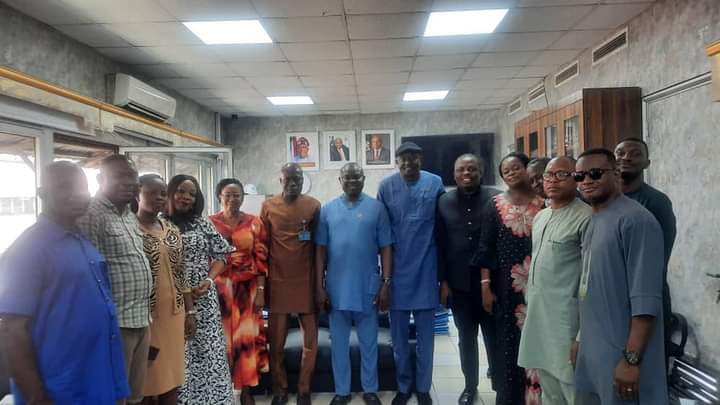
The Rivers State Government has pledged partnership with the Nigerian Institute of Building to check quackery in the building profession as a way of reducing incidents of building collapse in the State.
The Commissioner for Physical Planning and Urban Development, Rt. Hon. Evans Bipi, who made the pledge when a delegation of the Rivers State Chapter of the Nigerian Institute of Building paid him a courtesy visit in his office, said the partnership also aims to promote professionalism and adherence to building standards.
Describing the spate of building collapses in the State as worrisome, Bipi attributed the causes to use of substandard building materials and failure by site engineers to adhere to standards and regulations of the building industry.
The Commissioner said findings by the Ministry also revealed that property owners are complicit in the recent building collapses in the State for prioritizing cost-cutting over safety and quality standards.
He said some property owners hire unqualified site engineers and foist substandard building materials on them to cut corners.
The Commissioner acknowledged that as key stakeholder in the building industry, the Nigerian Institute of Building plays a crucial role in reducing incidents of building collapse in the society by ensuring that only qualified professionals practice in the industry.
He further said the Institute of Building can also contribute through advocacy and public enlightenment on the dangers of building collapse and adherence to safety standards in building sites.
Hon. Bipi assured that the Ministry is poised in partnering with more professional bodies in the industry to curb the menace of building collapse in the State.
He also informed his guests that he has reconstituted the Compliance Committees of the Ministry to effectively monitor building sites across the State and enforce compliance with the building law and regulations of the State as part of measures to address the issue of building collapse.
Earlier in his remarks, the Chairman of the Nigerian Institute of Building, Rivers State Chapter, Mr. Abah Adejoh, suggested that Construction Methodology, Project Quality Management Plan, as well as Project Health and Safety become mandatory requirements for property developers seeking building plan approval from the State Government.
He stated that this will enhance compliance with safety and regulatory standards, while also facilitating accountability in the event of a building collapse.
Mr. Adejoh advised property developers to insist on hiring qualified site engineers or Licensed Builders rather than quack engineers in order not to compromise the structural integrity of their buildings and put lives at risks.
He said, “prioritizing cost-cutting over safety and quality standards is an unwise decision that can lead to far greater losses”.
The Chairman of the Nigerian Institute of Building also asserted that unlike medical negligence, building negligence has far-reaching and devastating consequences including loss of multiple lives, widespread destruction, long-term displacement and psychological trauma, hence the need to hire certified site engineers.
He further stated that to prevent compromise of the structural integrity of buildings, site engineers must insist on maintaining standards and quality, no matter the pressure from property owners to cut costs.
The Permanent Secretary of the Ministry, Surv. Wisdom Hebron, Directors, Town Planners and other Senior Staff of the Ministry of Physical Planning and Urban Development were in attendance at the courtesy visit.
Theresa Frederick & Charity Amiso

Continue Reading


A lecturer at the University of Port Harcourt, Prof. Ibibia Worika, has called for stronger implementation of legal and policy frameworks to address the conflicts and environmental challenges facing the Niger Delta region.
Worika, who is the Director of the University’s Centre for Advanced Law Research, Faculty of Law, made the call during a stakeholders’ workshop held in Port Harcourt, with the theme, “Building Peace in the Fire.”
Worika, a Professor of Comparative Petroleum and International Environmental Law and Policy at the University of Port Harcourt, said the workshop was aimed at promoting dialogue to enhance the utilisation of legal and policy provisions.
He explained that such provisions were designed to combat extractive industry-related conflicts in the Niger Delta region.
In his paper titled “Addressing the Challenges of Hydrocarbon Mining and Related Conflicts: Towards Promoting Rights-Based Actions for Combating Climate Change in Rivers State”, he noted that pollution and environmental degradation in the region were widespread and well documented.
According to him, deliberations at the workshop focused on Nigeria and international legal frameworks that support oil extraction, while safeguarding environmental responsibilities and human rights.
Worika explained that although Nigeria’s Constitution did not expressly provide for enforceable environmental rights, the domesticated African Charter on Human and Peoples’ Rights contained provisions on environmental rights that courts could enforce when necessary.
He urged multinational oil companies operating in the region to comply with established international norms, including the Organisation for Economic Co-operation and Development (OECD) Guidelines and the UN Guiding Principles on Business and Human Rights.
“These companies are largely from OECD member countries. They should internalise biodiversity safety measures and other international standards in their operations in the Niger Delta,” Worika said.
The Professor also urged the Federal Government to establish an environmental remediation trust fund for the Niger Delta, similar to the Hydrocarbon Pollution Remediation Project set up for Ogoniland.
He noted that while one billion dollars had been earmarked over 25 to 30 years for the Ogoni clean-up, other parts of the region suffering similar environmental damage required comparable intervention.
Worika further called for the effective implementation of the Host Community Development Trust provisions under the Petroleum Industry Act (PIA), with minimal political interference and equitable representation of host communities.
He emphasised transparency and accountability in managing the trusts, adding that communities should be fully informed about membership criteria and project implementation processes.
On the remediation of Ogoniland oil pollution, Worika advocated for greater community engagement and inclusiveness in project planning and implementation.
“I would like to see greater community engagement, especially in cases where agencies decide how and where to intervene without adequate consultation with those affected. That is certainly not a good approach”, Worika said.
He stressed that communities most impacted by environmental degradation should be included at the planning and design stages and integrated into the project implementation process.
According to him, while technical aspects may require specialised expertise, local residents can handle less technical tasks such as sand removal and soil excavation, thereby enhancing ownership and empowerment.
Similarly, the President of the Movement for the Survival of Ogoni People (MOSOP), Mr. Olu-Andah Wai-Ogosu, attributed rising youth restiveness and communal conflicts in Ogoni communities to poor mentorship and leadership failures.
“Our youths today are so much in a hurry. They don’t take time to understand issues before taking sides. They are easily swayed by short-term benefits and often fall prey to politicians”, he said.
He added that the crisis in traditional and political leadership had contributed to conflicts in the area.
Wai-Ogosu used the opportunity to urge parents and community leaders to instil discipline and moral values in young people to promote sustainable peace and development in the Niger Delta.
The workshop was organised by the Habitat Protection and Sustainabley Development Initiative, in collaboration with the Centre for Advanced Law Research, Rivers State University.
By: Theresa Frederick & Charity Amiso

The newly appointed Rector of Kenule Beeson Saro-Wiwa Polytechnic, Bori (KENPOLY), Dr. George Chile Wadike, has said he would prioritize the welfare of students by improving the learning environment.
Dr. Wadike, who disclosed this to The Tide during an interview in his office, said his administration would reduce acts of social vices in the Polytechnic and make it more learning friendly.
“We want to ensure that the school environment is more peaceful and friendly to all.
“We also want to curtail the act of social vices, especially cultism experienced in the Polytechnic”, he state.
According to him, under his watch as Rector, he would ensure zero tolerance for social vices on campus.
On the infrastructures, the Rector said his administration would improve in the existing infrastructures in the school to enhance adequate learning.
He also said his administration shall improve electricity supply on campus to enable students read their books and better their academic performance
Kenpoly, Wadike said, would compete globally with its counterparts in all fields of learning.
“I promise to sow the seed of hard work, learning and teaching amongst others in the Polytechnic as a Rector.
“We shall also improve the Polytechnic by working with its Alumni and improve students welfare. That is why we are really here”, he said.
He assured on protection for students of the school in their academic pursuit and urged them to take their academics seriously.
On cultism and other social vices, Dr. Wadike said his administration shall partner with security agencies and the host community to eradicate acts of cultism in the institution
He also appealed to the students to embrace peace and take their academics seriously, rather than indulging in acts that will be inimical to their life.
The Rector further promised to build a cordial working relationship with the host and neighbouring communities, noting that such relationships shall improve the activities of the Polytechnic.
Dr. Wadike, an Accountant, who promised to reposition the image of the Polytechnic globally, said the activities of the Polytechnic would be publicised to the international communities to earn more credibility.
By: Chinedu Wosu

A former Accord Party Governorship candidate in Rivers State, Chief Dumu Lulu-Briggs, has commended President Bola Ahmed Tinibu for his “pragmatic support” for State Police in Nigeria.
Lulu-Briggs lauded the President on Friday during an exclusive chat with Journalists at the Port Harcourt International Airport, Omagwa, in Rivers State.
According to him, State Police will help in reducing criminal activities across the country, saying that the security of life and properities is essential and it is a collective responsibility.
The former Governorship candidate called on governments at all levels to support the State Police in order to make the society crime-free.
He said the State Police would not only reduce crime, but will also boost employments across the country.
Lulu-Briggs also used the medium to applaud President Tinibu for intervening in the face-off between the Executive and Legislative arms of Government in Rivers State.
He expressed happiness that peace has returned to the state, noting that the fued between the two organs of the governments has delayed the speed of developments in the state.
The two-time governorship candidate also expressed optimism that the peace accord will give more rooms for development and also create a better atmosphere for empowerment of the youths and Women.
“Now that peace has returned in the state, there is need to queue behind the peace to be sustained for the overall interest and betterment of all in the State..
“On the political tussle in the state, I thank President Tinibu on the recent reconciliation. Now that the problem has been settled by the aggressive parties, it is the responsibility of the people to embrace peace and work towards the growth of the state and continuous sustainability of developments in the state”, he said.
On 2027 election, the Kalabari-born politician said politics is not a do-or-die affair, and advised both the public and politicians to play politics in accordance with the rules.
“To me, politics is not a do-or-die affair, whoever that wins election is still our brother or sister, the important thing is that let them do the needful, they should develop the area and the people.
“The problem we are having in Nigerian politics is that some of our politicians in positions of trust sometimes abuse the opportunities given to them”, he said.
By: Enoch Epelle