
City Crime
What is a No-Deposit Bonus and How Do You Use It?

In the exciting world of online casinos, players are always on the lookout for advantages, and one of the most enticing offers is the no-deposit bonus. If you’ve ever wondered how to play casino games without risking your own money, this guide is for you.
What Exactly is a No-Deposit Bonus?
A no-deposit bonus is a type of promotional offer that online casinos provide to new or existing players, allowing them to play real-money games without having to make an initial deposit. Think of it as free credit or free spins given by the casino. It’s a fantastic way to experience a casino’s games and services firsthand, completely risk-free.
Unlike welcome bonuses that require you to deposit funds to unlock them, a no-deposit bonus is usually credited to your account simply for signing up or, in some cases, as a reward for loyalty or a special promotion.
Why Do Online Casinos Offer No-Deposit Bonuses?
It might seem counterintuitive for casinos to give away free money, but there are several strategic reasons behind no-deposit bonuses:
-
Attracting New Players: It’s a powerful incentive to get new players to sign up and try out their platform.
-
Showcasing Games: It allows players to sample a variety of games, from slots to table games, without any financial commitment.
-
Building Trust: By offering a risk-free way to play, casinos can build a sense of trust and transparency with potential customers.
-
Marketing Tool: It’s an effective marketing strategy that generates buzz and encourages word-of-mouth referrals.
How to Use a No-Deposit Bonus
Using a no-deposit bonus is generally straightforward, but it’s crucial to understand the associated terms and conditions. Here’s a step-by-step guide:
-
Find a Reputable Online Casino: Start by researching and choosing a licensed and reputable online casino that offers a no-deposit bonus. Look for reviews and check their regulatory status.
-
Register for an Account: You’ll typically need to create a new player account. This usually involves providing some basic personal information.
-
Claim the Bonus: The bonus might be automatically credited to your account upon registration, or you may need to enter a specific bonus code during the sign-up process. Some casinos require you to contact customer support to claim it.
-
Understand the Terms and Conditions (T&Cs): This is the most critical step. Every no-deposit bonus comes with specific terms and conditions. These commonly include:
-
Wagering Requirements: This is the number of times you must bet the bonus amount (or winnings from free spins) before you can withdraw any winnings. For example, a $10 bonus with a 30x wagering requirement means you need to wager $300 before cashing out.
-
Maximum Cashout Limit: Many no-deposit bonuses have a cap on how much you can win and withdraw. For instance, you might only be able to cash out up to $100 from your bonus winnings.
-
Eligible Games: The bonus might only be valid for specific games or game categories (e.g., certain slot machines, but not live dealer games).
-
Time Limits: You usually have a specific period to use the bonus and meet the wagering requirements before it expires.
-
Bet Size Limits: There might be a maximum bet amount you can place while using the bonus funds.
-
-
Start Playing: Once you understand the T&Cs, you can start playing the eligible games. Keep track of your wagering progress.
-
Withdraw Winnings (After Meeting Requirements): If you meet all the wagering requirements and other conditions, you can then request a withdrawal of your winnings, up to the maximum cashout limit.
Is a No-Deposit Bonus Right for You?
Absolutely! A no-deposit bonus is an excellent opportunity for both new and experienced players. It allows you to:
-
Test a Casino Risk-Free: Get a feel for the casino’s interface, game selection, and customer service without spending your own money.
-
Discover New Games: Try out games you might not usually play.
-
Potentially Win Real Money: While subject to T&Cs, there’s a real chance to walk away with some winnings.
While no-deposit bonuses offer a fantastic way to explore online casinos without financial commitment, always remember to read the fine print. Understanding the terms and conditions will help you make the most of this exciting offer and maximize your chances of turning free play into real winnings!
Deneme Bonusu
Canl? Casino
Bahis Siteleri
Deneme bonusu veren siteler
Canl? Casino Siteleri



A former staff of the Rivers State Newspaper Corporation, publisher of The Tide Newspapers, Idongpee Akwaowo Reuben, has been appointed the Acting Registrar/Chief Executive Officer of Chartered Chemists of Nigeria (ICCON) by the Federal Government of Nigeria.
Akwaowo’s appointment follows the expiration of the second tenure of the former Registrar, Chemist Jwalshik Wilford.
According to a letter released from the office of the Minister of State for Health and Social Welfare dated August 5, 2026, the Minister of State for Health and Social Welfare, Dr. Iziaq Adekunle Salako, said the appointment was with immediate effect.
The minister had earlier announced Akwaowo’s appointment during a meeting with the Permanent Secretary, Heads of Departments, and Directors in June 10, 2026 in the Minister’s Conference Room.
He said the appointment was automatic and effective 1st June, 2026 following the satisfactory handover that followed the succession procedure.
The Minister nullified the earlier process put in place for a substantive appointment, citing it as a contravention of the provision of the ICCON Act.
He further directed that the appointment letter be issued without further delay.
The Minister admonished the new ICCON Chief Executive to take charge and ensure that the Institute is on the path of peace and progress to deliver her mandates.
In his response, Akwaowo thanked the the Federal Government for the appointment which, he said, has laid every uncertainty surrounding the leadership of the Institute to rest.
He pledged his unalloyed loyalty to the Federal Government and the Minister and promised to work with his Management Team to align with the policy directives of the Ministry as well as the renewed hope agenda of the Federal Government.
Akwaowo joined ICCON in 2005 as a pioneer staff, rose through the ranks and served in many capacities transcending virtually all the departments in the Institute including HOD, Administration/Accounts & Finance.
Most recently, he served as the pioneer Team Lead and the Registrar/CEO Representative in the National Chemical Personnel Audit excercise to Chemical companies and Chemistry Departments in Tertiary Institutions as part of the Institute’s regulatory mandates.
He has attended several courses and workshops and represented the Institute at various conferences and fora.
Akwaowo is a Chartered Chemist and also a member of a number of professional bodies.
He rose to the rank of Director, Scientific in 2025, and was until his appointment, the Coordinator, Zonal Offices of ICCON.
City Crime
Bayelsa Water Coys Raise Alarm Over Business Threats …Set To Resist Multiple Levies Amid High Production Cost

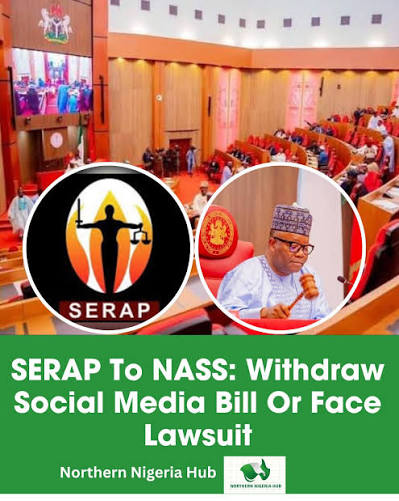
The Socio-Economic Rights and Accountability Project has asked the National Assembly to immediately withdraw the proposed Nigeria Data Protection (Amendment) Bill, 2026, describing it as a backdoor attempt to regulate social media and expand government control over online expression.
SERAP warned that it would institute legal action if the bill is passed in its current or substantially similar form.
The bill, sponsored by Senator Ned Nwoko (APC, Delta North), seeks to compel social media platforms, data controllers and data processors operating in Nigeria to establish physical offices in the country.
It also empowers the Nigeria Data Protection Commission to shut down or prohibit the operations of any entity that fails to comply within 30 days.
In a letter dated July 18, 2026, and addressed to Senate President Godswill Akpabio and Speaker of the House of Representatives Tajudeen Abbas, SERAP said the proposed amendment posed a threat to constitutionally guaranteed rights.
The letter, signed by SERAP Deputy Director Kolawole Oluwadare and issued on Sunday, read in part, “Requirements compelling technology companies to establish local offices would increase government leverage over platforms, facilitate political pressure, make censorship demands easier and expose local employees to retaliation.
“The Bill would create sweeping powers capable of shutting down or excluding social media platforms from the Nigerian market and expose millions of Nigerians to serious violations of their constitutionally and internationally guaranteed human rights.”
SERAP argued that the bill revives previous attempts to regulate social media that attracted widespread public opposition.
“The current Bill revives substantially similar proposals previously introduced by Senator Nwoko, raising renewed concerns that localisation requirements are being used as a vehicle for expanding governmental control over digital platforms and online expression,” it said.
The organisation warned that it would challenge the legislation in court if enacted.
“Should the Bill be enacted into law in its current or substantially similar form, SERAP shall promptly take all appropriate legal actions to challenge its legality in the public interest and to ensure that Nigerians’ fundamental rights are fully protected,” the letter stated.
According to SERAP, the proposed legislation would give the Nigeria Data Protection Commission excessive powers to block digital platforms without adequate procedural safeguards.
“The Bill constitutes a backdoor attempt to regulate social media and increase governmental control over online expression through corporate localisation requirements rather than through transparent and constitutionally permissible regulation,” it said.
The group argued that the bill lacks provisions for prior judicial authorisation, meaningful opportunities for compliance beyond the proposed 30-day period, and safeguards to protect the rights of millions of Nigerians who rely on digital platforms.
SERAP also cited the judgment of the ECOWAS Court of Justice on Nigeria’s suspension of Twitter, arguing that the proposed amendment could produce similar consequences by indirectly excluding social media platforms from operating in the country.
“The Bill also risks recreating the very dangers previously condemned by the ECOWAS Court of Justice. In SERAP and Others v. Federal Republic of Nigeria, the Court held that the suspension of Twitter violated the rights to freedom of expression, access to information and media freedom protected under the African Charter.
“Although the present Bill differs from the Twitter suspension in form, it creates the possibility of achieving the same result indirectly by empowering regulators to prohibit digital platforms from operating in Nigeria.
“The National Assembly should not enact legislation capable of producing, through indirect regulatory means, the very restrictions on fundamental rights that regional human rights law prohibits,” the organisation said.
It maintained that while governments have a legitimate interest in regulating digital platforms, such measures must comply with constitutional guarantees and international human rights standards.
The organisation further warned that mandatory localisation requirements would increase compliance costs for technology companies, startups, educational institutions and artificial intelligence developers.
“The proposed amendment conflicts directly with the objectives of the Nigeria Startup Act 2022 and the National Digital Economy Policy and Strategy.
“Mandatory localisation requirements substantially increase compliance costs, particularly for startups, open-source projects, educational institutions, research organisations, AI developers and smaller technology companies, while reducing Nigeria’s attractiveness as a destination for innovation and investment.
“No major democratic jurisdiction requires every social media platform to establish a physical office as a blanket precondition for providing services.”
SERAP added, “The National Assembly should immediately reject and withdraw the Bill, as it is manifestly incompatible with the Nigerian Constitution and Nigeria’s obligations under the African Charter on Human and Peoples’ Rights and the International Covenant on Civil and Political Rights.”
-

 News2 days ago
RSG Targets Nine Million Residents in Mosquito Net Distribution Campaign
-

 Oil & Energy2 days ago
Aiyedatiwa Signs New Electricity Bill
-

 Oil & Energy2 days ago
NLNG Commissions Research And Innovation Centre In RSU
-

 Maritime2 days ago
Marine Minister Commends President Tinubu On NPERA Bill Assent
-

 News2 days ago
KenPoly Holds Eight Convocations, August 29
-

 News2 days ago
RSG Begins Another Phase of Projects Commissioning Today
-

 News2 days ago
RMAFC Completes Revenue Sharing Review, Proposes New Pay
-

 Maritime2 days ago
NAGAFF Petitions IGP Over Alleged Maritime Police Harassment