
Politics
NSIPA Amendment Bill Scales 2nd Reading In Senate

The National Social In vestment Programme Agency (NSIPA) Amendment Bill, 2023, yesterday, scaled through second reading at the Senate.
This followed the presentation of the lead debate on the general principles of the bill sponsored by the Senate Leader, Sen. Opeyemi Bamidele, at plenary yesterday.
The bill was entitled “National Social Investment Programme Agency (Establishment) Act 2023 (Amendment) Bill, 2023 (163).
Leading the debate, Bamidele moved a motion for the Senate to suspend its rule 78(1) in order to read the bill a second time.
The motion was supported by Senate Minority Whip, Sen. Darlington Nwokocha.
Leading the debate, Bamidele said that the bill was read for the first time yesterday.
He said that the bill sought to amend the National Social Investment Programme Agency Act for proper and effective management and implementation of the National Social Investment Programmes under the President.
Opeyemi said that the NSIP was created in 2016 by the last administration while the National Social Programme Agency Act was enacted in 2023 to address socio-economic inequalities and alleviate poverty among Nigerians.
“It’s expected to address these inequalities through four social support programmes meant to empower the poorest and most vulnerable Nigerians to attain an acceptable standard of living.
“This directly and indirectly have impacted the lives of poor Nigerians through its four cluster programmes namely, the N-POWER Programme, the Government Enterprise and Empowerment Programme (GEEP).
“Others are the National Home Grown School Feeding Programme (NHGSFP) and the Conditional Cash Transfer Programme (CCT),” he said.
Opeyemi said that the bill sought to amend sections 9(3), 14(1), 21(1), 22(1), 26(1) and 33 of the National Social Investment Programme Agency Act.
“This is by transferring the agency from the ministry of Humanitarian Affairs to the Presidency under the direct supervision of the President, C-in-C.
“This amendment is as a result of the commitment of the renewed hope mantra of President Bola Tinubu in ensuring that Social Investment Programme are standard, transparent, effective and accountable structure of delivery.
“With this amendment, a wide range of Sustainable Development Goals (SDGs) including poverty reduction, education, health, social inclusion and empowerment can be achieved through the NSIPA.
“Countries the world over have recognised and deployed similar social support programmes as an effective strategy for poverty reduction, social development and economic growth.
“The passage of this bill will ensure continuity and sustainability of NSIPA as a reliable tool to solve poverty problems in Nigeria and also serve as an enduring legacy of this administration, “ he said.
In his contribution, Sen. Ahmad Lawan (APC-Yobe) said that those who should benefit from the programme were those who could not be reached since the country was talking about social inclusion.
“If the bill is to be passed, we must ensure the capturing of those to benefit and the National Assembly must monitor and participate in the entire process.
“Our relevant committees must be fully involved,” Lawan said.
Sen. Ali Ndume (APC-Borno), said that the role of all stakeholders including lawmakers should be spelt out in the bill.
“They should ensure efficient and effective implementation.”
On his part, the Deputy Senate President, Sen. Jibrin Barau commended the President for the amendment of the law and effort to domicile the programme in the Presidency.
“This is because the President has decided to work toward eradication of poverty and better the lot of ordinary Nigerians.
“So, let’s support the president to do what he wants to do by passing the bill,” he said.
In his remarks, President of the Senate Godswill Akpabio, said that there was need to appraise the implementation of previous social intervention programmes and find ways to improve on it since government was continuous.



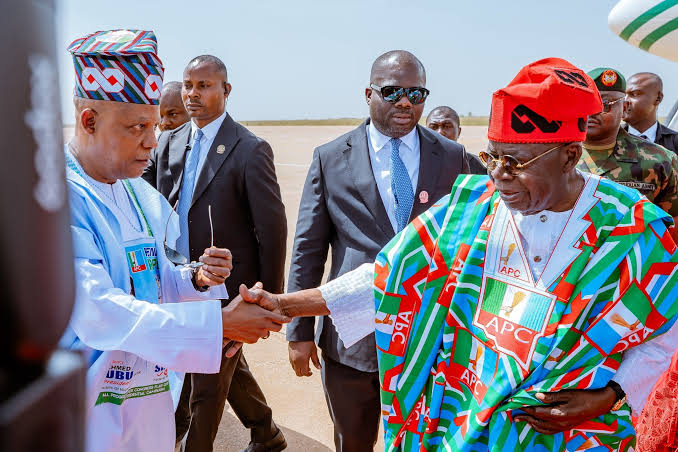
The campaign rally, held at the Kaduna Township Stadium, attracted Vice-President Kashim Shettima, APC governors, party leaders, federal and state lawmakers, political stakeholders and supporters from across the country.
The flag-off marks the beginning of the APC’s drive to secure a second presidential term for President Tinubu, with the party expected to promote its achievements, defend its economic reforms and outline its policy priorities under the proposed Renewed Hope 2.0 agenda.
Kaduna’s selection for the campaign launch underscores the strategic importance of the North-West, a region with a substantial voting population and considerable influence on presidential election outcomes.
The APC faces a significant challenge in Kaduna, where the Peoples Democratic Party’s presidential candidate, Alhaji Atiku Abubakar, defeated President Tinubu in the 2023 election. The rally therefore provides the ruling party an opportunity to strengthen its grassroots structures and regain electoral support in the state.
Addressing supporters, Vice-President Shettima appealed to Northern voters, highlighting President Tinubu’s political relationships with prominent Northern leaders, including Alhaji Abubakar, Mallam Nuhu Ribadu and the late President Muhammadu Buhari.
The Vice-President’s appeal reflects the APC’s determination to consolidate its support in the North as the party intensifies preparations for the presidential contest.
The Renewed Hope 2.0 agenda is expected to feature prominently in the campaign, providing a platform for President Tinubu to explain his administration’s economic policies and outline plans for another term.
However, the President’s record on economic reforms, rising living costs, petrol prices, employment, infrastructure and insecurity is expected to attract considerable scrutiny during the electioneering period.
-
 Education2 days ago
FCE Yola Graduates 3,555 Teachers , Seeks Upgrade to University
-

 Sports2 days ago
Nigerian Trio Target Titles At PFL Africa Finals
-

 Niger Delta2 days ago
Diri Restates Stance On Lagos-Calabar Coastal Highway
-

 Niger Delta2 days ago
C’River, NUJ Pay Tribute To Late Guardian Editor
-

 News2 days ago
NDLEA Recovers Tons Of Illicit Drug Consignments In Nine States
-
 Opinion2 days ago
Checking Voter Apathy In Nigeria’s Electoral Process
-
 Politics2 days ago
2027: DICKSON’S EX-ALLY VOWS TO WORK AGAINST NDC INTEREST IN BAYELSA
-

 Politics2 days ago
2027: GROUP PLEDGES 40,000 SUPPORTERS FOR COALITION CANDIDATES IN RIVERS