
Editorial
Subsidy Removal: Sustaining The Palliatives In Rivers

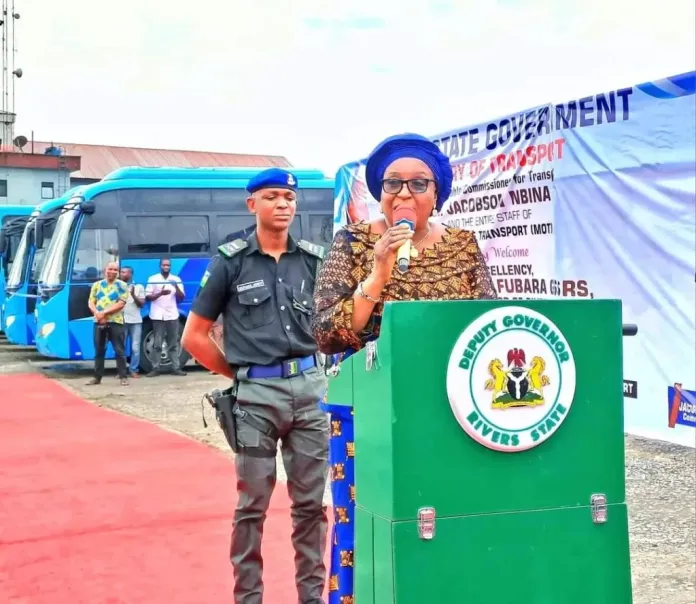
As indigenes and inhabitants of Rivers State grapple with the consequential impacts of the fuel subsidy withdrawal, Governor Siminalayi Fubara has initiated the deployment of 17 high-end buses for intrastate transportation. This measure aims to assuage the pernicious repercussions commuters in the State are currently dealing with following exorbitant fares.
Speaking during the flag-off at the Rivers State Transport Company complex in Port Harcourt, Governor Fubara maintained that the state government, under his watch, was aware of and concerned about the difficulties produced by fuel subsidy eradication. This necessitated the intervention.
Unveiling the buses in Port Harcourt last Tuesday, Fubara, who was represented by his Deputy, Prof. Ngozi Odu, said the buses would convey commuters on designated major routes in the state capital and beyond. He disclosed that the subsidy intervention luxury buses fulfilled a promise he made to organised labour recently.
He declared, “I am indeed very delighted to perform the flag-off ceremony of the Rivers State Government mass transit system. The Rivers State Government is aware and concerned about the economic challenges faced by the populace as a result of the removal of fuel subsidy.
“Consequently, this scheme flagged off today, is a deliberate intervention by the Rivers State Government to mitigate these economic challenges. Therefore, it is a gift given to us, and we must treasure it”.
Shortly after President Bola Tinubu announced the withdrawal of fuel subsidy during his inauguration on May 29, transport fares in Rivers State, specifically within the capital city of Port Harcourt, rose by a 100 per cent and more along many routes. Besides the upsurge in consumer goods prices, many commuters find it difficult to commute to and from work.
The consternation about this intervention is its celerity; how the government brought in the scheme a few weeks after the subsidy withdrawal. There is no other State in Nigeria where this has happened. Kudos to the administration. Many thought the project would take a longer period than expected. It demonstrates how committed and responsive the governor is to the people’s predicament.
The well-conceived and well-received palliative will aid numerous individuals in the State in dealing with subsidy removal’s painful effects. Commuting to work and transporting children to school has become excessively burdensome, which explains why the intervention is broadly welcomed. Even political opponents of the government cannot provide compelling reasons for opposing this meritorious project.
Free bus policy improves mobility for vulnerable segments of society. We strongly urge the state government to maintain substantial support for the Rivers public as Nigeria permanently shifts to the post-fuel subsidy regime. Additional measures should be taken to enhance convenience for the people and foster sustainable economic growth.
In times of national emergency, the government must show its benevolence. The transportation industry plays a significant role in such situations. However, it is implausible for the government to carry the burden alone. Therefore, it is essential to charge a nominal fare for the management and upkeep of these subsidy palliative vehicles.
While the programme is valuable, its sustainability is crucial when assessing its effectiveness and public impact. The government can generate employment opportunities for young individuals through this initiative. A shared concern is that the commuting public must contribute by maintaining orderliness while utilising the free bus service. This is to ensure the government’s vision succeeds.
It is widely acknowledged that rural communities experience critical public transport challenges. Accordingly, it is necessary to implement free buses in such localities, considering the complexities associated with securing funding, the restricted frequency of service, and the lack of accessibility compared to urban public transportation. In essence, this endeavour should not be restricted to urban centres alone.
Choosing the Rivers State Transport Company (RTC) as the location for the launch of the free bus service highlights the necessity of reviving this dormant enterprise. The dire condition of the state-owned transport company has precipitated apprehensions among residents, who are dissatisfied with its prolonged closure. The government’s failure to reopen the RTC has left citizens at the mercy of privately owned transport companies. This has denied many their rightful job opportunities.
Besides serving as a palliative for the less privileged in the State, the long-term goal of this valuable strategy should be to make the state a habitable place where most car owners will not see the need to put their cars on the road during business hours, as they can rely on well-structured and coordinated Rivers bus services to transport them to their desired stations.




Nigeria stands at a critical juncture as the world marked World Press Freedom Day (WPFD) on May 3. This annual observance is a reminder that a free press is central to democratic life, good governance, and public accountability. For Nigeria, it is also a moment for sober reflection on how far the country has come and how far it still has to go in safeguarding the independence of its media.
World Press Freedom Day exists to highlight the fundamental importance of freedom of expression and to honour journalists who risk their lives in pursuit of truth. It underscores the idea that without a free press, societies cannot function transparently, nor can citizens make informed decisions. In countries like Nigeria, where democracy continues to evolve, the observance carries particular urgency.
This year’s theme, “Shaping a Future at Peace: Promoting Press Freedom for Human Rights, Development and Security”, places journalism at the heart of global stability. It emphasises that a peaceful society cannot be built on silence, fear, or manipulated information. Rather, it depends on the free flow of accurate, timely, and independent reporting.
At its core, the theme highlights the role of journalism in fostering accountability, dialogue, and trust. These are not abstract ideals. In Nigeria, where public confidence in institutions is often fragile, the media remains one of the few platforms through which citizens can question authority and demand transparency. When press freedom declines, so too does public trust.
Journalism serves as a foundation for peace, security, and economic recovery. Countries with robust media systems tend to attract greater investment, maintain stronger institutions, and resolve conflicts more effectively. Nigeria’s economic challenges, ranging from inflation to unemployment, require open scrutiny and informed debate, both of which depend on a free press.
However, the issue of information integrity has become increasingly complex in the digital age. Artificial Intelligence (AI) and online platforms have amplified the spread of misinformation and disinformation. In Nigeria, where internet penetration has grown rapidly, false narratives can travel faster than verified facts. This makes the role of credible journalism more vital than ever.
The challenge is not only technological but also ethical. AI-driven manipulation of information threatens to distort public discourse, influence elections, and deepen social divisions. In such an environment, professional journalism must act as a stabilising force, ensuring that truth prevails over sensationalism and propaganda.
Equally troubling is the safety of journalists. Across Nigeria, reporters face growing levels of online harassment, judicial intimidation, and physical threats. Self-censorship is becoming more common, as media practitioners weigh the risks of reporting sensitive issues. This trend undermines the very essence of journalism.
A particularly alarming incident involved a serving minister in the present administration, who openly threatened to shoot a journalist during a televised exchange. Such conduct, broadcast to the public, sends a dangerous signal that hostility towards the press is acceptable. It erodes the norms of democratic engagement and places journalists in harm’s way.
This year’s theme aligns closely with the United Nations Sustainable Development Goal (SDG)16, which promotes peace, justice, and strong institutions. Freedom of expression is a cornerstone of this goal. Without it, institutions weaken, corruption thrives, and justice becomes elusive. Nigeria’s commitment to SDG 16 must therefore include genuine protection for the media.
Historically, the Nigerian press has been a formidable force. From resisting colonial rule to challenging military dictatorships, our journalists have played a central role in shaping the nation’s political landscape. Today, however, that legacy appears to be under strain, as the media operates under what can best be described as a veneer of freedom.
Beneath this facade lies a troubling reality. Journalists are routinely harassed, detained, and prosecuted for performing their constitutional duties. Reports from media watchdogs indicate that dozens of Nigerian journalists face legal threats or arrest each year, often for exposing corruption or criticising those in power.
The Cybercrimes (Prohibition, Prevention, etc.) Act of 2015 has become a focal point of concern. Originally intended to combat cyber threats, it has increasingly been used to silence dissent. Sections 24 and 27(1)(b), in particular, have been invoked to target journalists, bloggers, and social commentators.
Although amendments introduced in February 2024 were meant to safeguard journalists, concerns persist. The law continues to be wielded in ways that stifle investigative reporting and restrict freedom of expression. Legal reforms must go beyond cosmetic changes to address the root causes of misuse.
To safeguard the future of journalism in Nigeria, decisive action is required. The Cybercrimes Act must be revisited to ensure it cannot be weaponised against the press. Law enforcement agencies must operate free from political influence, upholding the rule of law and protecting journalists’ rights. Civil society and international partners must also strengthen independent media through funding, training, and platforms for wider reach.
In this rapidly evolving world shaped by artificial intelligence and digital innovation, Nigeria faces a clear choice. It can either allow press freedom to erode under pressure, or it can champion a truly independent media landscape. The path it chooses will determine not only the future of journalism, but also the strength of its democracy and the peace it seeks to build.
-

 News1 day ago
Court Sentences Seven To Death Over Murder Of Cleric In Rivers
-

 Politics1 day ago
APC PRIMARIES: FUBARA’S WITHDRAWAL, HISTORIC SACRIFICE FOR NATIONAL STABILITY ……. GROUP
-

 Sports1 day ago
PH Arsenal Community Set For Streets Procession, Saturday
-

 News2 days ago
Group Hails Tinubu, Chinda Emergence
-

 Politics1 day ago
IPAC Flays INEC Over Election Guidelines Judgement
-

 Politics1 day ago
NDC To Adopt Electronic Voting For Future Primaries
-

 Sports1 day ago
Stakeholders Laud GTI On NPFL Partnership
-

 Sports1 day ago
NPFL: Rivers United Finishes Second, Secures Continental Ticket