
Agriculture
Livestock Farmers Crucial To Nigeria’s Economic Growth -Technologist

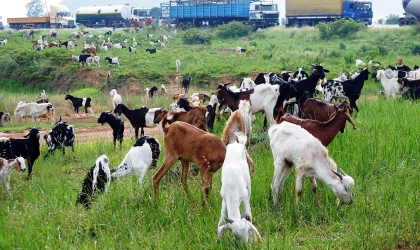
An animal health technologist, Mr Oluleye Odetola, has described livestock farmers in Nigeria as constituting important element in the economic development of the country.
Odetola said this recently in a chat with The Tide source on the sidelines of the 2022 annual retreat of the Nigerian Association of Animal Health and Husbandry Technologists (NAAHHT), Oyo State Chapter, held at National Museum of Unity, Ibadan, the Oyo State capital.
He noted that livestock farmers play major role in the economic development of the country, particularly in employment creation.
“Livestock business create not less than 70 percent employment for the citizens of Nigeria. Because from every phase, be it small, medium or large scale business, having yourself in fold, you will still be coping with the condition of this country economically.
“So, livestock farmers are real people, real citizens as far as Nigeria is concerned. They create jobs, food and they make things easy for others. In summary, livestock farmers deserve to be respected and supported in all ramifications”, he said.
Another animal health technologist, Mr Abiodun Akinboade, while speaking on sales and marketing as it relates to the theme of the retreat, “Animal Health And Production Technologists As Key Players in the MSMEs In Nigeria”, said sales and marketing are the pillars of every compant and that is the area where some people get it wrong.
“When they have product and they do not have the medium to promote and sell the said product. We have a lot of channels companies can explore: there are online media, also ability to market your product through one-on-one communication is anothet critical aspect which can be taken advantage of, he said.
The outgoing Chairman, Nigerian Association of Animal Health and Husbandry Technologists (NAAHHT), Oyo State Chapter, Mr Kazeem Akingboye, said during the one-day retreat, “The theme for this year’s retreat was carefully chosen to mirror our engagements in micro, small and medium scale enterprises in the livestock industry and animal health services of the agricultural sector of our econnomy.”



Federal Government and the Ogun State Government, on Wednesday, distributed farm inputs to farmers as part of effort to address food security challenge.
The State Director, Federal Ministry of Agriculture and Food Security, Dr. Toyin Ayo-Ajayi, during the flag-off ceremony of Inputs Redemption Under The National Agricultural Growth Scheme-Agro Pocket (NAGS-AP), in Ogun State, disclosed that beneficiaries of the gesture were primarily rice, maize and cassava farmers across the State.
Ayo-Ajayi commended the Ogun State Government for partnering with the government at the centre for the effort in supporting farmers with inputs that would bring about yieldings for local consumption and likely exportation.
She noted that government is supporting rice, cassava and maize farmers with inputs worth N212,000; N189,000 and N186,000 respectively.
The Permanent Secretary in the State Ministry of Agriculture, Mrs Kehinde Jokotoye, who represented the Commissioner in the Ministry, Bolu Owotomo, stated that traditional farmers are critical in food production, hence the need to encourage and support them with inputs that would bring about desired results during harvesting.
Owotomo said: “Let us make good use of this opportunity, so that the success of this phase will make farmers benefit more from the state and federal governments of Nigeria.”
Earlier, State Coordinator, Federal Ministry of Agriculture and Food Security, Dr. Oluwatoyin Ayo-Ajayi, appreciated the present administration for partnering with the federal government for the initiative, adding that the programme is designed to support farmers at the grassroots level in cassava, rice and maize with inputs such as, seeds, pesticides, herbicides and fertilizers, to boost their production and enhance their livelihood.