
Politics
Electoral Violence: South-East Stakeholders Demand Adherence To Electoral Act

Some political stakeholders in the South-East have reiterated that effective implementation of the Electoral Act would assist in check-mating electoral violence in the 2023 general elections in the country.
The stakeholders made the call while reacting to a News Agency of Nigeria (NAN) survey on checkmating Electoral Violence ahead of the 2023 General Elections in the country.
Nelson Nwafor, the Executive Director of Foundation for Environmental Rights, Advocacy and Development (FENRAD) in Abia, said that electoral violence was a “serious threat” to the achievement of sustainable democracy in Nigeria.
According to him, the menace has become detrimental to democratic sustainability in Nigerian politics and required swift action toward addressing the issue.
Mr Nwafor said that politicians and the electorate were jointly responsible for the continued occurrence of electoral violence recorded during electioneering periods.
He commended the federal government for the Electoral Act (2022), adding that it would play a vital role in guiding the conduct of the politicians and electorate during the elections.
He charged political parties to ensure that the campaigns of their candidates were issue-based to enable them to build a work plan that would facilitate delivery of democracy dividend to the citizenry.
Mr Nwafor called on relevant agencies to conduct regular sensitisation campaigns on the need for the electorate to be law abiding during the electioneering period.
A teacher, Kingsley Kalu, said he had vowed never to participate in the country’s general elections again because of his experience in 2019.
He said that he almost lost his life while working as an adhoc staff to the Independent National Electoral Commission, as thugs invaded the venue in an attempt to snatch the ballot box.
“If not for the intervention of the police, I would have died as these boys came, descended on me and my colleagues in one of the remote communities in the state during the House of Assembly election,” he said.
He expressed hope in the new Electoral Act, saying that it would curb electoral violence because there would be no snatching of ballot boxes.
In Ebonyi, some analysts have advised politicians across states of the federation to focus on issue based campaigns that could bring development to the nation and desist from causing violence.
They decried the way thuggery had brought a lot of conflicts in the Nigeria political system including ethnicity, religion and tribalism amongst others.
Thamos Ikenna, a lawyer, noted that the issue of thuggery during campaigns and elections started as a result of bad governance. “Failure of political leaders to do the needful in providing gainful employment for the teeming population of youths.
“The youths remained the instruments used by politicians to perpetrate these violent crimes in the country. “These violence are being caused as a result of bad governance, unemployment, poverty, bribery and corruption amongst others,” Mr Ikenna said.
Monday Nkwoagu, Bishop of Anglican Communion, Diocese of Abakaliki, condemned the incessant killings and violence so far experienced in the country ahead of the 2023 general polls.
Mr Nkwoagu tasked politicians on peaceful campaigns and added that violence was not a strategy to win elections.
Also speaking, Professor Benard Odoh, 2023 governorship candidate of the All Progressives Grand Alliance (APGA) in Ebonyi, said that a peaceful campaign could bring security of lives and property for the people.
“It is better to campaign on issues rather than concentrating on destruction of campaign materials and all sorts of violence,” he advised. Mr Odoh stressed the need to implement laws and strengthen them against thuggery and political violence in the country.
He called on youths in particular and colleagues in various political parties to steer clear of the act and focus on issues that could bring development to the state and nation at large.
“Elections should not be seen as war against persons,” Mr Odoh added.
In Anambra, politicians contesting positions during the 2023 general elections are yet to begin campaigns, apparently because only state and national elections would be conducted in the state.
A check by our source showed that most of the candidates were still doing consultations, a month after the Electoral Act as amended had okayed commencement of campaigns for the 2023 elections.
Chukwuma Agufugo, state secretary of the All Progressives Congress (APC) said the party was yet to inaugurate its state chapter of the campaign council.
He said that political activities were still low because the state was not holding a governorship election, but only national and state assembly elections.
“For now, I can say that we are not hearing anything about thuggery and violence and we believe that such problems usually take place towards the end of campaign period,” he said.
Paul-Chuks Umenduka, an Awka-based politician, said the state might not witness incidences of violence during the ongoing political process.
According to Mr Umenduka, my feeling is that most people are enlightened and might not be tricked into political violence as before.
“I see a paradigm shift in the cases of political thuggery and violence in next year’s elections because of two reasons.
“Most Nigerians are aware that the electronic transmission of results from the polling units will make nonsense of snatching of ballot boxes.
“Again the common knowledge among most citizens now that those engaged for thuggery and other dirty political jobs by politicians are now aware of the consequences of engaging in such practices,” he said.
Mr Umenduka, who said that his position was informed by some preliminary findings made in his Aguata area, added that most youths now decline invitations for membership of pressure groups.
He said, before now, the pressure groups formed ahead of every dispensation often turned into recruiting windows for thugs.
He however, urged the Independent National Electoral Commission, the media, civil society organisations to intensify enlightenment on the danger of thuggery and violence during elections.



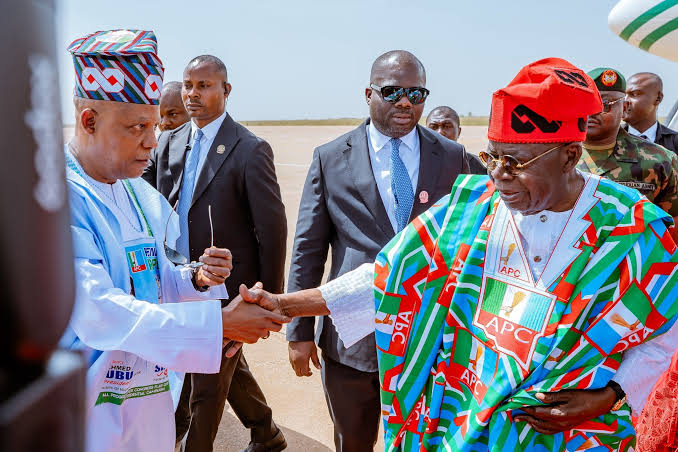
The campaign rally, held at the Kaduna Township Stadium, attracted Vice-President Kashim Shettima, APC governors, party leaders, federal and state lawmakers, political stakeholders and supporters from across the country.
The flag-off marks the beginning of the APC’s drive to secure a second presidential term for President Tinubu, with the party expected to promote its achievements, defend its economic reforms and outline its policy priorities under the proposed Renewed Hope 2.0 agenda.
Kaduna’s selection for the campaign launch underscores the strategic importance of the North-West, a region with a substantial voting population and considerable influence on presidential election outcomes.
The APC faces a significant challenge in Kaduna, where the Peoples Democratic Party’s presidential candidate, Alhaji Atiku Abubakar, defeated President Tinubu in the 2023 election. The rally therefore provides the ruling party an opportunity to strengthen its grassroots structures and regain electoral support in the state.
Addressing supporters, Vice-President Shettima appealed to Northern voters, highlighting President Tinubu’s political relationships with prominent Northern leaders, including Alhaji Abubakar, Mallam Nuhu Ribadu and the late President Muhammadu Buhari.
The Vice-President’s appeal reflects the APC’s determination to consolidate its support in the North as the party intensifies preparations for the presidential contest.
The Renewed Hope 2.0 agenda is expected to feature prominently in the campaign, providing a platform for President Tinubu to explain his administration’s economic policies and outline plans for another term.
However, the President’s record on economic reforms, rising living costs, petrol prices, employment, infrastructure and insecurity is expected to attract considerable scrutiny during the electioneering period.
-

 Niger Delta17 hours ago
Diri Restates Stance On Lagos-Calabar Coastal Highway
-

 Niger Delta17 hours ago
C’River, NUJ Pay Tribute To Late Guardian Editor
-

 News19 hours ago
NDLEA Recovers Tons Of Illicit Drug Consignments In Nine States
-

 Opinion17 hours ago
Checking Voter Apathy In Nigeria’s Electoral Process
-

 Sports14 hours ago
Nigerian Trio Target Titles At PFL Africa Finals
-

 Education15 hours ago
FCE Yola Graduates 3,555 Teachers , Seeks Upgrade to University
-

 Politics15 hours ago
2027: DICKSON’S EX-ALLY VOWS TO WORK AGAINST NDC INTEREST IN BAYELSA
-

 Politics15 hours ago
2027: GROUP PLEDGES 40,000 SUPPORTERS FOR COALITION CANDIDATES IN RIVERS