
Editorial
That Avoidable Tragedy On Onne-Eleme Road

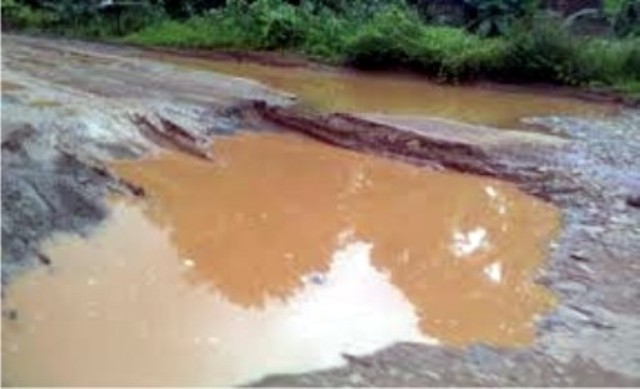
The untimely death of eight people on the Eleme-Onne stretch of the East-West Road is yet a further indication of the Federal Government’s insensitivity to the various plights of Nigerians who ply that road daily. The victims were crushed to death when a tanker loaded with large containers fell on a commercial bus because of the deplorable condition of the road.
Before the unfortunate incident, the road leading to the Port Harcourt Refining Company and other major multinational corporations received so much media publicity, seeking the attention of the Federal Government. The catastrophe attracted many reactions as residents and commuters lamented, wondering how many lives would go down on the road before it would receive the necessary attention. Accidents on that road are a day-to-day occurrence.
A few days after the disaster involving the eight persons, four people reportedly died on the same section of the road when a heavy-duty tanker knocked a Toyota Sienna into a collapsing Aleto bridge with its passengers. The Eleme axis of the East-West Road has remained dilapidated for years, despite several protests by youths and other stakeholders in Ogoni land.
The deplorable state of the road, which is about 15 kilometres, had caused Ogoni youths to stage a ‘mother of all protests last year, shutting down the nasty section for one week. It was later reopened after the protesters extracted commitment from the Federal Government to fix the bad portions. The Ministry of Niger Delta Affairs commissioned Reynolds Construction Company (RCC) to take up the project.
However, soon after RCC mobilised to the site, it pulled out unceremoniously. The then Minister of Niger Delta Affairs, Senator Godswill Akpabio, later clarified that the project, which would cost N85 billion, exceeded what the Ministry of Niger Delta Affairs, could execute, explaining that the Federal Ministry of Works had taken over the project and listed it to be funded from the Federal Infrastructure Development Fund Programme.
The East-West Road is the connecting link between the Niger Delta and other parts of the country. It is believed that the tactical location of the road should ordinarily make it a prime project for execution by the Federal Government. Apart from serving Bayelsa, Rivers, Akwa Ibom, Cross River, Edo, and Delta States where Nigeria’s oil wealth is drilled, the road transverses Ogun and Lagos, the nation’s commercial hub.
But, like most public infrastructure in the country, this road is a virtual death trap, owing to negligence by successive governments. Driving on the road can be agonising. During the rainy season, craters left behind by erosion torment motorists to no end. Some gullies are wide enough to swallow vehicles, leaving owners to groan about the expenses they will incur to repair their vehicles. It could be worse when floods overflow the banks of rivers.
Sadly, that same portion of the East-West Road has become a piece of cake for some unscrupulous government officials. Almost every year, one form of patchwork or the other takes place, sometimes by firms that can hardly boast of modern tools for a road of significance to the socio-economic well-being of the nation. It is difficult to tell why it is so. Is it a case of inter-agency rivalry or duplication of functions to get some private pockets well-lined?
When former President Olusegun Obasanjo awarded the contract for the project in 2006 in the heat of violent agitations by youths of the Niger Delta, there was unending joy and euphoria in the oil-bearing region, as the road held great promises. Beyond its social and economic importance, Obasanjo conceived it as a means to douse the fire of militancy in the oil region. Many years after, feuds still trail the project, despite massive sums sunk into it so far.
But after the former President left office in 2007, stakeholders realised that it was an empty award. The first problem spotted was that the road had no design, and experts said it was impossible to execute any engineering project without a design that would assist in estimating the cost. The next hiccup was that the projected cost of N211 billion was not captured in the 2007 budget. This nullified it since no such contract award could be realistic without a budgetary provision.
Recall that in 2015, Governor Nyesom Wike met with strategic multinational companies, including Intels, Indorama, West Africa Containers Terminal, Port Harcourt Refining Company and the Nigeria Ports Authority operating in the Onne axis on how to rehabilitate the failed road, and they agreed to contribute N3 billion collectively for the task. While the private companies in the axis actually made their contributions, the Federal Government-owned establishments were very slow to fulfil their part of the bargain.
Also, it is on record that the Federal Government, through its agencies, had equally rebuffed efforts of th Rivers State Government to intervene in the rehabilitation of that section of the East-West Road. The result of all these is the now total collapse of the section of the road.
The Federal Government should, through the Ministry of Works and Housing and the Ministry of Niger Delta Affairs, quickly mobilise the contractor handling the road project to the site to fix the entire stretch of the highway. The government should be held vicariously liable and guilty of the deaths of the commuters on the East-West Road. Because of the strategic nature of Onne Port and the place it occupies in boosting Nigeria’s economy, a thinking government would have given it priority attention.
If the federal authorities can expend over N48 billion on pipeline surveillance contracts, there should be no reservations in fixing the entire Ogoni axis of the East-West Road. The demand now is a total reconstruction of the failed section of the expressway and not rehabilitation. Any attempt to rehabilitate it to secure some cheap political points ahead of the 2023 general election should be completely resisted by Rivers’ people.
The road to the Onne seaport is critical to the effective use of the port by investors. Such a road should not be left to the dictates of official bureaucracy. No government worthy of its name would abandon a road that warehouses hundreds of multimillion-dollar foreign and local investments such as are found in the Oil and Gas Free Zone, Onne Eleme Local Government Council to consume the lives of citizens plying that route. This is unacceptable by every civilised standard. We condemn it in no uncertain terms.



-
Maritime1 day ago
Customs Declares War Against Narcotics Baron At Idiroko Border
-
Maritime1 day ago
Nigeria To Pilot Regional Fishing Vessels Register In Gulf Of Guinea —Oyetola
-

 Sports1 day ago
Gombe-Gara Rejects Chelle $130,000 monthly salary
-
Maritime1 day ago
NIMASA,NAF Boost Unmanned Aerial Surveillance For Maritime Security
-
Maritime1 day ago
NIWA Collaborates ICPC TO Strengthen Integrity, Revenue
-

 Sports1 day ago
TEAM RIVERS SET TO WIN 4×400 ” MORROW” …Wins Triple jump Silver
-

 Sports1 day ago
NSC eyes international hosting rights
-

 Sports1 day ago
NPFL Drops To 91st In Global League Rankings