
News
…Resign Now As National Chairman, Clark Tells Ayu

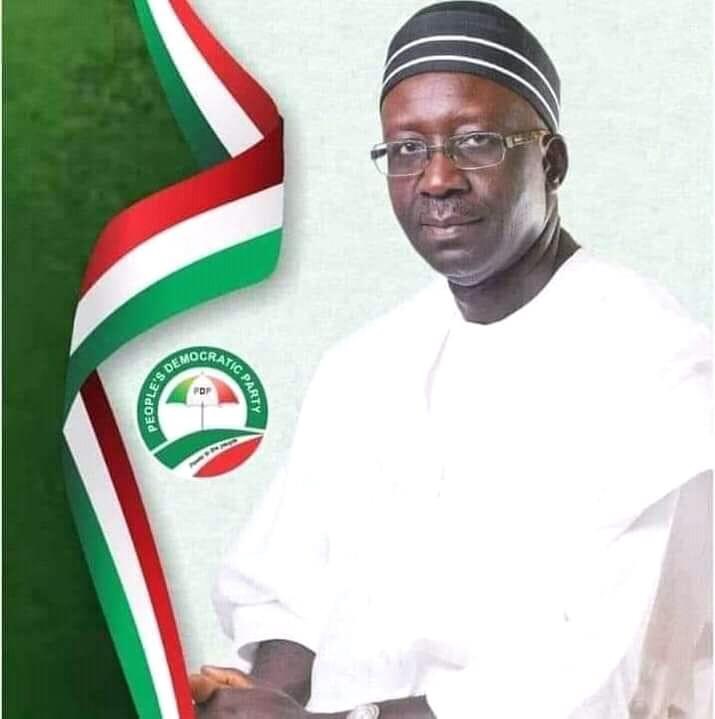
Following the emergence of former Vice President, Atiku Abubakar as the Presidential candidate of the Peoples Democratic Party (PDP) ahead of 2023 elections, former Federal Commissioner for Information and South-South Leader, Chief Edwin Clark, has asked the National Chairman of PDP, Senator Iyorchia Ayu, to, as matter of urgency, resign his position.
In a statement he personally signed, yesterday, Clark, who is also the leader of Southern, Middle Belt Leaders Forum (SMBLF) and Pan-Niger Delta Forum (PANDEF), said that with the outcome of Saturday’s primary election at the Moshood Abiola Stadium, it has become imperative for Ayu to resign as he can no longer head the National Working Committee (NWC) of the PDP.
The elder statesman, who took a swipe at the action of Governor Aminu Tambuwal of Sokoto State, where he stepped down for Atiku Abubakar at the venue of the convention, stressed that what he did was not only dishonourable, but also a serious electoral abnormality and tragic betrayal of national patriotism for hidebound interests.
He argued that Tambuwal, having formally addressed the delegates, as other aspirants did within the time frame given them, would not have been allowed to speak a second time, when delegates were already preparing to cast their votes.
He said that allowing Tambuwal to speak again was a clear violation and abuse of the electoral process, and should not have been allowed to happen.
Clark, however, hailed the efforts of the Convention Committee that was chaired by former President of the Senate, Senator David Mark, and his assistants, particularly, the Governor of Bayelsa State, Senator Douye Diri.
Clark’s statement read, “I decided to issue this Press Release because of the worrying occurrences in our polity vis-a-vis the dappled party primaries being conducted, across the country; the reported outrageous financial inducements of delegates and the cynical dollarisation of the electoral process. These happenings give strong warnings of, more likely, deleterious outcomes of the 2023 General Election, mainly the presidential, and their aftermaths.
“Most disturbing is what happened at the Special National Convention of the Peoples Democratic Party (PDP), in Abuja, on Saturday, May 28, 2022. I followed the live broadcasts of the proceedings, keenly, until about 12.30am on Sunday, the 29th. I was quite impressed by the efforts of the Convention Committee, which was headed by former Senate President, Senator David Mark, and his assistants, particularly, the Governor of Bayelsa State, Senator Douye Diri.
“But, sadly, the outcome of the election leaves much to be desired; it was very unjust and rather unwholesome. It will definitely impact severe, adverse ramifications on the future unity of the country.
“I was alarmed by the outrageous and Machiavelli manner in which AlhajiAminuTambuwal, Governor of Sokoto State, was so apparently ‘arranged’ to announce his withdrawal from the contest, at the last minute; his speech changed the mood of the event. That was done in order to foist another Northerner as the party’s flag-bearer; having regard to the fact that Governor AminuTambuwal was the only aspirant from the whole of the North-West, which had about 192 delegates at the convention.
“What Tambuwal did was not only dishonourable but also a serious electoral abnormality and a tragic betrayal of national patriotism for hidebound interests.
“Another Northern aspirant, Mr Mohammed Hayatu-Deen, a businessman from Borno State, had, earlier, also suddenly, withdrawn from the contest, citing its obscene monetisation as his reason; but we now know better. It is now widespread understanding that there were pressures mounted on Governor Bala Mohammed of Bauchi State, and former Senate President, Senator BukolaSaraki, to also withdraw, while Tambuwal deliberately delayed his action till the last minute. By so doing, unduly swept his North-West votes to AtikuAbubakar.
“One can now appreciate the reasons given by Mr Peter Obi for his withdrawal from the PDP, both as a member, and as an aspirant, few days before the party’s primary. And I would think that what he did was, without doubt, in respect, or obedience, to the position of the Southern and Middle Belt Leaders’ Forum.
“Unfortunately, some aspirants from the South believed that, with the resources and facilities at their disposal, their elders no longer matter, and disregarded, with impunity, the patriotic advice on the need to be steadfast on the position of the zoning of the Presidency to the South. They never minded that what we have been advocating was in their interest. They proved themselves to be selfish and arrogant, and thought they could win on their own steam. They failed; I can only hope that they have, now, learned their lessons.
“Even much worse, in the extreme, was the action of the National Chairman of the Peoples Democratic Party (PDP), Senator IyorchiaAyu, in his open visit to Governor Tambuwal to congratulate and hail him, in his words, as ‘the hero of the convention’. This clearly reveals his partiality and predilection in the processes leading to the baffling conclusion of the PDP presidential primary. His undignified and parochial conduct, to please his Northern principals, is not only a big disgrace to the office he occupies but, also, a sad display of lewd subservience to the political subjugation of one ethnic group, in a diverse country like Nigeria.
“We had earlier suspected that he was in favour of a northern candidate, when on the day of his inauguration as national chairman, last year, he, needlessly, said during his speech, that he would resign if a Northerner emerged as the presidential candidate of the party.
“Senator Ayu has failed to realise that what we are fighting for affects all minorities in Nigeria. The Southern Nigeria relationship with the Middle Belt is well established, dating back to the First Republic, during the period of Dr. J. S. Tarka, from today’s Benue State, a founding member of the then, United Middle Belt Congress, and the strong alliance with Chief ObafemiAwolowo’s Action Group. The relationship subsisted during the Second Republic, when the minorities of the South and the minorities of the North combined to fight for a common course; the inclusion, and full participation of all minorities in the politics and governance of the country, of which I was the leader.
“Senator IyorchiaAyu’s appalling, thoughtless and unpatriotic public conduct bears grave negative consequences. He should, therefore, no longer consider himself fit and proper to retain his position as the national chairman of the Peoples Democratic Party (PDP), and should resign now.”
He had made that commitment while accepting his election, and, therefore, should keep to his pledge to resign if a Northerner emerged from the party.



Rivers State Governor, Sir Siminalayi Fubara, has commended the leadership of the All Progressives Congress (APC) in Rivers State over the outcome of last Saturday’s presidential primary election that saw President Bola Ahmed Tinubu sweeping the poll with a total of 280,082 votes.
Fubara, who served as the State Collation Officer for the primary election, said that while the APC had a total of 297,068 registered members, the number of those accredited for the election was 280,082.
According to him, all those accredited for the election, cast their ballot for Tinubu, leaving Stanley Osifo, his only opponent, with no votes.
Fubara expressed delight at the peaceful and seamless process which he said was as a result of good planning by the party.
“I feel that this process has recorded one of the most organised outings of our great party in recent times. The only reason it came out this way has to do with good planning. In all, I want to say that I’m really impressed with the process.
“So, I can say here that having taken time to go through the figures diligently, I, Siminalayi Fubara, who is standing as the State Collation Officer, hereby certify that the information contained in my own spreadsheet represents the true, correct and accurate record of the summary of results from the 23 LGAs of Rivers State,” he said.
The governor said that while it was evident that President Tinubu defeated his opponent in the primary election in the State, the report would be sent to the APC headquarters in Abuja where the results will be formally declared.

The Federal Government has called for increased private sector participation and donor funding to sustain ongoing gains in the Ogoni environmental restoration project under the Hydrocarbon Pollution Remediation Project.
Speaking at a conference on donor facilitation and diplomatic support for HYPREP in Abuja, yesterday, the Minister of Environment, Balarabe Lawal, stressed that the Ogoni cleanup programme was designed as a long-term intervention requiring sustained funding, technical support, and international cooperation.
“The project is supposed to be a lifespan project. We must move towards achieving its main aim, which is environmental restoration and sustainable development,” he added.
Lawal acknowledged the contributions of the United Nations Environment Programme, describing its assessment as the scientific foundation of the ongoing remediation efforts in Ogoni land.
“We are all here because of that UNEP report. It provided the scientific foundation for what has become one of the world’s most ambitious environmental remediation programmes,” he said.
According to him, hundreds of hectares of hydrocarbon-polluted land have been remediated, while additional sites are currently undergoing cleanup operations.
“We have remediated hundreds of hectares of polluted land, and more sites are still being worked on. Water schemes have also been delivered to affected communities,” he stated.
He added that ecosystem restoration, livelihood support programmes, and healthcare projects were ongoing across affected communities.
“Body health facilities are being constructed, livelihood programmes are empowering thousands, and we are also restoring access to safe drinking water because the first victim of pollution is water,” he said.
The minister also disclosed that the Centre of Excellence for Environmental Restoration was nearing completion, describing it as a major milestone in the project.
“If you go there, you will see one of the biggest edifices being constructed under HYPREP. It will serve as a postgraduate and research institute for environmental remediation,” Lawal said.
Despite the progress, he warned that funding challenges remain a major threat to sustaining the project.
“While substantial progress has been made, the journey is not yet complete. The implementation of UNEP recommendations requires long-term commitment and sustained financial and technical support,” he said.
Lawal therefore, appealed to development partners, donor agencies, international financial institutions, foundations, and private sector players to scale up their support.
“We need your support—financial, technical, scientific, and strategic. No organisation or government can do it alone,” he said.
He further described the Ogoni cleanup as a global model for environmental recovery, climate resilience, and international cooperation.
“The restoration of Ogoni land is not merely a Nigerian undertaking; it is a global model. Its success will show what is possible when governments, communities, and partners work together,” he added.
Also speaking, the Chairman of the Board of Trustees of the Ogoni Trust Fund, Emmanuel Deeyah, said the conference was organised to attract financial, technical, and institutional support for the cleanup exercise.
“We are looking for resources, financial support, expertise, partnership, and collaboration. Government cannot do everything alone,” he said.
Deeyah said the agitation for environmental justice in Ogoni dated back to 1991 when residents drew global attention to the environmental degradation caused by oil exploration activities.
“We farm in Ogoni land and we also fish, but our waters were polluted and the land could no longer support farming activities,” he said.
He explained that the UNEP report recommended that oil companies should contribute $1bn every five years for 30 years to support the remediation programme.
“We have done 10 years now and we have not even received the full $1bn that was supposed to be contributed. The refineries and local operators have not contributed a dime,” he stated.
Last week, the Hydrocarbon Pollution Remediation Project announced the closure of 30 contaminated sites in Ogoniland, Rivers State, while investigations have commenced on 18 high-risk polluted locations in residential communities.

The Inspector-General of Police, Olatunji Disu, yesterday paid a courtesy visit to the Federal Ministry of Works in Abuja as part of efforts to strengthen collaboration on critical infrastructure projects nationwide.
The visit, disclosed in a statement posted on X by the Nigeria Police Force, was attended by the Minister of Works, David Umahi; the Minister of State for Works, Bello Goronyo; and directors of the ministry.
According to the statement, discussions during the meeting centred on ongoing infrastructural projects nationwide, particularly the Lagos-Calabar Coastal Highway and other major road construction initiatives aimed at improving national development and connectivity.
The police chief reportedly reaffirmed the NPF’s commitment to providing security support for the execution of critical national infrastructure projects across the country.
“The Nigeria Police Force will continue to provide adequate security support and deploy necessary operational resources to ensure the smooth execution and protection of critical national infrastructure projects nationwide,” the statement read.
The meeting was also said to have highlighted the need for stronger inter-agency collaboration in protecting public infrastructure from vandalism and other security threats capable of disrupting construction activities.
PUNCH reports that the Federal Government had raised concerns over acts of vandalism along the Lagos-Calabar Coastal Highway corridor, with Umahi warning that the destruction of drainage systems and road infrastructure could threaten the durability of the project.
-

 News10 hours ago
Court Sentences Seven To Death Over Murder Of Cleric In Rivers
-

 Politics8 hours ago
APC PRIMARIES: FUBARA’S WITHDRAWAL, HISTORIC SACRIFICE FOR NATIONAL STABILITY ……. GROUP
-

 News19 hours ago
Group Hails Tinubu, Chinda Emergence
-

 Politics8 hours ago
IPAC Flays INEC Over Election Guidelines Judgement
-

 Comment11 hours ago
Rivers @59: Progress Through Tough Times
-

 Sports8 hours ago
NPFL: Rivers United Finishes Second, Secures Continental Ticket
-

 Politics8 hours ago
NDC To Adopt Electronic Voting For Future Primaries
-

 Sports8 hours ago
Stakeholders Laud GTI On NPFL Partnership