Connect with us

Niger Delta

Diri Berates Govt, Stakeholders Over Dwindling Educational Fortunes

Published

on

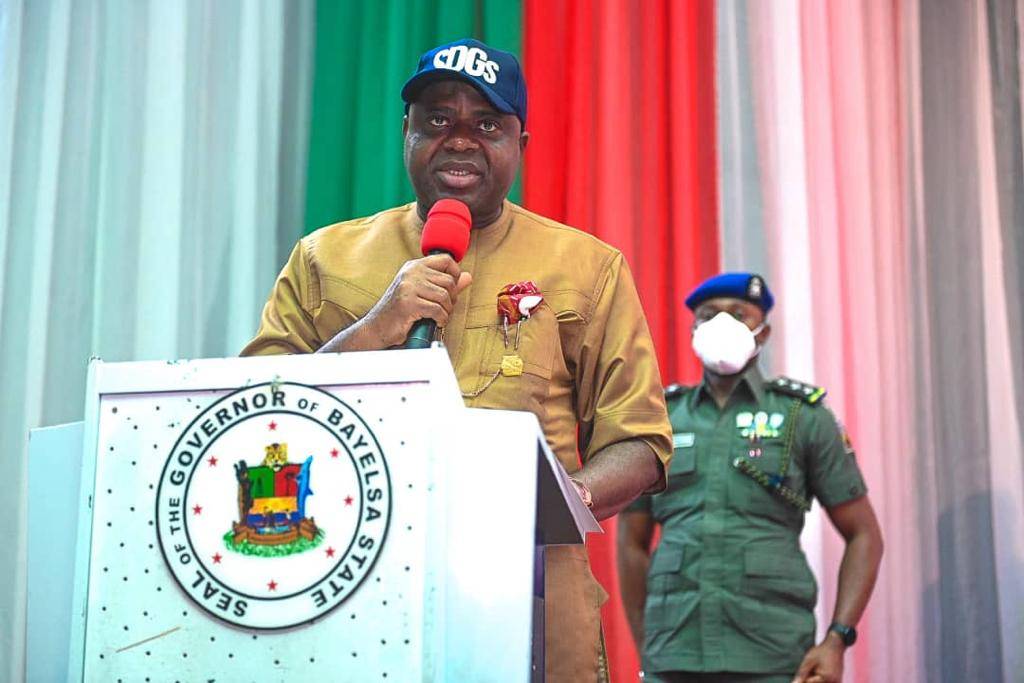
Bayelsa State Governor,Senator Douye Diri, has identified shirking of responsibility by government, teachers and communities as the cause of dwindling fortunes in education in the country.
He stated this at Toru-Orua Community in the Sagbama Council Area of the state yesterday while flagging off the 5th Batch of primary school teachers training programme organised by the State’s Teacher Training, Registration and Certification Board (TTRCB).
Diri, represented by his Deputy, Senator Lawrence Ewhrudjakpo, noted that achieving quality sustainable education is becoming increasingly difficult as key stakeholders are not playing their roles well, berating all tiers of government for paying lip service to measures that are capable of strengthening primary education.
The ‘Miracle’ Governor, who also lambasted teachers, community leaders and other stakeholders for their nonchalant attitude towards education, stressed that the faulty foundation being created at the primary school level was rubbing off negatively on the country. However, he applauded the immediate past administration of former governor Seriake Dickson for laying the foundation for the present administration to build a better educational system in the state.
Underscoring the importance of training and re-training of teachers, Diri pointed out that no Educational system could rise above the quality of its teachers, just as he assured of government’s commitment to funding the training programme.
The Governor advised the teachers to be passionate, humble and determined in the discharge of their duties, bearing in mind that, to a large extent, quality education delivery rests on them.
“No doubt, that our education system is wobbling and tottering because the primary school system has been eroded and destroyed, for three reasons.
“First, the incompetence of those managing it; the lack of government commitment towards education, and the unwillingness of the communities themselves to support the system. So there is a pile of blame to be apportioned to everybody.Government has paid too much lip-service to the primary education system. Commitment of government is more of rhetorics than of practicality; it is more of talk and less of work.
“I want to call on government at all levels across the country to take the issues of primary school more seriously than it is now.
“On their part, our communities have become docile and indifferent to what is happening in the primary schools. They feel what happens in the schools is not their business. It should be your business because the pupils to be trained in the schools are your children and wards”, he said.
“Our communities must take it as a duty that they need to respond to what happens in our primary schools. Communities should be able to recruit ad hoc teachers to support the school system. As teachers you are holding destinies and futures of a lot of people in your hand. You are managing from primary one to six. Those who are responsible always remember their primary school teachers but in these days we can’t remember our primary school teachers because they have conducted themselves in a way that we can’t remember them”, Governor Diri added.
Earlier in her opening remarks, the Executive Chairman of the Teacher Training, Registration and Certification Board, Dr. Stella PeremoboereUgolo, expressed gratitude to the Governor for fully funding the teacher’s training programme.
She also appreciated the Management of the University of Africa, Toru-Orua for making its facilities available for the training exercise, saying the Board was committed to quality assurance in the delivery of Educational services in the state.

By: AriweraIbibo-Howells, Yenagoa

Continue Reading

Niger Delta

MNCH Week Begins Today  … As Consultant Urges Parents To Vaccinate Children, Others

Published

on

The second phase of the Optimised Maternal Newborn Child Health Week (oMNCHW) is billed to hold from today to Thursday, July 12, 2026.
In an interview with the Behavioural Change Consultant for the Rivers State Primary Healthcare Management Board, Sandra James, she disclosed that although the programme is tagged Maternal Newborn Child Health (MNCH) Week, it is not for only children.
“We are looking at everybody. That we tagged  it MNCH does not make it strictly for mother and child. It’s a one-stop-shop, as we usually call it, for mother, children, adolescents, and fathers.
“Everybody can work into a Primary Healthcare facility, because it’s going to be a major facility-based activities: you just work in for your deworming exercise for your children under five; for your sexual gender-based violence services for girls and boys that are sexually assaulted; for Family Planning (FP) for both adolescent and everybody of reproductive age; for free delivery during the week; and for nutrition in which you check the children who are malnourished and you ensure that their nutritional status are improved through counselling, through dispensing of nutritional therapeutic ready-to-eat meal”, she said.
She continued that it also include malaria treatment, and HIV treatment counselling to prevent maternal child transmission. All of these will be available during the one week period of he programme.
She said, “any person that works into our health centres within the period in the 23 local government areas will access the services.
“The Executive Secretary, Dr. Chituru Adiele, has ensured that all the 23 LGAs have their health facilities up  and running to ensure that there is, and will be, a successful maternal health week.”
She adviced parents to access the facilities within the period, saying the services “are not mainly there for mother’s to go and deliver their babies, they are not mainly for immunisation services, they’re not there for antinatal care, they’re not for post-natal services. It’s for everybody.
“That’s your first place of call to ensure that you’re healthy. Per adventure, you go to these health facilities, and anything is beyond them, they have been trained to know when to refer.
“So, please, minimise self-medication, herbal medication, and ensure that you utilise the services of these primary healthcare centres in our communities.”
Speaking on areas currently experiencing diphtheria in Rivers State, the State Immunization Officer, Dr. Joseph Urang, said the focus is on Oyigbo and Agbandele, both in Oyigbo and Obio/Akpor Local Government Areas, respectively.
According him, so far, one case in Oyigbo, and two cases (twins) in Agbandele of clinically diagnosed diphtheria have been identified, with one of them already dead, due to the fact that the twins, who are four years old, are both zero dose, while the single case in Oyigbo (15 years) has however been vaccinated in childhood.
Dr. Urang explained that when the team of health officers moved into both areas, the parents resisted their children being immunised, and only succumbed after much persistence and persuasion by the health team.
Explaining the diphtheria vaccine, he said it is part of he pental vaccines: “what happens is that the World Health Organisation (WHO) has said that at between 3 and 5, the effect actually weans out. That’s why they recommend that when you give your child the vaccine, you have a booster dose at 5, 10, and 15 years.
He said after the booster dose at 15 years, the person will have protection for life.
Diphtheria, he explained, “is a bacteria, and it has strong affinity to the respiratory system. It’s an infection in the respiratory system. It’s all around us, in the air we breadth.
“That’s why it requires continuous vaccination, because once you stop vaccination, it comes back to infect our system. The way we, as humans, are struggling to survive, that’s how these organisms are struggling to survive.”
He urged everybody to avail themselves the opportunity of accessing the available services in health centres close to them.
By: Sogbeba Dokubo
Continue Reading

Niger Delta

Eno Promises To Actualise Ibom Deep Seaport Project

Published

on

Akwa Ibom State Governor, Umo Eno, has reiterated his administration’s commitment towards actualising the Ibom Deep Seaport project
This is contained in a statement by the Information Commissioner, Dr. Aniekan Umanah, in Uyo on Saturday.
The statement disclosed that Eno made the expression at a high-level technical engagement and working session with Africa Global Logistics Group in Paris, France.
According to the statement, the session reviewed the recently submitted technical feasibility report prepared by Worley Parsons.
It also examined the critical pathways for investment, project implementation, and long-term sustainability.
During the engagement, Eno emphasised the need to accelerate project delivery, and called for clear timelines, milestones, and actionable steps for project implementation.
He said the state government was committed to working effectively with other partners to achieve the deep seaport initiative.
He described the project as a landmark blue economy initiative with the potential to position Akwa Ibom as a leading maritime, trade, and logistics hub in the Gulf of Guinea.
Continue Reading

Niger Delta

Group Bothers Over Oil Pollution-Related Health Hazards In Bayelsa 

Published

on

The International Working Group (IWG), a non-governmental organisation on Petroleum Pollution and Just Transition in the Niger Delta, has described as highly traumatizing the impact of oil pollution on the environment and health of the people of Bayelsa State.
The NGO, which is currently carrying out a sensitisation campaign on health hazards associated with oil pollution in the state, disclosed this during a courtesy visit to the State Governor, Douye Diri, in Government House, Yenagoa.
Speaking through its team lead, Professor Engobo Emeseh, the group expressed concern that average life expectancy in the state has reduced significantly, saying that the citizens and others living in the State are forced to live on contaminated land, air and water.
Professor Engobo, who is of the Law Faculty of Aberyswhyth University, UK, clarified that the IWG was focusing advocacy on the health of the people in line with the recommendations of the Bayelsa State Oil and Environmental Commission Report, which was submitted in 2023.
She disclosed that laboratory analysis of blood samples taken from indigenes from across the eight LGAs in the State indicated very high levels of hydrocarbon pollution and carcinogenic metals, causing a sharp increase in mortality and morbid rates in the state.
The academics, who commended the  State Government for being the first subnational government in Nigeria to set up a high-powered Commission on oil and environment, said the Group would continue to partner the state and other relevant organizations to mitigate the negative impact of oil pollution on the health of the people.
“Most of us here were constituted as members of the Bayelsa State Oil and Environment Commission. We gave our report in 2023; first presented at the House of Lords, and also presented to the Bayelsa State Government here in Creek Haven in October 2024, and then presented to the wider public in Abuja.
“In all of this, the Bayelsa State Government had given us the space and the support to provide our expertise and advice on how to deal with the challenge of the scourge of oil pollution in our state.
“My colleagues and I, who were members of the expert working group, were quite traumatized at what we found in Bayelsa State, and we called our report an environmental genocide.
“Based on that, we committed that even though our commission was de-commissioned in November 2024, we were going to carry on with this work”, she added.
In his response, Diri, represented by his Deputy, Dr. Peter Akpe, described the report of the Bayelsa State Oil and Environment Commission as one of the most important documents to guide concerted actions in the mitigation of environmental hazards from oil pollution in the state.
He thanked members of the International Working Group for partnering the State Government by making their expertise available to ongoing efforts towards mitigating the impact of oil pollution on the health of Bayelsans.
While calling on the Federal Government and international organizations to treat the issue of oil pollution in Bayelsa as a special case, he assured the IWG of his administration’s support towards environmental remediation and improved healthcare delivery in the state.
“Your visit is very significant. It is to buttress and consolidate the partnership that began with the Bayelsa Oil and Environment Commission. We are happy that the relationship is matured to this kind of sustained international platform of advocacy.
“We recall the presentation His Excellency, the Governor made, in New York. We travelled from Bayelsa to New York because of the importance we attached to the Commission and all your activities.
“The Commission’s report remains one of our important documents, especially concerning environmental condition of our state and the wider Niger Delta. For us, it is not a closed chapter, it is a living document whose recommendations must continue to guide concrete actions.
“We can’t thank you enough for what you are doing already. We welcome your planned health research, interactions and engagements in the state. And we assure you that we are totally in support and we equally expect to see positive results from your work”, the Governor said.
Members of the six-man IWG delegation include Dr. Kathryn Nwajiaku-Dahou, representing ODI Global UK;  Prof. Michael Watts of University of California; and Dr. Isaac Osuoka of York University, Canada.
Others are Prof. Anna Zalik, also from the York University, Canada, and Dr. Cautlin Strong of the ODI Global, United Kingdom.
By: Ariwera Ibibo-Howells, Yenagoa
Continue Reading

Trending