
Editorial
Military’s Claim And Fight Against Terrorists

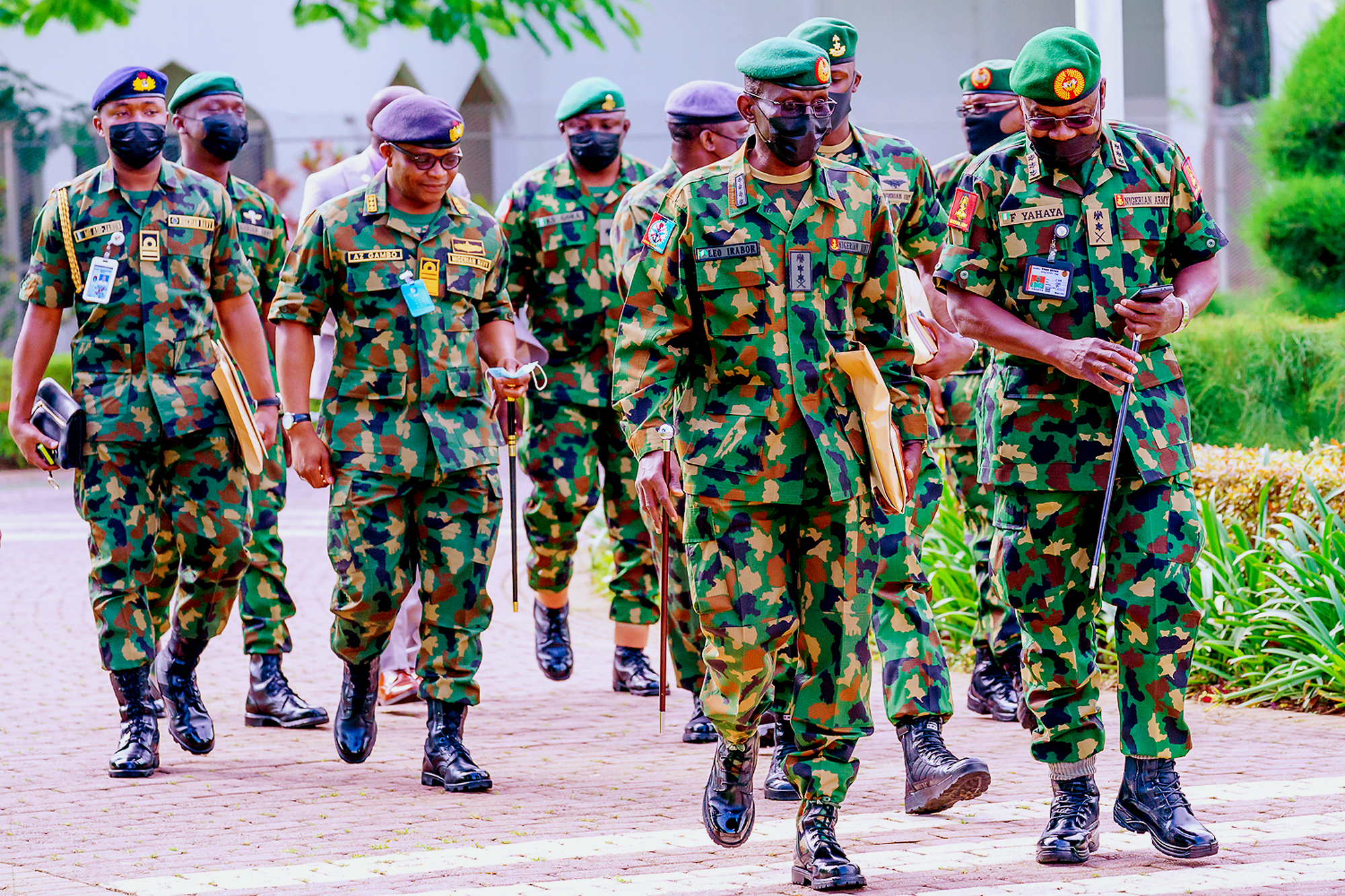
A new assertion by the Defence Headquarters (DHQ) that soldiers on counter-insurgency and other internal security operations across the country killed 1,910 terrorists, bandits and other criminals between May 20, 2021, and January 6, 2022, may have broached more questions than answers. The DHQ further affirmed that soldiers arrested over 700 terrorists, bandits and other criminals and released 729 kidnapped victims from their abductors.
The Acting Director of the Defence Media Organisation (DMO), Major-General Bernard Onyeuko, made this clear in a briefing. He maintained that 24,059 terrorists and their families comprising 5,326 males, 7,550 females and 11,183 children gave in to troops in the North-East within the period under review.
Onyeuko revealed this while providing an update on military operations over the last nine months. He said the blitz against terrorists, bandits, kidnappers and other criminal groups had led to the annihilation of several hide-outs of the criminals, retrieval of copious arms, ammunition, weapons together with gun trucks and devastation of several unlawful refineries in the South-South part of the country.
While it is not in question that the military is doing its best in the anti-insurgency war, the impact of the presumed achievements is yet to be felt by Nigerians. If the military has done so much, why do we still have all kinds of occupied territories? Why are killings and kidnappings by terrorists, bandits and other criminals on the upward turn? Why does the military consistently trumpet their ostensible triumphs against these criminals but stoutly deny reports of army fatalities in incursions?
If the Nigerian government’s rehearsed claims of military conquests over criminal elements, especially insurgents are anything to go by, why does violence persevere in the country’s North-East and North-West? Why have abductions, ambushes, and deadly suicide bombings continued unabated in large proportions? Although military operations have discomfited terrorists’ capacity to hold territories to an extent, Nigerian security forces are drawing back from securing the region’s enormous rural areas from attacks.
In the areas surrounding Lake Chad, the Islamic State of West Africa Province (ISWAP) — which split from Boko Haram in 2016 — seems to have acquired a stronger basis. Hundreds of thousands of civilians are still forced out and living in internally displaced persons (IDP) camps and neighbouring host communities, unable to access their land or return to their villages in diverse parts of the country including Benue State.
President Muhammadu Buhari was first voted into office in 2015 primarily because of the past administration’s inability to defeat the Boko Haram insurgency and end insecurity in the land. Sadly, more than six years into his administration, Nigerians have perceived more attacks from insurgents in more states outside the North-East. Also, banditry, other forms of crime and violence remain humongous challenges in the country.
Recall that seven months into its first term in 2015, Buhari’s administration had invented the phrase that Nigerian militant group, Boko Haram had been “technically defeated” and said Borno was in a “post-conflict stabilisation phase”, in defiance of the continued attacks. This statement rang increasingly hollow for a reasonable length of time. But the group and its by-products have never gone away to date.
Similarly, the immediate past Chief of Army Staff, Tukur Buratai, had said that the Boko Haram terrorist group had since been worsted but the Nigerian military was fighting an international criminal gang known as ISWAP. According to him, Boko Haram had been chased out of the North-East, and the band of international criminal gangs operating under the guise of ISWAP would also be pursued and hunted down. As can be seen, ISWAP and Boko Haram have metamorphosed into even more potent force.
Last year, there had been nearly 100 attacks, according to one estimate. Some military bases and towns, including Geidam and Damasak, a hub for aid workers, were overrun. Hundreds had been killed and weapons carted away, while food and medicines were looted. These and many other happenings confirm that the disparate pronouncements of successes by the military in the anti-insurgency war could be simulated, after all.
That does not, however, suggest that the nation’s military has not been recording victories in the war. Indeed, the armed forces have largely restricted the terror groups to three North-Eastern states of Adamawa, Borno and Yobe. But the terrorists are still able to assail civilian and military targets, killing hundreds of people. A recent spike in lethal violence has led many to wonder what is at the root of the authorities’ failures.
An over-reliance on a military strategy to tackle insurgents is at the essence of the nation’s inability to deal with the danger. That is why, regrettably, almost 11 or 12 years into the counter-insurgency undertaking, we are not observing major attainments. With the latest declaration of bandits as terrorists, Nigerians expect to see reinvigorated actions in that line.
Recently, the Borno State Governor, Professor Babagana Zulum, alerted Nigerians that two local government councils in his state were under the full control of terrorists. This must be viewed seriously. The fact is that to crush insurgency or terrorism, our nation needs more than a military operation. Its root causes have to be recognised and addressed. Lack of good governance that leaves the population poverty-stricken, embittered and uneducated is one extensive root cause.
There are outstanding government initiatives that are meant to speed up development in the North-East, but little advancement has been made. There is also the National Counter-Terrorism Strategy which entails economic development and counter-radicalisation, in addition to the utilisation of troops. But it seems that the strategy is not being fully carried through.
Experts say the endemic hand-to-mouth existence in the country, particularly in the North-East, and the insurgents’ violent approach facilitate the continued recruitment of generation after generation of combatants. People are willingly ready for enlistment just to remain alive. Along with de-radicalisation, there should be a tremendous surge in military action similar to what was seen in Iraq and Syria when the Islamic State group’s so-called caliphate was dismantled.




Nigeria stands at a critical juncture as the world marked World Press Freedom Day (WPFD) on May 3. This annual observance is a reminder that a free press is central to democratic life, good governance, and public accountability. For Nigeria, it is also a moment for sober reflection on how far the country has come and how far it still has to go in safeguarding the independence of its media.
World Press Freedom Day exists to highlight the fundamental importance of freedom of expression and to honour journalists who risk their lives in pursuit of truth. It underscores the idea that without a free press, societies cannot function transparently, nor can citizens make informed decisions. In countries like Nigeria, where democracy continues to evolve, the observance carries particular urgency.
This year’s theme, “Shaping a Future at Peace: Promoting Press Freedom for Human Rights, Development and Security”, places journalism at the heart of global stability. It emphasises that a peaceful society cannot be built on silence, fear, or manipulated information. Rather, it depends on the free flow of accurate, timely, and independent reporting.
At its core, the theme highlights the role of journalism in fostering accountability, dialogue, and trust. These are not abstract ideals. In Nigeria, where public confidence in institutions is often fragile, the media remains one of the few platforms through which citizens can question authority and demand transparency. When press freedom declines, so too does public trust.
Journalism serves as a foundation for peace, security, and economic recovery. Countries with robust media systems tend to attract greater investment, maintain stronger institutions, and resolve conflicts more effectively. Nigeria’s economic challenges, ranging from inflation to unemployment, require open scrutiny and informed debate, both of which depend on a free press.
However, the issue of information integrity has become increasingly complex in the digital age. Artificial Intelligence (AI) and online platforms have amplified the spread of misinformation and disinformation. In Nigeria, where internet penetration has grown rapidly, false narratives can travel faster than verified facts. This makes the role of credible journalism more vital than ever.
The challenge is not only technological but also ethical. AI-driven manipulation of information threatens to distort public discourse, influence elections, and deepen social divisions. In such an environment, professional journalism must act as a stabilising force, ensuring that truth prevails over sensationalism and propaganda.
Equally troubling is the safety of journalists. Across Nigeria, reporters face growing levels of online harassment, judicial intimidation, and physical threats. Self-censorship is becoming more common, as media practitioners weigh the risks of reporting sensitive issues. This trend undermines the very essence of journalism.
A particularly alarming incident involved a serving minister in the present administration, who openly threatened to shoot a journalist during a televised exchange. Such conduct, broadcast to the public, sends a dangerous signal that hostility towards the press is acceptable. It erodes the norms of democratic engagement and places journalists in harm’s way.
This year’s theme aligns closely with the United Nations Sustainable Development Goal (SDG)16, which promotes peace, justice, and strong institutions. Freedom of expression is a cornerstone of this goal. Without it, institutions weaken, corruption thrives, and justice becomes elusive. Nigeria’s commitment to SDG 16 must therefore include genuine protection for the media.
Historically, the Nigerian press has been a formidable force. From resisting colonial rule to challenging military dictatorships, our journalists have played a central role in shaping the nation’s political landscape. Today, however, that legacy appears to be under strain, as the media operates under what can best be described as a veneer of freedom.
Beneath this facade lies a troubling reality. Journalists are routinely harassed, detained, and prosecuted for performing their constitutional duties. Reports from media watchdogs indicate that dozens of Nigerian journalists face legal threats or arrest each year, often for exposing corruption or criticising those in power.
The Cybercrimes (Prohibition, Prevention, etc.) Act of 2015 has become a focal point of concern. Originally intended to combat cyber threats, it has increasingly been used to silence dissent. Sections 24 and 27(1)(b), in particular, have been invoked to target journalists, bloggers, and social commentators.
Although amendments introduced in February 2024 were meant to safeguard journalists, concerns persist. The law continues to be wielded in ways that stifle investigative reporting and restrict freedom of expression. Legal reforms must go beyond cosmetic changes to address the root causes of misuse.
To safeguard the future of journalism in Nigeria, decisive action is required. The Cybercrimes Act must be revisited to ensure it cannot be weaponised against the press. Law enforcement agencies must operate free from political influence, upholding the rule of law and protecting journalists’ rights. Civil society and international partners must also strengthen independent media through funding, training, and platforms for wider reach.
In this rapidly evolving world shaped by artificial intelligence and digital innovation, Nigeria faces a clear choice. It can either allow press freedom to erode under pressure, or it can champion a truly independent media landscape. The path it chooses will determine not only the future of journalism, but also the strength of its democracy and the peace it seeks to build.

-
Rivers15 hours ago
MBA Forex Trial Adjourn To June 3, Amid Bereavement … As Court Declines Cost Application
-

 Featured10 hours ago
WASSCE: RSG Distributes Science Materials To Secondary Schools
-
Business15 hours ago
Customs Impound N2.35bn Cocaine, 15 Trailers of Rice
-
Aviation15 hours ago
Passengers Stranded As Delta Airline From Atlanta Route Back Eight Hours After
-

 Nation5 days ago
Education Commissioner Seeks media Collaboration In Rivers
-

 Nation5 days ago
RSUBE Holds Training For 1,000 New Teachers To Strengthen Basic Education
-
Politics15 hours ago
2027: Bayelsa Senator Gets Critical Endorsement For Second Term
-

 Features16 hours ago
Omerelu’s Historic Milestone … First Female Professor Rekindles Faith in Education