
News
I’ll Never Shut Up, You’ve Failed, Ortom Tells Buhari

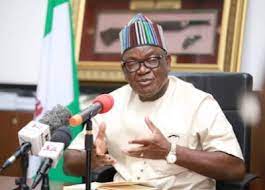
Benue State Governor, Samuel Ortom, yesterday, came hard again on the President MuhammaduBuhari-led Federal Government, accusing it of trying to silence every dissenting voice.
Ortom, who said he would never be cowed, maintained that the All Progressives Congress (APC), government had failed in every indices.
The Benue governor made the assertion in Enugu during an event on organized by the Radio Nigeria chapel of the Nigeria Union of Journalists (NUJ).
He said the government was busy fighting perceived oppositionwhile at the same time looking the other way amid mindless killing and maiming of Nigerians by herdsmen.
Ortom said, “the present administration at the centre has adopted the approach of intimidation of those who dare to voice out their frustrations and concerns over growing insecurity and marginalization.
“But I, Samuel Ortom, will never keep quiet as long as injustice and marginalization prevail in the affairs of our country. I uphold the words of Dr. Martin Luther King Junior when he said and I quote: ‘If peace means accepting second class citizenship, I don’t want it. If peace means keeping my mouth shut in the midst of injustice and evil, I don’t want it. If peace means being complacently adjusted to a deadening status-quo, I don’t want peace. If peace means a willingness to be exploited economically, dominated politically, humiliated and segregated, I don’t want peace.’
Ortom’s full speech read, “It is an honour and delight for me to stand before this august gathering on the invitation of Nigeria Union of Journalists (NUJ), Radio Nigeria, Enugu Chapel, to address you on a very important issue affecting our country.
“I must commend the NUJ, FRCN for also finding me worthy of its esteemed recognition and award. I therefore, bring you warm felicitations and goodwill of the government and people of Benue State.
“This event comes up at a time we face a lot of challenges nationwide. Consequently, the South-East is one of the geo-political zones of this country which have been adversely affected by insecurity in the last couple of years. It is for this reason that the theme for this lecture ‘Emerging Security Situation in the South East: The Place Of Good Governance’ is apt.
“Journalists in this country have been reliable partners with government in ensuring that good governance takes place at the national, state and local government levels. Let me particularly acknowledge the critical role which the Federal Radio Corporation of Nigeria plays in its wide coverage of events with timely, balanced, accurate and objective reports, as well as programmes. This underscores the fact that the Nigerian media has made significant contributions to nation building.
“It is on this note that the current spate of insecurity in different parts of the country places a greater burden on media professionals to do more in assisting security agencies in particular, and the general public with unbiased information that can assist in tackling challenges in this regard.
“The theme of this lecture has posed a serious question on the role of good governance in addressing the security situation in the South-East region. The puzzle that readily comes to mind whenever the issue of security is to be discussed is that of insincerity on the part of the leadership of this country especially at the Federal level. The coercive forces are owned and controlled by the Federal Government and they can deploy the forces whenever and wherever they want.
“It is evident that the Federal Government has chosen to play double standards in its handling of the security situation as it affects some regions especially the South-East, North-Central, South-South and South-West, while at the same time treating with kid gloves, the menace of killer Fulani herdsmen, bandits and other terrorists in the North-East and North-West.
“The speed with which the leader of the Indigenous Peoples of Biafra (IPOB), NnamdiKanu and the Yoruba Nation agitator, Sunday Igboho, were arrested confirmed the fact that the Federal Government has the capacity to tackle insecurity with determination and commitment. We live in a country today where those who demand for equal rights and freedom to end the wave of injustice and marginalization are hurriedly declared terrorists, while real terrorists who invade communities and kill hundreds of innocent people are pampered and given government protection.
“The South-East has been at the receiving end of such levels of injustice, impunity and marginalization. Let me make myself very clear. I am not a supporter of violence in any form, neither am I here to justify the violence being witnessed in parts of the East. This is why I condemn in strong terms, the destruction of Federal Government properties such as INEC offices, attacks on police stations, law enforcement operatives and even traditional rulers. Such attacks and destruction do not make a positive case for freedom fighters and campaigners for justice. Dialogue remains the best option in any dispute. We must however admit that the ongoing agitations by youths of the South-East are as a result of years of neglect, injustice, unfairness and lack of equity by those who have held this country to ransom.
“The lopsided federal appointments, nepotism and other acts of sectionalism, particularly from 2015 to date, have divided Nigeria now more than at any other time in the country’s history. The Federal Character Principle as enshrined in the Constitution has been abused and abandoned by the present administration. This is where leadership has failed Nigerians and good governance has also been relegated to the back seat.
“Eastern Nigeria, like other parts of the country, deserves equal attention with the provision of critical infrastructure and development projects, as well as allocation of resources and key appointments at the federal level. No section of this nation is more Nigerian than another. My definition of democracy is doing what the people want the way they want things done. As leaders, we owe the people who voted us a duty to serve them without prejudice and sentiments on account of region, religion, ethnicity, language and political affiliation.
“The founding fathers of this nation saw a vision for a united Nigeria where the place of someone’s origin should not supersede the quality of what he or she has to offer the country.
“The present administration at the centre has adopted the approach of intimidation of those who dare to voice out their frustrations and concerns over growing insecurity and marginalization. But I, Samuel Ortom, will never keep quiet as long as injustice and marginalization prevail in the affairs of our country. I uphold the words of Dr. Martin Luther King Junior when he said and I quote: ‘If peace means accepting second class citizenship, I don’t want it. If peace means keeping my mouth shut in the midst of injustice and evil, I don’t want it. If peace means being complacently adjusted to a deadening status-quo, I don’t want peace. If peace means a willingness to be exploited economically, dominated politically, humiliated and segregated, I don’t want peace’.
“I want peace that is anchored on equity, fairness and justice.
“The current Presidency is on record to have levelled weighty allegations and criticisms against the Goodluck Jonathan administration.
“They even threatened that if they were not allowed to take over power in 2015, ‘the dog and the baboon would be soaked in blood’.
“As you may recall, they also claimed that the fight against Boko Haram was an attack on the north. Perhaps, that explains why Boko Haram chose the then Presidential candidate of All Progressives Congress as their representative in negotiation with the Jonathan administration.
“These people occupying the Presidency at the moment also blamed the government of Jonathan for falling to tackle insecurity, but today, they are the same people harassing and intimidating Nigerians who speak against their failures.
“The present administration has introduced selective persecution and prosecution of perceived political opponents.
“Its fight against corruption is only targeted at those who hold alternative views. No matter how corrupt someone is said to be, the moment such a person defects to APC, he becomes a saint. That is why some of my colleagues have already joined them. They have been intimidating members of other political parties with EFCC and other anti-corruption agencies. For instance, in Benue State, no day passes without one or more appointees of Government being invited and intimidated by EFCC simply because I have refused to bow to the strings of threats and harassment from Abuja to betray my people.
“Until the Presidency is willing to listen to the voices of patriotic Nigerians and take steps to address the worsening insecurity, excruciating poverty, hunger, unemployment and increasing prices of commodities, the agitations may not go away so soon.
“Our universities and other tertiary institutions keep producing graduates on a yearly basis without commensurate efforts by the Federal Government to create an enabling environment for youths’ engagement and empowerment.
“The World Bank reported a few months ago that seven million Nigerians had plunged below the poverty line due to increase in inflation in the country in 2020. The statement came on the heels of the Presidency’s claim that in the last two years, the present administration lifted 10.5million Nigerians out of poverty. The World Bank had earlier projected that an additional 20million Nigerians could be impoverished by the year 2022.
“Similarly, Statistical Research Department in its January 29, 2021 Report, stated that Jihadist Fulani herdsmen activities in Nigeria from 2015 to 2020, led to the killing of over 7,400 Christians particularly in the Northern region. The Report further indicated that over five million people were displaced and their properties destroyed. Even the South-East, South-South and South-West were not spared.
“Let me start by once again commending the state governments of Southern Nigeria for taking the bold step of enacting open grazing prohibition laws. There is no doubt that livestock production, as currently being carried out contributes significantly to food security and poverty reduction, but not without massive environmental implications like any other economic activity. In Nigeria, open grazing has been the practice of livestock production.
“However, in recent times, livestock production system has led to unwarranted attacks on farmers in all parts of the country. This is due largely to population growth, infrastructural development and increased economic activities and above all, the Fulanisation agenda of Fulani nationalities worldwide who have vowed to make Nigeria their own country exclusively.
“Today, we live in the 21st century and open grazing is extinct in most countries of the world. In Europe, America, Asia and in many countries in Africa, pastoralism has long given way to ranching. How can Nigeria then still be battling with a problem of open grazing of animals has been solved over a century ago in other countries? According to the United States Department of Agriculture, USDA 2021 Report, India with a land mass of 1.2square miles and with the highest number of cattle has about 305,500,000 cattle, representing 30.52% of the world cattle population.
“Brazil with a land mass of 3.3million square miles has the second highest number of livestock of about 252,700,000 cattle representing 25.25%. China with a land mass of 3.7 square miles has about 98,620,000 cattle which represents 9.55%.
“USA with a land mass of 3.6square miles has 93,595,000 cattle representing 9.35%. These are countries that have long abandoned open grazing and adopted ranching as the most sustainable and profitable form of livestock production. There is therefore no justification why Nigeria with just over twenty million cattle and land mass of 923,768square kilometres should not adopt ranching.
“Across the country, open grazing has caused the invasion of farming communities by Fulani herdsmen leading to massive killings, maiming of people, raping of women, destruction of property, loss of livelihoods and displacement of persons. You might have heard that on 20th March, 2021, there was an assassination attempt on me by Fulani militia on my way back from the farm. It took the grace of God for me to survive the attack.
“The group called Fulani Nationality Movement (FUNAM) came out to take responsibility for the attack on me, saying that they narrowly missed their target owing to a technical hitch. Shockingly, the report of the investigation into the attack on me is yet to see the light of day.
“As at today, many states in Nigeria have been affected by the activities of marauding herdsmen. The decision by governors of the Southern states to make laws to ban open grazing is therefore a step in the right direction which deserves to be supported by all good people from all the regions that make up the South. We in Benue State took our stand and rejected open grazing four years ago when I, in the presence of Benue stakeholders, on 22nd May, 2017 signed the Open Grazing Prohibition and Ranches Establishment Law. The law has since recorded tremendous success with more than 400 herders and cattle rustlers arrested with many already tried by competent courts of law and convicted.
“More than 15,000 herds of cattle have been impounded. The law has helped us to expose the evil agenda of Fulani terrorists.
“In my lecture at the University of Nigeria, Nsukka in 2019, I predicted that one day, ranching will be embraced and celebrated in this country the same way June 12 is now being celebrated. That prediction is gradually coming to pass earlier than anyone could have anticipated.
“I am optimistic that the enactment of the law here in the East and other parts of the South followed by full implementation will drastically reduce the herdsmen attacks and guarantee peace and development in various communities of Benue State.
“As you are aware, youth restiveness, herdsmen attacks, banditry and other criminal activities have had negative impact on socio-economic life of the country and are also fuelling ethnic tensions. As I stated earlier, the current secessionist agitations here in the East and elsewhere are a result of injustice and lack of fairness to Nigerians by the current Presidency. This is why there is a growing perception that the Federal Government is encouraging the murderous activities of Fulani herdsmen by its actions and inaction.
From all indications, the public trust in the Presidency has been eroded. This does not speak well for the corporate existence of Nigeria.
“In 2020, the unemployment rate in the country stood at 9.01percent. This year 2021, the unemployment rate in the country is estimated to be at 32.5percent.
“You can now guess where Nigeria will be in terms of unemployment in 2023 when this administration will be leaving office. The question is, what has happened to the promise which those in control of the now government made in 2015 while campaigning that they will provide three million jobs per year? This was one promise that sparked jubilations at campaign rallies prior to the 2015 presidential elections. Sadly, the country has lost more jobs in six years than at any other time in the last few decades.
“If the Presidency had fulfilled its promise to create three million jobs per year, there would have been 12million jobs in four years for Nigerians. On the contrary, the rate of unemployment under this government has risen from 18:8percent in May 2015 to 33.3percent in May, 2021, translating to about 23.2million jobless people.
“Tackling insecurity in the East and other parts of the country has to go hand in hand with job creation and youth empowerment. When youths are gainfully engaged, they have little or no time for agitations and criminal acts.
“The South-East is known for entrepreneurship. If only the Federal Government had supported entrepreneurship development in the region, millions of youths would have been gainfully employed.
“The menace of insecurity in the East and other parts of the country can only be successfully addressed when we all set aside sentiments and confront the monster. I, therefore, urge the federal, state and local governments, traditional rulers, religious groups, civil society organizations, youths and all other stakeholders to support security agencies to perform better. Security is everyone’s business.
“Governments at all levels should take aggressive steps to address the problem of youth unemployment. There must be concerted efforts at job creation and youth empowerment using the private sector to provide employment to young Nigerians. This is one sure way to reducing youth restiveness.
“The Federal Government should urgently put in place the enabling environment for the private sector to thrive, in order to prevent more industries from folding up. Government policies ought to be friendly to boost private sector participation.
“The Federal Government should, as a matter of honesty and urgency, respect the Federal Character Principle to end marginalization and injustice in form of appointments and development projects.
“The Federal Government should also implement the National Livestock Transformation Plan that was adopted by the National Economic Council (NEC). This will not only protect farming communities from attacks and herdsmen from cattle rustling but also lead to environmental protection, security of lives and property as well as guarantee food security. Indeed, ranching will also boost livestock production.
“As I have been saying, the Federal Government should publicly condemn the atrocities perpetrated by armed herdsmen, as well as arrest and prosecute the leadership of Miyetti Allah KautalHore, Fulani Nationality Movement (FUNAM) and other armed herder groups who have consistently admitted to the wanton killings and destruction of communities across the country.
“The Federal Government should proscribe all militant Fulani groups as was done in the case of the Independent People of Biafra (IPOB), given that the Global Terrorism Index ranks Fulani militia as the fourth deadliest terrorist group in the world.
“The Federal Government should urgently convene a national dialogue of all ethnic nationalities to address the concerns being expressed by Nigerians.
“The Presidency should urgently hold a meeting of stakeholders of the entire Eastern Nigeria (devoid of party affiliation), probably here in Enugu to discuss the challenges facing the people which have given rise to youth restiveness and the violence being witnessed across the region.
“The Federal Government should listen to patriotic calls from Nigerians and address the worsening insecurity, injustice, marginalization, poverty, hunger, unemployment and inflation, to be able to end agitations across the country.
“I must also appeal to youths of the Eastern region to uphold peace and the non-violence approach in their agitations. I believe that the non-violence model is a better option, as it has worked in other parts of the world.
“I equally appeal to the youths to cease further destruction of federal government structures in the region. Remember that the property you are destroying is your own property. They have already made a genuine case for restructuring among other meaningful demands and their voices have been heard loud and clear across the country and beyond.
“Let me conclude by once again appreciating NUJ, Radio Nigeria Enugu for this honour. I am grateful that you found me worthy of your award. I also congratulate other awardees on this occasion.
“May this event serve as a pedestal for sober reflection over the future of our dear country. I beseech you all to take a moment and reflect on how to make this country a better place for all. Nigeria is on life support and is running out of oxygen.
“All hands must therefore be on deck irrespective of political, ethnic, religious and cultural differences to ensure the resuscitation of the country”, Ortom added.


The Rivers State Universal Basic Education Board (RSUBE) has trained 1,000 newly recruited teachers with a view to raising standards in public primary and junior secondary schools in the state.
The two-day orientation and capacity building programme held in Port Harcourt introduced the teachers to civil service rules, classroom management practices, and professional conduct expected of educators in the state.
The State Commissioner for Education, Dr. Peters Nwagor, told the newly recruited teachers that teaching demands more than academic qualifications, and called for discipline, diligence, and a strong commitment to service.
He described teaching as a noble profession that is central to the development of the state.
The recruitment, he said, reflects the government’s investment in children and long-term development.
“Education is the foundation of societal progress, and basic education is where that foundation is laid,” Nwagor stated.
He urged the teachers to shape the values and character of pupils during their most formative years.
He pledged continued support from the Ministry of Education through training, resources, and an environment that allows teachers to perform effectively.
Nwagor directed RSUBEB to reject transfer requests from rural to urban schools, saying the newly employed teachers have an obligation to serve where they are posted and help strengthen education in those communities.
In his opening remarks, the RSUBEB Chairman, Hon. Sam Oge, explained that the recruitment process began in 2023 under the previous board, adding that after assuming office, he consulted widely and secured Governor Siminalayi Fubara’s approval to complete the exercise.
Oge said the selection was competitive, with 1,000 candidates chosen from more than 5,000 applicants, and urged the teachers to treat the opportunity seriously and avoid lobbying for reposting.
He directed the teachers to resume at their assigned schools immediately, saying request for reposting will not be entertained.
The former RSUBEB Chairman, Ven. Dr. Fyneface Akah, who delivered the keynote address, described the orientation as the teachers’ formal entry into the civil service.
He urged them to be creative, purposeful, and open to learning on the job.
Akah stressed that teachers have a role in restoring values lost to moral decline, and urged them to model national values and see their work as a calling with lasting impact on the society.
He thanked the State Government for approving the recruitment, noting that the exercise will improve access to quality basic education across the State.
Akujobi Amadi

The Independent National Electoral Commission (INEC) has disclosed that no fewer than 1.4 million members of the National Youth Service Corps will be deployed for the 2027 general elections.
The Chairman of the commission, Prof Joash Amupitan (SAN), made this known on Monday during a courtesy visit to the Director-General of the NYSC, Brig Gen Olakunle Nafiu, at the Yakubu Gowon House, headquarters of the scheme, in Abuja.
Amupitan, in a statement signed by his Chief Press Secretary and Media Adviser, Adedayo Oketola, described the meeting with the NYSC senior management team as more than a formal courtesy visit, saying it was also a mission of gratitude.
According to him, the NYSC remains a critical pillar in Nigeria’s democratic process.
He noted that corps members had participated in virtually every election cycle since 1999, stressing that, “INEC cannot conduct elections in Nigeria without the NYSC.
“As the Chairman of the Independent National Electoral Commission, I am honoured to discuss our collaborative efforts toward ensuring seamless and credible elections in Nigeria.
“You provide the heartbeat of our field operations. When we speak of election manpower, we are essentially speaking of corps members.
“They are the most dedicated, educated and patriotic election duty staff we have, and their presence at polling units brings a level of neutrality and public confidence that is irreplaceable.
“They form the backbone of our election processes, especially as ad hoc staff, whose dedication, discipline and patriotism are critical to the success of our elections,” he added.
Amupitan said institutional data from the 2023 general election showed the importance of the partnership between INEC and the NYSC.
He explained that INEC deployed about 1.2 million ad hoc staff for the 2023 elections, with over 70 per cent, nearly 850,000 personnel drawn from corps members and student volunteers.
Speaking on preparations for the 2027 elections, the INEC chairman said more than 1.4 million ad hoc staff would be engaged, with corps members making up the majority.
“For the 2027 general election, we will require 707,384 ad hoc staff for the Presidential and National Assembly elections scheduled for January 16, 2027.
“The same number will be needed for the governorship and Houses of Assembly elections on February 6, 2027, making a total of 1,414,768,” he said.
He added that INEC would also require 52,446 corps members for the Ekiti and Osun governorship elections, as well as by-elections in Nasarawa, Enugu, Rivers, Ondo, Kebbi and Kano states.
Amupitan said corps members accounted for nearly 90 per cent of Registration Area Officers and Presiding Officers in many states during previous elections.
“These young Nigerians did not just facilitate voting; they protected the sanctity of the ballot in 176,846 polling units across some of the most difficult terrains in the country,” he said.
He further praised the corps members for their role in off-cycle elections, particularly the Anambra governorship election and the FCT Area Council polls.
According to him, their digital proficiency contributed significantly to the seamless operation of the Bimodal Voter Accreditation System.
“In those exercises, it was the digital proficiency of corps members that ensured the seamless performance of our BVAS, proving they are the tech-savvy backbone of our modern democracy,” he added.
Amupitan acknowledged the sacrifices made by corps members during elections and assured that INEC would continue to work with the NYSC and security agencies to strengthen safety measures and welfare packages for them.
As the 2027 general election approaches, we are committed to ensuring adequate mobilisation and preparedness of NYSC members for this important national assignment,” he said.
He also noted that the Ekiti and Osun governorship elections, scheduled for June 20 and August 15, respectively, alongside several by-elections, would serve as tests for innovations ahead of the 2027 elections.
Responding, Brig. Gen. Nafiu thanked INEC for its continued collaboration with the scheme.
He recalled that the Memorandum of Understanding between both organisations was signed in 2011 and had been periodically renewed.
Nafiu described corps members as credible, reliable and easily trainable manpower.
“The last batch of millennials will soon exit the scheme, leaving behind Gen Z corps members known for their digital savviness, which will benefit INEC,” he said.
He assured the commission of the NYSC’s continued support in both the 2027 general elections and upcoming off-cycle elections.
-

 Featured4 days ago
WASSCE: RSG Distributes Science Materials To Secondary Schools
-
News4 days ago
Xenophobic Attacks: Nigerian Lives More Important Than Foreign Investment – Oshiomhole
-
Rivers5 days ago
MBA Forex Trial Adjourn To June 3, Amid Bereavement … As Court Declines Cost Application
-
News4 days ago
ActionAid Demands Probe Of Govs Using Public Funds For Campaign
-
Aviation5 days ago
Passengers Stranded As Delta Airline From Atlanta Route Back Eight Hours After
-
Business5 days ago
Customs Impound N2.35bn Cocaine, 15 Trailers of Rice
-
Politics4 days ago
2027: Bayelsa Senator Gets Critical Endorsement For Second Term
-

 Politics4 days ago
INEC Sets Rivers South-East Senatorial By-Election For June 20