
Featured
Insecurity, Prevailing In Nigeria, Buhari, Lawan Admit … Boko Haram’s Continued Existence, Surprising, Says Buhari …As Senate Vows To Give Effect To Community Policing

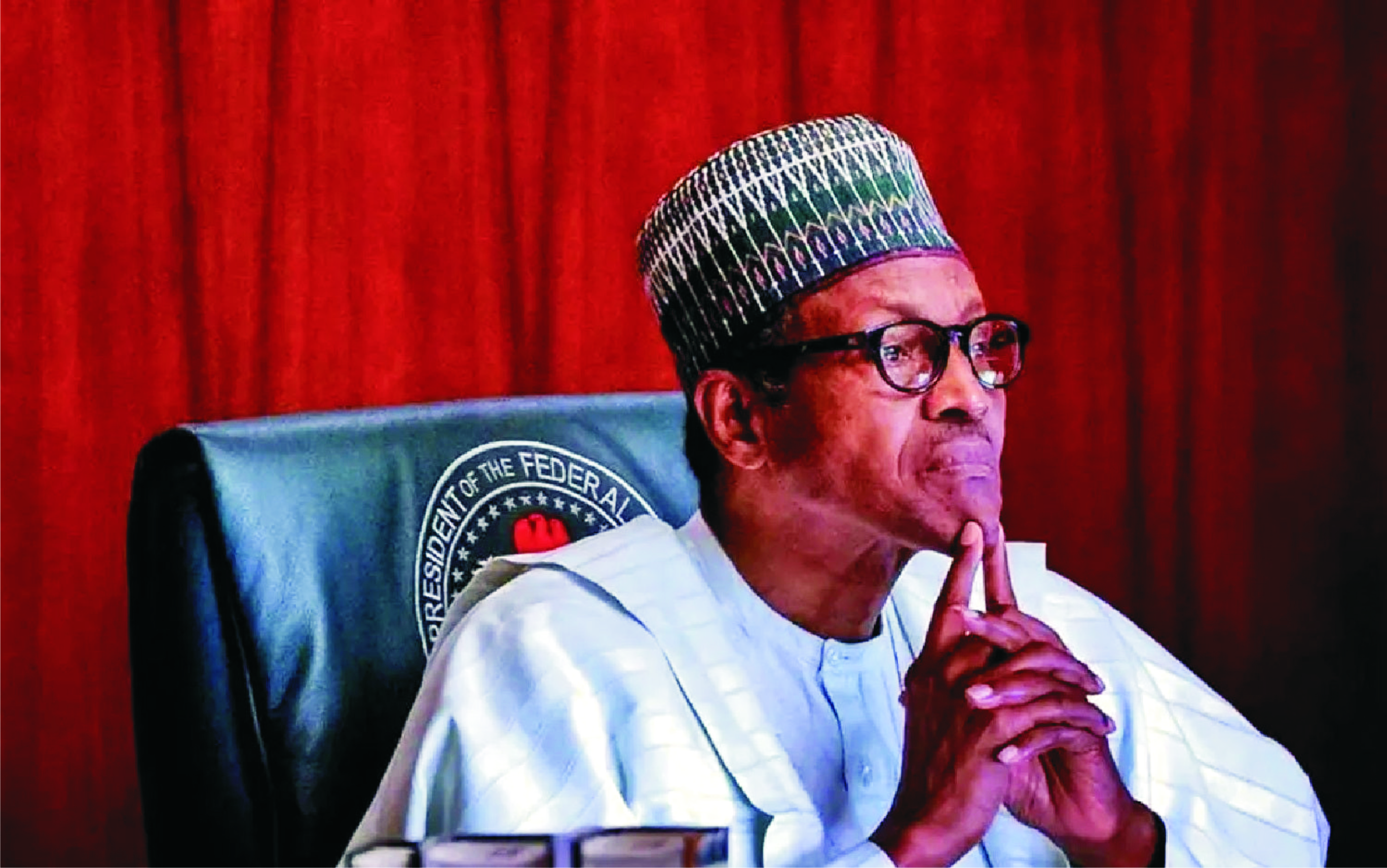
President Muhammadu Buhari says “harder times’’ await bandits whose disruptive activities have brought sorrow to Nigerians, kept many away from their means of livelihood, and heightened insecurity in parts of the country.
The President stated this when he received a delegation of Eminent and Respected Citizens of Niger State led by Governor Abubakar Sani Bello in State House, Abuja, yesterday.
Buhari maintained that the activities of the bandits had forced many to abandon their farms and homes, adding: “we will now be harder on them.
“I was taken aback by what is happening in the North-West and other parts of the country. During our campaigns, we knew about the Boko Haram. What is coming now is surprising.
“It is not ethnicity or religion; rather it is one evil plan against the country.
“We have to be harder on them. One of the responsibilities of government is to provide security. If we don’t secure the country, we will not be able to manage the economy properly.’’
He said the onslaught of the bandits had also affected agricultural output in some parts of the country, in spite of the favourable weather for farming, because many farmers were attacked, and others had to stay away for safety.
The President said the poverty level in the country would be significantly controlled by diversifying into agriculture, instead of the heavy reliance on oil, urging more Nigerians to take up agriculture.
Buhari said discovery of oil and gas reserves in Chad Basin, Benue trough and Bida, and some parts of Bauchi and Gombe, would further bolster current efforts to strengthen the Nigerian economy.
He advised leaders in the Niger Delta to “counsel those who blow up pipelines, resulting in spillages that affect farming and farmlands’’, noting that the loss had always been collective, sometimes, and turning hard working farmers to victims.
The eminent and respected persons said they needed to show appreciation to the President for his many interventions on infrastructure, security and appointment of indigenes of the state into key positions of government.
Speaking for the group, the former governor of Niger State, Aliyu Babangida, said activities of bandits had rendered many homeless, while others could no longer go the farms, thanking the President for taking a more decisive action by directing aerial protection by the military.
Babangida called on the President to intervene in completion of some federal roads, like the Mokwa-Birnin Gwari-Kaduna road and Kotongora road.
He also asked for more attention on the Minna airport, which should complement access to the FCT.
In his remarks, the Etsu Nupe, Alhaji Yahaya Abubakar, assured the President of continuous support, praying: “May God give you strength and wisdom to handle the affairs of our great country, Nigeria.’’
Meanwhile, the Senate President, Dr Ahmad Lawan, stated this in his speech to welcome senators from the Christmas and New Year recess.
He reiterated that the security situation in the country required serious attention and due consideration by the Senate, and indeed, the National Assembly.
He said that the Senate would engage the executive arm of government to discuss the implementation of the recently launched National Security Strategy (NSS) 2019.
He added that for a long time major stakeholders in the security of the country and police authorities appeared to achieve consensus on the necessity of introduction of Community Policing in the country.
Lawan said: “Recently, the security in the country had deteriorated and the attendant loss of lives is not acceptable.
“We need to secure the lives and property of our citizens, as enshrined in our Constitution.
“We all are witnesses to how our economy is also affected by the inclement security situation. Therefore, we need to speedily seek for solutions to fix the security problem bedevilling our dear country.
“There is urgent need for paradigm shift and reform of the architecture and structure of our security systems.
“Equally important is the citizen participation, and collaboration in providing security. In this regard, the Senate will engage the Executive arm of government to discuss the implementation of the recently launched National Security Strategy (NSS) 2019.
“For a long time, major stakeholders in the security of our nation and police authorities appear to achieve consensus on the necessity of introduction of Community Policing in the country.
“The Senate is going to pursue the implementation of community policing vigorously.
“To this end, the police authorities will be invited to brief and update the Senate on the progress made so far.”
Lawan stated that pursuant to the Legislative Agenda of the Ninth Senate, the next six months, like the first six months, will be a busy and engaging period to address the challenges facing the oil and gas sector as well as the nation’s electoral system.
He added that the National Assembly needed to start work on the Petroleum Industry Bill (PIB) immediately.
“The previous attempts in the sixth, seventh and eighth assembly sessions to pass the bills failed.
“This Senate should learn from the mistakes that militated against the successful passage of the bills.
“We need to break the jinx. We must avoid the pitfalls that worked against the passage of the previous bills,” Lawan said.
According to him, the Petroleum Industry Bill when passed will encourage investments into the oil and gas sector.
He said: “The International Oil Companies (IOCs) have deferred investments in the industry largely due to two decades of fiscal uncertainties occasioned by various failed attempts to deliver on the petroleum industry legislations that practically subsisted since 1967 and disputes associated with fiscal clarity of the 1993 Production Sharing Contracts.
“It is, therefore, imperative to speedily deliver on the reforms in the oil and gas sector to spur economic growth and prosperity for our people.
“It is my belief that when the petroleum industry governance and fiscal laws are delivered, economic uncertainties will be eliminated and conducive environment for exploration and production of oil and gas will be emplaced.”
He said that it is imperative that the National Assembly starts work to effect amendments in those areas of the nation’s electoral processes and procedures that posed some real challenges to free, fair and credible elections in previous elections, and insisted that for elections to express the will of the electorate, “they must be free and fair.”
Lawan said: “The Senate will consult widely with stakeholders to ensure that any legislative intervention reflects the necessary step to reforming the electoral environment.”
He recalled that before the Senate went on recess, it held roundtable discussions on the power, agriculture and solid minerals sectors with the view to identifying the challenges militating against the optimum performance by those sectors.
The Senate president said: “The reports of the discussions are ready and will be presented to the Senate by the appropriate committees.
“The reports will be debated in plenary and necessary resolutions will be taken.
“Ultimately, there will be shared responsibilities between the Legislature and the Executive on the way forward to address the various bottlenecks.”
He stated that it is an incontrovertible fact that the power sector cannot function optimally and thrive under the current circumstances.
He lamented that the anticipated outcome of improvement in effectiveness and efficiency of the privatization process has not been achieved, and doesn’t look feasible.
“Therefore, we have to take all necessary steps to salvage this indispensable sector.
“The ensuing debate on the report of the Roundtable Discussions will no doubt reveal the actions that the Federal Government will need to take,” Lawan said.
He also lamented that the solid minerals sector was neglected after the discovery of oil.
Lawan noted that though there have been attempts to revamp the sector, “it is yet to make any meaningful contribution to our economy.”
He added: “Today, the solid minerals sector accounts for only about 0.3% of our Gross Domestic Product.
“It is obvious that we need to take a holistic look into the challenges in the sector. It has also been reported that, presently, about 80% of mining operators fall into the category of artisanal and small-scale miners.
“This deserves our attention, to ensure inclusion, effective and efficient operations by those involved.”
The Senate President also reminded his colleagues that agriculture played an important and leading role in the nation’s economy before the discovery of oil.
He said: “Prior to the discovery of oil in Nigeria, agriculture was the mainstay of our economy.
“Agriculture was then the highest earner of foreign exchange for the country and Nigeria was also largely self-sufficient in food production.
“However, with the discovery of oil, the lure of petro-dollars turned the focus of the country from agriculture.
“Despite the present efforts of the Federal Government to enhance the performance of the agricultural sector, there is still much to be done to make the sector perform optimally.
“No doubt, the agricultural sector is critical for the diversification of the economy of Nigeria, as we can create jobs, create wealth, earn foreign exchange and ensure food security.
“We therefore, should ensure the restoration of the viability of this sector in order to utilize the abundant potentials and opportunities it offers.
“The challenges and work before us are enormous and indeed urgent.
“But, we have demonstrated patriotism, commitment, capacity and willingness in our previous handling of similar challenges.
“We can, therefore, equally tackle these issues with the same dispatch and commitment.”
However, the immediate past deputy president of the Senate, Chief Ike Ekweremadu, will soon reintroduce a bill for the creation of state police.
The Media Adviser to the Senator, Mr. Uche Anichukwu, stated this on Political Platform, a RayPower Radio programme, monitored in Abuja, yesterday morning.
Anichukwu said although the Bill, which Ekweremadu sponsored along with about 74 other members of the Senate Committee on Constitution Review in the 8th National Assembly could not progress beyond the first reading, there have been calls for the Bill to be reintroduced in the 9th Assembly.
Anichukwu said, “The senator has been receiving calls from across the country on the need to reintroduce the State Police Bill.
“I think the security realities in the country now are very clear and even among his colleagues, the popular opinion is that the bill should be reintroduced immediately.
“As a matter of fact, I just spoke with the Distinguished Senator this morning and he said plans were underway to reintroduce the bill along with his colleagues. It is an idea which time has come,” he said.
On how the bill would address the concerns over funding, possible abuse, among others, Anichukwu explained the bill would likely place funding for each State Police Service on the first line charge.
He also said that the funds could be channelled directly to them through the National Police Service Commission so as to make them financially independent of the state governors.
He said, “Regarding the worry that some states may not have the resources to pay state police personnel, it is important to note that it shall not be compulsory on any state to establish a state police.
“Just as the case of state universities, those who have the resources can start, while others who cannot will continue to rely on federal universities, in this case, federal police.
“First, the idea is to model the issue of policing after what we have in the National Judicial Council.
“The federal police will be responsible for the maintenance of public security, preservation of public order and security of persons and property throughout the federation.
“The governor may give lawful directive to the commissioner of police with respect to the maintenance and securing of public safety and public order as he may consider necessary.
“The commissioner is also empowered by the bill to request that matter be referred to the State Police Service Commission for review if he feels that the directive is unlawful or contradicts general policing standards or practice.
“In such circumstances, the decision of the State Police Service Commission shall be final and shall not be inquired into by any court.
“Again, a governor cannot just wake and sack a commissioner of police of his or her state.
“The commissioner shall only be removed by the governor upon the recommendation of the National Police Service Commission praying that he be so removed on grounds of misconduct in the performance of his official duties, serious breach of policing standards, among others.”
Meanwhile, against the backdrop of the planned implementation of the Federal Government’s community policing vision, the Police management team, led by the Inspector General of Police, Mohammed Adamu and the DIGs, yesterday, met with the chairman and commissioners of the Police Service Commission for several hours.
The meeting which held at the headquarters of the PSC at Federal Secretariat, brainstormed on the modalities for the employment of a total of 40, 000 personnel drawn from the 774 local government areas and the communities therein.
It was gathered that the meeting followed an unconfirmed communication which some states were brandishing as authorization to commence the recruitment of Police Constables for State Police Commands.
A senior source said that while he cannot discountenance that such communication exists, he is aware that many state police commands are not aware of such a directive including the Police Service Commission.
In driving the community policing vision, Adamu had during a meeting with the police hierarchy at Force Headquarters recently emphasized that tackling the mounting insecurity in the country, grassroots policing is the way to go.
He said, “In order to give full effect to our Community Policing Vision as a pathway towards bridging security gaps, we shall soon commence the implementation of the strategy across all the zones of the country.
“Hopefully, the breakdown of the Community Policing deployment plan will cover the recruitment of a total of forty thousand (40,000) Community Police Officers (CPOs) across the country.
“The CPOs will be recruited from within the communities where the prospective applicants reside and an average of 50 CPOs are to be engaged in each of the 774 local government areas.
“In addition, 1,300 CPOs will be drawn from professional bodies like the academics, road transport unions, artisans, traders associations, religious bodies, women unions, and youth organisations, among others, in order to ensure diverse representation.
Continuing he said, “In relation to the South-West, the CPOs shall be deployed to complement the police in law enforcement functions within their localities by performing low-risk and non-sensitive policing functions.
“They will also act as liaisons between the police and their communities.
“This policing architecture will free up conventional police personnel that hitherto perform such functions and enhance our manpower profile in relation to deployment to frontline operational duties in the South-West and across the country.
“When fully implemented, the Community Policing Strategy will bridge the gap between the police and the citizens in a manner that will enhance optimal, cost-effective, and sustainable law enforcement service delivery by the police.
He explained that the Community Policing concept involves engagement of citizens in identifying and prioritizing prevalent communal security threats as the effect their localities and working together with the police towards developing and implementing solutions.
“In giving effect to this, we are drawing on the Provisions of the Police Act in relation to the recruitment and utilisation of Special Constables who in this instance, will be engaged as Community Policing Officers (CPOs) under the coordination of the Nigeria Police towards evolving a community-focused policing architecture,” he said.
It was learnt that a clear picture on how the 40, 000 Community Policing Officers will be issued after the meetings between the Police High Command and the Police Service Commission arrive at workable modalities.



Rivers State Governor, Sir Siminalayi Fubara, has charged the newly appointed Secretary to the State Government (SSG) and Chief of Staff (CoS) to carry out their duties with discipline, loyalty and a firm commitment to the success of the administration and the wellbeing of the people of Rivers State.
The governor warned that any involvement in unauthorised nocturnal meetings or any conduct capable of embarrassing the government will attract immediate dismissal.
Fubara gave the warning yesterday shortly after the newly appointed Secretary to the State Government (SSG), Dr Dagogo S.A. Wokoma and the new Chief of Staff (CoS), Barrister Sunny Ewule, were sworn in at the Executive Council Chambers of Government House, Port Harcourt.
As part of the ceremony, the Chief Registrar of the State High Court, David Ihua-Maduenyi administered the Oath of Allegiance and Oath of Office on the duo before the governor gave his charge.
Addressing the appointees, Fubara reminded them that their elevation to the new positions was a call to service and not a platform for political grandstanding or the pursuit of personal ambition.
He stressed that their foremost responsibility should be to themselves and to the people of Rivers State, stressing that their conduct must always reflect integrity, restraint and dedication to public good.
Speaking directly to Dr. Wokoma, whom he described as an accomplished academic and mathematician, the governor expressed confidence in his intellectual depth and capacity to deliver on the new assignment.
The office of the Secretary to the State Government, Fubara stressed, demands thoroughness, discipline and a deep sense of responsibility. He charged the SSG to represent the State with honour at all times.
“Your duty includes representing the state government. You need to represent us in a way and manner that will bring honour to us.
“What is important to this administration is to see that the good works that we started and the ones that we met, are concluded in a way that will bring progress and development to our dear state,” he stated.
Turning to the new Chief of Staff, the governor explained that he is expected to ensure smooth administrative coordination, managing official engagements effectively and safeguarding the image of the Government House.
He underscored the sensitive and personal nature of the role and emphasised that the position operates strictly under the authority of the governor.
Fubara stressed that the role does not permit independent political engagements or private strategy meetings without his knowledge and consent.
“Let me sound it here very clearly. Your duty is to make sure that you handle the administrative duties and image making roles perfectly well, liaising with whoever is coming for any official assignment here.
“If you involve yourself in nocturnal meetings and all those things, I will sack you. I’m very serious. What is important to me today is peace, progress and prosperity of this state. I’m not going to compromise anything for it,” he said.
The governor cautioned that involvement of the new appointees in any action capable of bringing the government or his office to disrepute would attract appropriate sanctions.
While congratulating the new appointees, Fubara expressed optimism that they would justify the confidence reposed in them.
He called on all public officials to work together in unity, observing that collective success is stronger and more enduring than individual achievement.
The governor who also addressed the Permanent Secretaries present at the ceremony, directed those of them who have reached retirement age to start preparing their handover notes without delay.
The notice, he said, was not intended to scare anybody but to prepare their minds towards the inevitability of exiting the service one day and to pave way for an orderly transition.
He warned against any attempt to engage in financial misconduct or last-minute irregularities, stressing that he was closely monitoring the system to ensure strict enforcement of accountability rules.

Rivers State Governor, Sir Siminialayi Fubara, has dissolved the State Executive Council.
The governor announced the cabinet dissolution yesterday in a statement titled ‘Government Special Announcement’, signed by his new Chief Press Secretary, Onwuka Nzeshi.
Governor Fubara directed all Commissioners and Special Advisers to hand over to the Permanent Secretaries or the most Senior officers in their Ministries with immediate effect.
He thanked the outgoing members of the State Executive Council for their service and wished them the best in their future endeavours.
The three-paragraph special announcement read, “His Excellency, Sir Siminalayi Fubara, GSSRS, Governor of Rivers State, has dissolved the State Executive Council.
“His Excellency, the Governor, has therefore directed all Commissioners and Special Advisers to hand over to the Permanent Secretaries or the most Senior officers in their Ministries with immediate effect.
“His Excellency further expresses his deepest appreciation to the outgoing members of the Executive Council wishing them the best in their future endeavours.”
The Independent National Electoral Commission (INEC) yesterday told the National Assembly that it requires N873.78bn to conduct the 2027 general elections, even as it seeks N171bn to fund its operations in the 2026 fiscal year.
INEC Chairman, Prof Joash Amupitan, made the disclosure while presenting the commission’s 2026 budget proposal and the projected cost for the 2027 general elections before the National Assembly Joint Committee on Electoral Matters in Abuja.
According to Amupitan, the N873.78bn election budget covers the full conduct of national polls in 2027.
An additional N171bn is needed to support INEC’s routine activities in 2026, including bye-elections and off-season elections, the commission stated.
The INEC boss said the proposed election budget does not include a fresh request from the National Youth Service Corps seeking increased allowances for corps members engaged as ad-hoc staff during elections.
He explained that, although the details of specific line items were not exhaustively presented, the almost N1tn election budget is structured across five major components.
“N379.75bn is for operational costs, N92.32bn for administrative costs, N209.21bn for technological costs, N154.91bn for election capital costs and N42.61bn for miscellaneous expenses,” Amupitan said.
The INEC chief noted that the budget was prepared “in line with Section 3(3) of the Electoral Act 2022, which mandates the Commission to prepare its election budget at least one year before the general election.”
On the 2026 fiscal year, Amupitan disclosed that the Ministry of Finance provided an envelope of N140bn, stressing, however, that “INEC is proposing a total expenditure of N171bn.”
The breakdown includes N109bn for personnel costs, N18.7bn for overheads, N42.63bn for election-related activities and N1.4bn for capital expenditure.
He argued that the envelope budgeting system is not suitable for the Commission’s operations, noting that INEC’s activities often require urgent and flexible funding.
Amupitan also identified the lack of a dedicated communications network as a major operational challenge, adding that if the commission develops its own network infrastructure, Nigerians would be in a better position to hold it accountable for any technical glitches.
Speaking at the session, Senator Adams Oshiomhole (APC, Edo North) said external agencies should not dictate the budgeting framework for INEC, given the unique and sensitive nature of its mandate.
He advocated that the envelope budgeting model should be set aside.
He urged the National Assembly to work with INEC’s financial proposal to avoid future instances of possible underfunding.
In the same vein, a member of the House of Representatives from Edo State, Billy Osawaru, called for INEC’s budget to be placed on first-line charge as provided in the Constitution, with funds released in full and on time to enable the Commission to plan early enough for the 2027 general election.
The Joint Committee approved a motion recommending the one-time release of the Commission’s annual budget.
The committee also said it would consider the NYSC’s request for about N32bn to increase allowances for corps members to N125,000 each when engaged for election duties.
The Chairman of the Senate Committee on INEC, Senator Simon Along, assured that the National Assembly would work closely with the Commission to ensure it receives the necessary support for the successful conduct of the 2027 general elections.
Similarly, the Chairman of the House Committee on Electoral Matters, Bayo Balogun, also pledged legislative support, warning INEC to be careful about promises it might be unable to keep.
He recalled that during the 2023 general election, INEC made strong assurances about uploading results to the INEC Result Viewing portal, creating the impression that results could be monitored in real time.
“iREV was not even in the Electoral Act; it was only in INEC regulations. So, be careful how you make promises,” Balogun warned.
The N873.78bn proposed by INEC for next year’s general election is a significant increase from the N313.4bn released to the Commission by the Federal Government for the conduct of the 2023 general election.
-
Politics5 days ago
2027: NIGERIANS FAULT INEC ON DIGITAL MEMBERSHIP REGISTER DIRECTIVE
-
Politics5 days ago
LP Crisis: Ex-NWC Member Dumps Dumps Abure Faction
-

 Politics5 days ago
Umahi Dismisses Allegations On Social Media, Insists On Projects Delivery
-
Politics5 days ago
NATASHA ELECTRIC VEHICLES INITIATIVE IN KOGI CENTRAL
-

 Sports5 days ago
Abia Not Sure To Secure continental Ticket
-
Politics5 days ago
IT’S A LIE, G-5 GOVS DIDN’T WIN ELECTION FOR TINUBU – SOWUNMI
-
Sports5 days ago
La Liga: Yamal Records First Career Hat-trick
-

 Sports5 days ago
PSG Extend Lead In Ligue 1