
Oil & Energy
Refineries Post N114.3bn Loss In 11 Months


Nigeria’s refineries posted a cumulative loss of N114.3 billion in the first 11 months of 2018, latest industry data have revealed.
Figures obtained from the Nigerian National Petroleum Corporation (NNPC) on Friday in Abuja showed that the Kaduna Refining and Petrochemical Company, Port Harcourt Refining Company and Warri Refining and Petrochemical Company made losses in the months under review.
The KRPC made a deficit of N31.62 billion, PHRC recorded N44.2 billion loss, while WRPC lost N38.5 billion. The losses were from January to November 2018.
Further analysis of figures received from the national oil firm showed that the expenses incurred by the refineries were higher than the revenue they generated during the specified period.
Among the three refineries, it was observed that Kaduna refinery earned the lowest revenue of N3.1 billion, while its expenses in the same period was put at N34.73 billion.
Port Harcourt refinery garnered a revenue of N140.82 billion while its expenses for the 11-month period was N185.03 billion.
For Warri refinery, it spent N178.3 billion higher than its total revenue of N140.23 billion.
Figures from the NNPC also showed the budgeted revenue, expense and surplus that were expected from the refineries during the period.
The corporation’s budget for Kaduna refinery, in terms of revenue, was N294.8bn, while an expense of N265.2bn was also budgeted, leaving a surplus of N29.55bn.
This, however, did not happen as budgeted.
For Port Harcourt refinery, the NNPC expected a revenue of N441.43bn, an expense of N377.2 billion and a surplus of N64.25 billion. This also did not manifest in the actual figures from the refinery during the 11 months.
Similarly, for the Warri refinery, the expected revenue was N348.1 billion with an expense of N305.82 billion and a surplus of N42.3bn. But just like the first two refineries, the Warri refinery could not also meet the projections.
Nigeria’s refineries have been performing below standard over time, a development that made the government to search for international financiers to revamp the facilities, although this move had yet to succeed.



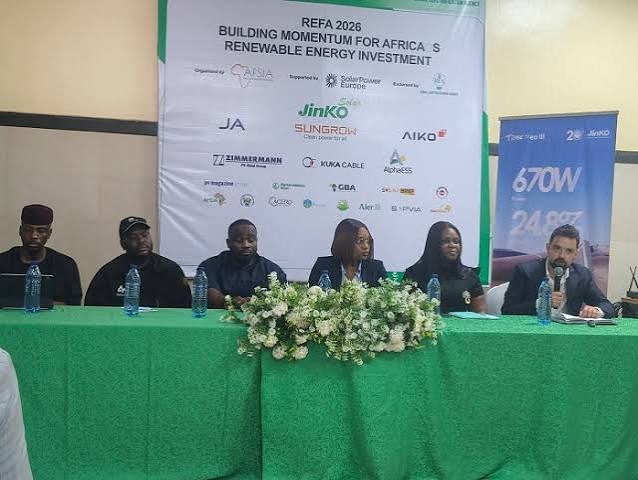
Nigeria’s growing solar market will take centre stage as the Renewable Energy Forum Africa (REFA) 2026 holds in Lagos on November 25-26 with the backing of the Rural Electrification Agency (REA).
Organised by the Africa Solar Industry Association (AFSIA) and supported by SolarPower Europe, the forum would bring together investors, developers, regulators, utilities and policymakers at the Radisson Blu Anchorage Hotel, Victoria Island.
The agency said the forum would strengthen partnerships, attract investment and support Nigeria’s clean energy and local manufacturing ambitions.
REA Managing Director, Abba Abubakar Aliyu, is billed to deliver the keynote address at the opening plenary.
The country also leads the continent in mini-grid capacity with 132MWp, while its commercial and industrial (C&I) solar capacity stands at 385MWp.
The market is receiving fresh support through the $750m World Bank-backed Distributed Access through Renewable Energy Scale-up (DARES) programme, targeting 1,350 mini-grids and electricity access for 17.5 million Nigerians.


-
Rivers3 days ago
Don Seeks Repositioning Of Tech Education For Dev
-

 Education3 days ago
PAMO MEDICAL UNIVERSITY -Nullifies Arrest warrant on VC
-
Niger Delta3 days ago
PANDEF Seeks 50% Oil Derivation Allocation Increase
-

 Education3 days ago
IAUE MOVES TO END GHOST WORKERS SYNDROME AS 400 NEW NON-TEACHING STAFF UNDERGO MANDATORY ETHICS TRAINING
-

 News3 days ago
Fresh Ebola Scare As NCDC Records Two Cases
-
News3 days ago
Customs Partners EFCC, NDLEA, Others To Tackle Money Laundering, Terrorism Financing
-

 Politics3 days ago
2027: South-East Govs Insist On Tinubu’s Re-election
-

 Politics3 days ago
2027: RIVERS GUBER CANDIDATES SIGN CHARTER TO PRIORITIZE CITIZENS’ DEMANDS