
Business
FG Reviews Trade, Investment Policies

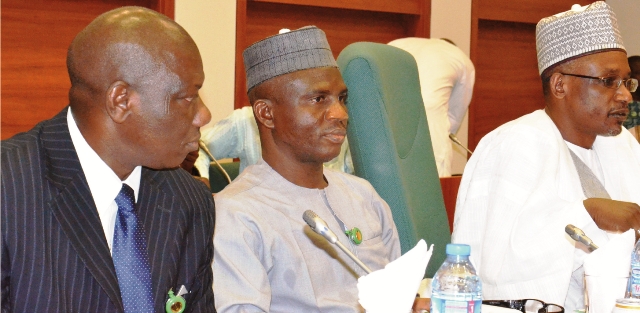
Federal Government is reviewing trade and investment policies to create an enabling environment for businesses to thrive.
The Permanent Secretary, Federal Ministry of Industry, Trade and Investment, Mr Aminu Aliyu-Bisalla, said this at an interactive forum with captains of industries in Lagos yesterday.
Aliya-Bisalla said President Muhammad Burahi – led administration was planning to implement Nigeria Industrial Revolution Plan, Nigeria Enterprise Development Programme, Harmonization of Quality Infrastructure and Certification.
He said government had also partnered with organised private sector to ensure a successful review of the policies.
“The government is desirous of addressing these initiatives and programmes, including reforms in the power sector and the review of trade, industry and investment policies.
He said the ministry would also ensure the ease of doing business in Nigeria.
“All these policies are geared towards stimulating socio-economic development in the country,” Aliyu-Bisalla said.
The permanent secretary added that the government was aware of the challenges facing the commercial and industrial sector ranging from transport to inability to access loan at single digit.
He said that the economic diversification agenda of the government would not be achieved without the organised private sector.
The minister, Dr Okechukwu Enelamah, at the forum, said the administration would partner with the private sector to operate objectively.
Enelamah said to further drive this policy, the Federal Government had set up an inter-ministerial council called the ‘Presidential Enabling Business Environment Council.’
He said the council is led by the Vice President.
“This is to address the challenges, bottlenecks and roadblocks that get in the way of adding value to businesses and take away growth”, Enelamah said.
Mr Paul Angya, Director General of Standards Organisation of Nigeria, said it was necessary for people to be able to do business easily, freely and achieve results.
Angya also said that the organisation was developing capacity that would help businessmen to improve standards, laboratories and certification for export.
“The influx of substandard products is a problem to the attempts by the government to improve the economy.
“So, we are renewing our pledge that we will do anything to ensure local industries have access to international markets”, he said.
Dr Jacobs Udemba, National President of Manufacturers Association of Nigeria (MAN), said the association was aware of the efforts of government to develop the sector but urged it to do more.
Udemba said the challenges of manufacturers included scarcity of forex to purchase raw materials and that taxes were affecting growth of the sector.
He also noted that VAT increase was not the way forward because it would be disastrous to the sector’s growth.
He said the association was working with the Raw Materials, Research and Development Council to reposition the manufacturing sector.



The Nigeria Inter-Bank Settlement System (NIBSS) has said that Bank Verification Number (BVN) enrolments rose by 6.8 per cent year-on-year to 67.8 million as at December 2025, up from 63.5 million recorded in the corresponding period of 2024.
In a statement published on its website, NIBSS attributed the growth to stronger policy enforcement by the Central Bank of Nigeria (CBN) and the expansion of diaspora enrolment initiatives.
NIBSS noted that the expansion reinforces the BVN system’s central role in Nigeria’s financial inclusion drive and digital identity framework.
Another major driver, the statement said, was the rollout of the Non-Resident Bank Verification Number (NRBVN) initiative, which allows Nigerians in the diaspora to obtain a BVN remotely without physical presence in the country.
A five-year analysis by NIBSS showed consistent growth in BVN enrolments, rising from 51.9 million in 2021 to 56.0 million in 2022, 60.1 million in 2023, 63.5 million in 2024 and 67.8 million by December 2025. The steady increase reflects stronger compliance with biometric identity requirements and improved coverage of the national banking identity system.
However, NIBSS noted that BVN enrolments still lag the total number of active bank accounts, which exceeded 320 million as of March 2025.
The gap, it explained, is largely due to multiple bank accounts linked to single BVNs, as well as customers yet to complete enrolment, despite the progress recorded.
-

 Editorial15 hours ago
Beyond Accessing Bonny By Road
-

 News18 hours ago
SERAP Sues Govs, FCT Minister Over Security Vote Spending
-

 Sports15 hours ago
Tinubu Lauds Super Eagles’ after AFCON bronze triumph
-

 Niger Delta15 hours ago
INC Polls: Ogoriba Pledges To Continuously Stand For N’Delta Rights … Picks Presidential Form
-

 Sports15 hours ago
Fulham Manager Eager To Receive Iwobi, Others
-

 News18 hours ago
Akande Proffers solution to insecurity in Nigeria
-

 Sports14 hours ago
AFCON: Lookman gives Nigeria third place
-

 Sports15 hours ago
“Mikel’s Influence Prevent Some Players Invitation To S’Eagles Camp”