
Education
Don Urges NIMASA To Enforce Cabotage Act

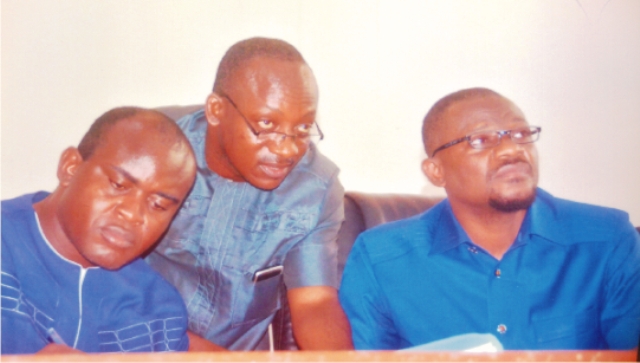
Professor Kelvin
Bobmanuel has called on the Nigerian Maritime Administration and Safety Agency (NIMASA) to properly enforce the Cabotage Act in order to optimise the benefits accruable in Nigeria’s Maritime sector.
Professor Bobmanuel, who gave this charge recently as part of recommendations in his inaugural lecture, said this will be to the advantage of indigenous maritime operations.
“NIMASA should properly enforce the Carbotage Act and drastically limit the wavers that are given to foreign vessels to operate in our territorial waters.
“This will enable our indigenous ship-owners and operators reap the benefits of carbotage and increase replacement of cadets and other graduates on board Nigeria registered vessels to gain sea experience. This measure will minimise the skills gap in the maritime industry”, he said.
Professor Bonmanuel’s topic, titled “Technological Advances in Maritime Transportation and Engineering: Impact on the Global and Nigerian Economy”, also recommended that the current monitoring policy on Ship acquisition should be reviewed to favour indigenous operators.
Beyond this, he recommended that Nigeria needs to invest in both building/ship repair dockyard, as well as “vigourously enforce the Nigeria content policy in ship/boat building and repairs in the country”.
In addition, the Professor of Maritime Engineering (Ship Power Plant) stated that the collaboration between maritime training institutions and industries in research should be intensified to enable the nation meet challenges of current and future technology.
He stated further that mitigation for maritime safety prevention and control of environmental pollution in Nigeria’s territorial waters should include frequent safety orientation to boat operators.
According to him, monitoring and strict enforcement of national and domesticated IMO regulations by the appropriate government body should also be included.
The Carbotage Act, Professor Bobmanuel said, spelt out four major conditions upon which it’s implementation must be applied.
They are: that carbotage vessels must be solely owned by Nigerians; be registered in Nigeria, manned by Nigerian crews, and that Nigeria ship guards must build and repair carbotage vessels.
In his remarks at the occasion, the Vice Chancellor of the Rivers State University of Science and Technology (RSUST), Professor Blessing C. Didia, extolled the achievements of the inaugural lecturer as the first Professor of Maritime Engineering in West Africa/South of the Sahara.
He used the opportunity to charge students and lecturers alike to strive to also excel in their chosen areas of endeavour.
Sogbeba Dokubo



The River State Commissioner for Education, Dr Peters Nwagor has called on media practitioners in Rivers State to deploy their various communication platforms toward promoting government programmes and policies aimed at achieving sustainable development in the education sector. Dr. Nwagor made the appeal when members of the Etche Ethnic Practicing Journalists (EEPJ) paid him a courtesy visit in Office in Port Harcourt. The Commissioner emphasized the strategic role of the media in shaping public perception, promoting government initiatives, and supporting policies capable of improving the quality of education and human capital development in the state. According to him, constructive media engagement remains essential in creating public awareness on educational reforms, students’ welfare, infrastructural improvements, and other interventions being implemented by the state government. Speaking on the recent appro

-

 Editorial1 day ago
Enough Of Xenophobic Attacks On Nigerians
-

 Nation1 day ago
RSU, Otonti Nduka Foundation Holds Centenary Conference, Unveil Book on Values in Nigeria
-

 Oil & Energy1 day ago
Rivers PETROAN Elects 12-Member Executive
-
Politics1 day ago
APC Group Protests Ex–Presidential Aspirant’s Disqualification From Rivers Senatorial Race
-

 Environment1 day ago
MOSOP – Tinubu Not Sincere With Ogoni People For Oil Resumption
-
Politics1 day ago
Reps Speaker Secures APC Return Ticket For Fifth Term
-

 News2 days ago
Fubara, Wife Hail Tinubu’s Renewed Hope Initiative …As Over 6,800 Families Benefit From Largesse In Rivers
-

 Sports1 day ago
Oparaodu Urges Rivers United To Win Katsina United