
News
More Troubles For Saraki …As FG Files Fresh Charges Against Senate President …CCT Dismisses Self-Disqualification Motion

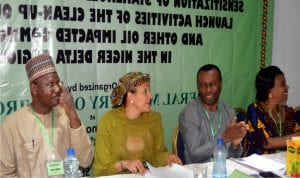
L-R: Minister of State for Environment, Ibrahim Usman, Minister of Environment, Amina Mohammed, Minister of Niger Delta Affairs, Pastor Usauni Usauni, Rivers State Commissioner for Environment, Mrs Roseline Konya at the sansitasation of stakeholders on Pre and Post Launch activities of the clean-up Ogoniland and other oil impacted communities in the Niger Delta Region in Port Harcourt, yesterday. Photo: Chris Monyanaga
The Federal Government, yesterday, filed two amended charges against the Senate President, Bukola Saraki at the Code of Conduct (CCT).
Saraki is currently standing trial on a 13-count charge bordering on false assets declaration.
Counsel to the Federal Government, Rotimi Jacobs, at the commencement of proceeding for the day after the tribunal Chairman, Danladi Umar, had dismissed the application for self-disqualification, urging the tribunal to accept the amended charges filed on April 27 so that, “the record can be set straight to what the defendant is facing.”
Saraki’s counsel, Paul Usoro, however, contended with the appeal, citing Section 216/1 of the Administration of Criminal Justice Act (ACJA).
He said the tribunal judge should direct the prosecution to present before the tribunal the fact that necessitated the amendment of the earlier charges.
But Rotimi, in his response, argued that the prosecution in pursuant to section 163 of the constitution, has the right to file an amended charge at anytime.
The chairman of the tribunal, in a short ruling said, “after carefully analysing section 216(1) of the Constitution, the prosecution has the right to file amended charges at anytime.
“The application of the prosecution is hereby accepted while that of the defendant contesting the application is refused,” Umar said.
The two charges read, “That you on or about September 16, 2013 within the jurisdiction of this honourable tribunal did make a false declaration in the asset declaration form for public officers which you filled and submitted to the Code of Conduct Bureau upon assumption of office as the governor of Kwara State in the year 2003 by your failure to declare your leasehold interest in number 42, Remi Fani-Kayode Street, Ikeja, Lagos, which you acquired through your company, Skyview Properties Limited from First Finance Trust Limited on December 12, 1996, and you thereby committed an offence contrary to section 15(1)(2) of the Code of Conduct Bureau and Tribunal Act. CAP. C15, Laws of the Federation of Nigeria, 2004 and as incorporated under paragraph 11(1)(2),I fifth schedule to the Constitution of the Federal Republic of Nigeria, 1999 (as amended) and punishable under section 23(2) of the Code of Conduct Bureau and Tribunal Act as incorporated under paragraph 18, Part I of the Fifth Schedule to the Constitution of the Federal Republic of Nigeria, 1999 (as amended).
“That you between June 2011 and October 2013, within the jurisdiction of this honourable tribunal, did receive monthly salaries or emoluments as governor of Kwara State and at the same time, from the Federal Government as a senator of the Federal Republic of Nigeria, and you thereby committed an offence contrary to section 6(a) of the Code of Conduct Bureau and Tribunal Act. CAP. C15, Laws of the Federation of Nigeria, 2004 and as incorporated under paragraph 2(a), Part I of the, Fifth Schedule to the Constitution of the Federal Republic of Nigeria, 1999 (as amended) and punishable under section 23(2) of the Code of Conduct Bureau and tribunal act as incorporated under paragraph 18, Part I of the Fifth Schedule to the Constitution of the Federal Republic of Nigeria, 1999 (as amended).”
Meanwhile, the Code of Conduct Tribunal in Abuja, yesterday, dismissed an application asking its Chairman, Danladi Umar, to disqualify himself and withdraw from the trial of the Senate President, Dr. Bukola Saraki.
The Federal Government is prosecuting Saraki before the Umar-led CCT on 13 counts of false asset declaration which he allegedly made between 2003 and 2011when he served as Kwara State governor.
Saraki had, in his motion, argued by his lawyer, Mr. Ajibola Oluyede, on Wednesday, asked Umar to disqualify himself on the grounds of likelihood of bias in the handling of the trial by Umar.
Oluyede argued that Umar would likely be subject to control by the Economic and Financial Crimes Commission (EFCC) on the basis that the anti-graft agency brought Saraki before the CCT for prosecution while it (EFCC) was still investigating the tribunal chairman for bribery.
But in the ruling of the two-man panel of the CCT, yesterday, Umar held that the application “lacked absolute meritý”.
He upheld the opposition of the prosecuting counsel, Mr. Rotimi Jacobs (SAN), to the motion, to the effect that contrary to Oluyede’s claim, the EFCC had cleared him of the bribery allegation.
He said the EFCC had by its letter dated March 5, 2015, through its then chairman, Ibrahim Lamorde, to the then Attorney-General of the Federation and Minister of Justice, Mohammed Adoke, cleared him of the alleged crime.
He said the March 5, 2015, letter in which the EFCC indicated that the allegation against him was a mere suspicion and that it did not constitute sufficient evidence to prosecute him, superseded the earlier investigation report issued by the anti-graft agency on June 24, 2014
In the June 24, 2014 report, Adoke had endorsed on it, directing that Umar and his co-accused be prosecuted.
But Umar ruled, yesterday, that the EFCC was not answerable to the AGF in its investigation and prosecution of cases.
“The AGF cannot prosecute without sufficient evidence from investigative agencies,” Umar said.
He added that the incumbent AGF, Mr. Abubakar Malami, had said he (Umar) had been cleared while appearing before a House of Representatives’ committee which was petitioned with respect to the bribery allegation.
He recalled that Malami told the committee that he (the AGF) stood by the March 5, 2015 letter of EFCC to Adoke, indicating that there was no sufficient evidence to prosecute him (Umar).
He said, “The issue of having case to answer before the EFCC is over.
“The application lacks absolute merit and it is hereby dismissed in its entirety.”
The tribunal then directed the defence led, yesterday by Mr. Paul Usoro (SAN), to continue the cross-examination of the first prosecution witness, Mr. Michael Wetkas.
Umar was accused of demanding N10million from an accused that was appearing before the CT sometimes in 2012.


The Rivers State chapter of the All Progressives Congress Christian Leaders Forum has expressed strong confidence in the capacity of All Progressives Congress (All Progressives Congress) candidates in the state to deliver effective governance if elected into office in the coming elections.
The State Coordinator of the forum, Archbishop Lucky Aroh, made this known during a breakfast and thanksgiving meeting held in Port Harcourt, where leaders gathered to pray for the stability of the party and the safety of its candidates ahead of the 2027 general elections.According to him, the meeting was convened to seek divine intervention for peace, unity, and security among APC candidates across Rivers State.
“Today we are praying for APC stability in Rivers State and the security of our candidates that have been elected to contest the 2027 elections. It is a breakfast meeting,” Aroh said.
He further expressed optimism that the party’s candidates would not disappoint the people if entrusted with leadership responsibilities.
“They will not fail when elected into office. We are here as fathers of the land to let them know, and I must tell you the truth that these are the authentic people that will do well in Rivers State,” he added.
Speaking earlier, the National Chairman of the forum, Professor Olanrewaju Abraham, commended the Rivers State chapter for organizing the programme, noting that the national body of the forum believes strongly in the power of prayer.
He stated that political leadership provides an opportunity to influence society positively, including advancing moral and spiritual values, while expressing confidence that APC candidates at all levels would emerge victorious in the upcoming elections.
Also speaking, the Rivers State Women Leader of the APC, Hon. Darling Amadi, praised the forum for its commitment to prayers for peace, stability, and the protection of party candidates.
Represented by the Deputy Women Leader of the party in the state, she described the initiative as commendable and urged other political and support groups within the party to emulate the gesture in promoting unity and stability.
By: John Bibor, Menebe Emmanuel & Fortune Paibi
Prominent businessman and philanthropist, Elder Anthony Osagwe-Ogo, was celebrated in grand style as he marked his 70th birthday anniversary, with distinguished Nigerians, business leaders, and golf enthusiasts gathering to honour his remarkable contributions to society.
The colourful celebration took place at the Port Harcourt Golf Club, where friends, associates, and well-wishers converged to pay tribute to the revered elder statesman.
Chairman of the occasion, High Chief (Dr.) Ikenna Okafor, described the celebrant as a detribalised Nigerian whose generosity, humility, and commitment to humanity have earned him admiration across different communities and backgrounds.
According to Dr. Okafor, Pa Osagwe-Ogo’s impact on society and the development of his community remains unparalleled. He noted that members of the golfing community are proud to be associated with a father figure who consistently promotes the welfare and well-being of those around him.
He further stated that the history and growth of the Port Harcourt Golf Club cannot be told without acknowledging the significant role played by the celebrant, whose wisdom, encouragement, and leadership have helped sustain the club over the years.
“We are here to celebrate a man who has impacted humanity positively, a peace-loving individual and an epitome of hope for the younger generation. We pray to emulate his virtues. Today, we celebrate a bridge-builder, a trailblazer, and an iconic leader whose life continues to inspire many,” Dr. Okafor said.
He expressed delight at the large turnout of guests from various walks of life, describing it as a testament to the respect and affection Pa Osagwe-Ogo commands within and beyond Rivers State.
In his response, the celebrant, Pa Anthony Osagwe-Ogo, expressed profound gratitude to God for preserving his life and granting him the privilege of attaining the milestone age of 70.
He also thanked members of the Port Harcourt Golf Club, family members, friends, and associates for identifying with him during the celebration and for their unwavering support over the years.
The event featured the cutting of the birthday cake, presentation of awards to deserving members of the club, goodwill messages, and moments of celebration among guests.
The ceremony was attended by notable personalities from the business community, the golfing fraternity, and other sectors, all of whom joined in celebrating the life and legacy of the respected elder statesman.
Rivers State Governor, Sir Siminalayi Fubara, and the Permanent Secretary of the Rivers State Ministry of Information and Communications, Dr. Honour Kuru Sirawoo, have been honoured with awards of recognition in connection with the 2026 Democracy Day celebrations held in Port Harcourt.
The awards, which formed part of activities marking Nigeria’s Democracy Day on June 12, were formally presented on Tuesday at the Ministry of Information and Communications in Port Harcourt.
Presenting the awards was Hon. Abdul Hameed Oladipupo Alli, popularly known as “Mr. Nigeria,” Publisher of Asiwaju Trumpet Magazine and Achievers World International Magazine.
Governor Fubara was recognised for his efforts in sustaining peace, stability, and a conducive political atmospherJohn Bibor / Menebe Emmanuel / Fortune Paibie in Rivers State. The organisers noted that his administration has fostered harmony and strengthened civic participation across the state.
Dr. Sirawoo, on the other hand, was honoured for his exemplary administrative leadership and significant contributions to effective information management within the Ministry of Information and Communications.
Representing Dr. Sirawoo at the presentation ceremony, Dr. Christian Davies received the award on his behalf and expressed gratitude for the recognition. He described the honour as a reflection of Dr. Sirawoo’s unwavering commitment to professionalism, excellence, and dedicated public service.
Dr. Davies assured the organisers that the award would be formally conveyed to the Permanent Secretary.
The event also featured the presentation of commemorative publications highlighting major governance and civic milestones in Rivers State, including Easter celebrations, Workers’ Day activities, the Governor’s third anniversary in office, and Democracy Day programmes.
Organisers of the awards commended the Rivers State administration for what they described as sustained peace, political stability, and improved civic engagement, noting that these achievements have contributed significantly to the state’s continued development.
By: Jessica Sambol
-

 News14 hours ago
Nigeria Won’t Surrender Any Territory To Criminals -Tinubu
-

 News14 hours ago
FG Begins Trial Of Over 600 Terrorism Suspects
-

 Niger Delta11 hours ago
Warri Airport Manager Disputes Air Peace Bird Strike Claim
-

 Rivers11 hours ago
79th IAUE Inaugural Lecture: Prof Anero Advoctes Tuition-Free Education For Children
-

 News14 hours ago
Rivers Judges Commence Annual Vacation, July 20
-

 Politics10 hours ago
Parties’ Deregistration: How Justice Lifu Overruled Appeal Court Justices
-
Politics11 hours ago
2027: Rivers PFN To Mobilise 600,000 Votes
-

 News14 hours ago
RSG Reaffirms Commitment To Women’s Empowerment