Environment
Nigeria Secures $7.8 Million For Forests Protection Programme

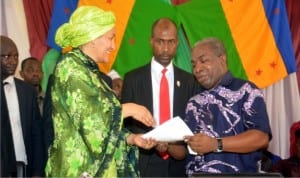
The MOSOP President, Mr Legborsi Piagbara (right) present his welcome address to the Hon Minister for Environment, Amina Muhammad (left) during her visit to Ogoni on Federal Government on clean-up of Ogoniland recently.
Nigeria has secured a
7.8 million dollars credit from International Donors, for the implementation of the National Programme on the Reduction of Emmission from Deforestation and Degradation ( REDD) plus programme.
The programme is an initiative by the United Nations for the protection forests against destructions across the world.
The programme popularly known as cop 15 was initiated by the United Nations in 2009 at Copenhagen Denmark.
The Agreement was signed by Nigeria in 2012 and Cross River State was designated as pilot state, and in 2015, the programme was scale up in Nigeria with the addition of Ondo and Nassarawa States.
The project coordinator for Ondo State, Mr John Akinnuba told The Tide in an exclusive interview in Port Harcourt, that the money was second between 2012 and 2016.
Mr Akinnuba specified that four million dollars was secured in 2012 for the implementation of the pilot programme in Cross River State while this year, 3.8 million dollars was granted to the Govenrment to scale up the project in Nassarawa and Ondo States.
According to him, the first phase of the programmes involves building institutional structures and putting of framework, while second phase will involve piloting, field survey and technological mapping, while phase three involves data gathering and analysis and the establishment of reference emission level which is the basis for the payment of carbon credit.
“The Redd plus is a programme of action to mitigate climate change by payments and compensations to governments and communities that protect the forests in forms of credit from carbon generated from the protected forests” he said.
According to him, since carbon dioxide is the major component coursing global warming, the progrmame will ensure that the carbon generated from the forest can be captured, measured and sold in the carbon market, stressing that by so doing. Forest communities will be given livelihood support. Mr Akinnuba said that Nigeria stands to benefit maximally from the programme as its forest resources would be preserved, while employment will be reduced through the unempowerment of communities.
The Environmentalist stressed the need for governments of the Niger Delta States to queue into the programme with the view to protecting its forests and biodiversities from destruction.

Environment
Stakeholders Unite To Build Greener, More Resilient In Kaduna
Environment
Disaster: Society Urges FG To Prioritise Ecological Challenges Across 36 States
Environment
FG Urges Citizens To Prepare That Flood Will Affect 266 LGIn 33 States
This was disclosed in a keynote address by the Minister of Water Resources and Sanitation, Engr Joseph Utsev, at the AFO public presentation at the Presidential Banquet Hall, Abuja, organised by the Nigeria Hydrological Services Agency, NiHSA, with the theme ‘Smart Water Resources Management: Moving from Oil to Water-Based Economy’.
Utsev acknowledged that early information saves lives, livelihoods, protects infrastructure, and reduces economic losses, saying that, as part of the Federal Government’s commitment to improving flood forecasts and preparedness, is the modernisation of the national hydrological monitoring networks.
The minister also said his ministry is strengthening collaboration with the Nigerian Meteorological Agency, NiMet, to ensure better integration of weather and water information, as it is critical for delivering reliable forecasts that support farmers, disaster managers, urban planners, and other key sectors of the economy.
He said AFO is therefore not just a scientific report, it is a call to action by all in terms of preparation ahead of the flood season, as early information saves lives, livelihoods, protects infrastructure, and reduces economic losses.
However, the minister acknowledged that forecasts alone are not sufficient if the information does not translate into action at the community level, which he said his Ministry is working with other relevant government agencies to mitigate the impacts of flooding.
Meanwhile, the 2026 AFO presentation had in attendance President Bola Tinubu, represented by the Minister of Environment, Balarabe Lawal.
Others present were the federal ministries: Water Resources and Sanitation; Livestock Development, Environment and Women Affairs.
Others include the Speaker of the House of Representatives, State Governments, Service Chiefs, development partners and the media.
He said: “The 2026 flood forecast presented today provides us with the following general highlights: High Flood Risk: 14,118 communities in 266 Local Government Areas (LGAs) in 33 States and FCT fall within the high flood risk areas. The States are: Abia, Adamawa, Anambra, Bauchi, Bayelsa, Benue, Borno, Cross River, Delta, Ebonyi, Edo, Enugu, Gombe, Imo, Jigawa, Kaduna, Kano, Kebbi, Kogi, Kwara, Lagos, Nasarawa, Niger, Ogun, Ondo, Osun, Oyo, Plateau, Rivers, Sokoto, Taraba, Yobe, Zamfara and the FCT.
“Moderate Flood Risk: 15,597 Communities in 405 LGAs, 35 states except Ekiti State, will experience moderate flood risk.
“Low Flood Risk: Incidences of minimal flood is expected in 923 communities in 77 LGAs in 24 States. The States are Adamawa, Anambra, Bauchi, Bayelsa, Benue, Borno, Cross River, Delta, Ebonyi, Edo, Jigawa, Kaduna, Kano, Kebbi, Kogi, Nasarawa, Niger, Ogun, Ondo, Osun, Oyo, Sokoto, Taraba and Zamfara.
“Flash and Urban Flooding: Flash and urban flooding are projected in major cities in the country due to high rainfall intensities, low attention to management of water facilities including drainage systems, waterways and lack of flood resilience structures. Cities such as Abakaliki, Abeokuta, Abuja, Asaba, Benin City, Birnin–Kebbi, Calabar, Ibadan, Kaduna, Kano, Lagos, Makurdi, Nguru, Onitsha, Oshogbo, Port Harcourt, Sokoto, Warri and Yola, among others are to experience these categories of flood incidence.
“Coastal and Riverine Flooding: Bayelsa, Cross River, Delta, Lagos, Ogun, Rivers and Ondo are to experience coastal flooding due to rise in sea level and tidal surge and this would impact on fishing, wildlife habitation and river navigation.”
He also emphasised that, “As we transition toward a water-based economy, we must recognize that water security is national security. Effective water governance will play a critical role in ensuring food security, supporting economic diversification, and improving the overall well-being of our citizens.”
However, the Minister called on State andand Local Governments including communities to start preparation to mitigate the impacts of the predicted flood.
“I therefore call on state governments, local authorities, disaster management agencies, farmers, and community leaders to carefully study the findings and advisories contained in this document and take the necessary steps to prepare for the coming flood season.
“Furthermore, we are encouraging state governments to integrate flood risk considerations into land-use planning, urban development, and infrastructure design.
“Floodplains must be properly managed, drainage systems must be improved, and communities must be empowered to adapt to changing climate conditions.
“Preparedness remains the most effective strategy for reducing flood risks. When we plan ahead, we protect lives, safeguard infrastructure, and preserve economic gains. Let us commit to building a safer, more resilient and more water-secure nation.”
Earlier, the Director General/Chief Executive Officer, Nigeria Hydrological Services Agency, Umar Ibrahim Mohammed, NiHSA, said the 2026 AFO aligns with the Renewed Hope Agenda in terms of economic diversification, infrastructure development, climate resilience, food security and sustainable water management.
Mohammed also explained that, “The AFO has evolved into an important national planning instrument that provides early scientific prediction of flood risks in the country, evidence-based guide for decision-makers and platform for emergency coordination among stakeholders.
“In producing this year’s forecast, the Agency undertook a comprehensive and data-driven process to provide tailored information for high-risk flood zones and flash floods in urban cities and towns.
“Building on the success achieved through AFO publications, we have upgraded from reporting flood forecast to Flood Risk Intelligence Architecture and from the traditional modelling to Hybrid AI-Integrated Modelling system to improve forecast reliability, reduce false alarms and improve the lead time accuracy.
“Not these alone, the modelling for the 2026 forecast have been conducted in-house. This marks a strategic shift toward enhancing capacity building, manpower development and institutional resilience.”
-
Rivers16 hours ago
MBA Forex Trial Adjourn To June 3, Amid Bereavement … As Court Declines Cost Application
-
Featured10 hours agoWASSCE: RSG Distributes Science Materials To Secondary Schools
-
Aviation16 hours ago
Passengers Stranded As Delta Airline From Atlanta Route Back Eight Hours After
-
Business16 hours ago
Customs Impound N2.35bn Cocaine, 15 Trailers of Rice
-
Nation5 days agoEducation Commissioner Seeks media Collaboration In Rivers
-
Nation5 days agoRSUBE Holds Training For 1,000 New Teachers To Strengthen Basic Education
-
Politics15 hours ago
2027: Bayelsa Senator Gets Critical Endorsement For Second Term
-
Features16 hours agoOmerelu’s Historic Milestone … First Female Professor Rekindles Faith in Education