Connect with us

Environment

Pollution And Environmental Litigations’ Effects In N’Delta

Published

on

The fact is that, it is only
few people that will dispute that environmental degradation is rampant throughout  the oil producing region  of Nigeria. Whether due to oil spills gas flaring, dumping of wastes associated with drilling artesenal refining or other related activities, the impacts on the environment and human livelihoods and health are widespread and severe.
Environmentally, the Niger Delta is sick and the inhabitants are poor. Moreover, there seems to be a rising tide of criminality and militancy in the region and this has made most communities, particularly in the riverine areas unsafe.
It is an obvious fact that the greatest casualties are the environment and the people.
It would be recalled that, in the past, the people of the Niger Delta have embarked on series of legal actions to seek redress on the pollution of their lands.
A publication recently released by the Centre for Environmental Human Rights And Development (CEHRD) revealed that over 38 environmental related cases have been prosecuted in the region since 1970.
The publication titled; “After Bodo: Effective Remedy And Recourse options for victims of environmental degradation related to oil extraction in Nigeria” showed that in many of these cases, the affected communities and individuals received compensations both monetarily and otherwise.
According to the report, the cases all bothered on pollution which include, pollution of water ways, and destruction of farmlands.
The first of these cases include; Mon Igara V. Shell BP 1970, San Ikpede V.SPDC PDC 1973, Atubie V. Shell BP PDC 1974 and Chinda v Shell BP PDC 1974.
Also mentioned in the report are; Umudje V. SPDC 1975, Nweke and others V. Nigerian Agip Oil Company in 1976. The report also said that in 1986, a number of oil companies were held liable in a case of crude oil pollution which occurred in the Calabar River and spread to Port Harcourt  River damaging marine life and raffia palms.
Other cases also examined by the report includes; Nwadiaro V. SPDC 1990, Otoko V. SPDC, a case of oil spillage along the Andoni River 1990, SPDC V Ambah 1991, SPDC V. Enoch 1992 and Elf V. Opere Sillo 1994.
The publication also mentioned the cases of SPDC V. Farah 1995, SPDC V. Tiebo 1996, SPDC V. Amaro 2001, SPDC V. A. Otelemaba Max, SPDC V. Isaiah 2001, Mobil V. Monokpo 2003, SPDC V. Edamkue 2003 and NNPC V. Sele 2004.
The rest are; Gbemre V. SPDC seeking a declaration to stop gas flaring in 2007, Phyne V. SPDC 2006, Firibed V. SPDC also in 2006.
Also are Agadia and Uruesheyi SPDC .V. SPDC 2006, Chief Omu and others V. SPDC V. Ohaka 2008, Agbara V. SPDC 2001 – 2010 SPDC V. John 2011, John Holt Krebale and others V. SPDC and Barizaa M. T. Dooh V SPDC in 2012.
The report further mentioned other cases such as Ogbodo V. SPDC 2011, Batan, Delta State V. SPDC, Bodo Community V. SPDC, SERAP V. Federal Republic of Nigeria and the Bonga Oil Field coast of the Niger Delta.
The report which dwelt extensively on the Bodo V. SPDC case described it as the most successful.
According to the report, the well studied and highly publicized Bodo V. Shell cases began with two large spills in August and December 2008 affecting thousands of fishermen and farmers in Bodo and neighbouring communities.
“The oil company’s response to the spill was slow and it infact admitted liability”.
It noted that the case which greatly benefitted from legal expertise and scientific evidence led to an out of court settlement in which a whooping sum of 83.3 million dollars was paid to the communities.
Commenting on the report in an interview with The Tide, a Director in the Centre for Environment Human Rights and Development (CCHRD) Mr Laurent Dube, said that getting Justice for the communities have always been problematic  except the case of Bodo.
Mr Dube said that, the situation shows the level of resistance to environmental pollution in the Niger Delta, adding that the resistance will continue  for a longer time to come until the oil companies change their strategies in their operations.
The overall impacts was that while some of these communities got compensations, others never received any  compensations.
The report also revealed that, some loop holes in our Judicial System were exploited by the companies to deny the communities of their rights. A case or point was that of Gbemre V. SPDC in Delta State, in which a declaratory injunction was sought for the stoppage of gas flaring on the Niger Delta by April 30 2007.
The Tide learnt that in the same year, the Judge was transferred to another court and the court file went missing.
SPDC however obtained a court order, thereby further delaying compliance and currently ruling has not been enforced.
The effect is that the non enforcement of the ruling has made gas flaring a common phenomenon in the Niger delta.
In the other cases, although compensations have been paid to the communities, but that has not stopped the companies from further polluting the environment.
An environmentalist, in the Niger Delta, Mr Thomas Ikaraba told The Tide in an interview that, the impacts of these litigations are yet to be felt in the region as after monetary compensations, the environment are left un-cleaned.
Mr Ikaraba cited the case of Bodo, where individuals and families received monies, but the community is yet to be clean up.
He urged for legislations that will make it crime for companies not to clean up polluted sites after paying compensations.
He views were also shared by across section of environmental Right Activities in the region.
In summary, the report showed the level of resistance by the people to pollution in the Niger Delta and the probable impacts.
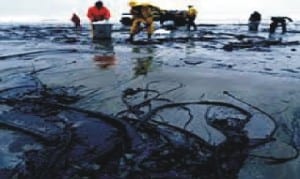
An oil spill polluted site in the Niger Delta


An oil spill polluted site in the Niger Delta

Continue Reading

Environment

Rivers State Government Suspend Fire Service Collection Levies

Published

on

Rivers State Government has  suspended the collection of Fire Service levies, charge and rate in the state.
Speaking during  a press conference on Thursday in Port Harcourt the Permanent Secretary ministry of special Duties Mr Sokari- George D. P,  said that from the 1st of January 2026 no nobody is authorized to collect fire service levies, tax and rate from any entity operating in Rivers State.
He  said  that tax is what government uses to develop and when they got the tax they use it to evaluate things, projects and programs of government and it help government to plan.
” A Statutory body, Board of Internal Revenue, a ministry of Special Duties has a department of the River State fire service that collect fire service levies, charges, and rate but  ordering the money should have been paid to Rivers State government cover but they discovered that their are tax forces going around with some staff of the ministry issuing demand notice and Fire certificate to taxable entity hospital, School, hotels, business premises and so fought.
” River State government as directed the general public that ends force no such body is recognized from1st January 2026.
” Nobody is authorized to collect fire service levies, tax  and rate from any entity operating in Rivers State.
” Fire Service tax collection is here by suspended for now until further notice, when government will come out with clear court guidelines  on how to go about collection of the taxes.
” Rivers State Government will introduce a sinless process where the board of internal Revenue will be also involved.
” So that the state will benefit from the taxes, so I here by advise the general public that nobody should collect tax on behalf of the River State fire service.
” in due course government of Rivers State we made further announcement on how the taxes is will be collected” Mr Sokari – George stated.
By: Kiadum Edookor
Continue Reading

Environment

Environment ministry validates plan to tackle climate-related challenges

Published

on

The Ministry of Environment on Thursday in Abuja, advanced its National Adaptation Plan (NAP) process, validating a comprehensive plan aimed at tackling climate-related challenges in the country.

The Permanent Secretary in the Ministry, Alhaji Mahmud Kambari, said this at the Stakeholders Consultative Workshop on the Development of the concept notes to the Green Climate Fund (GCF) for NAP in Nigeria.

Kambari, who was represented by Mrs Victoria Pwol,  the Deputy Director in the Department of Climate Change (DCC) in the ministry, said that the workshop is a collective resolve to confront the realities of climate change with purpose, strategy, and coordinated action.

“Over the past years, the Federal Government of Nigeria, with crucial support from the Green Climate Fund (GCF) and the United Nations Environment Programme (UNEP), has made significant progress in advancing the NAP process.

“As a nation, we stand at a critical juncture where climate risks ranging from extreme weather events to environmental degradation continues to threaten our socio-economic stability, food systems, public health, infrastructure, and national development aspirations.

“Through extensive technical work, we have completed a Climate Risk Assessment across all geopolitical and agro-ecological zones, developed an Economic Appraisal, an Adaptation Finance Strategy, and a robust Monitoring and Evaluation Framework.”

Kambari said that these foundational elements now guide Nigeria to identify priority adaptation needs and investment opportunities.

“Let me mention that we are at the tail end of this NAP Formulation Process and looking forward to the implementation phase.

“This workshop therefore serves as a strategic purpose to harmonise perspectives across key MDAs; refine project ideas into strong, evidence-based concept notes.

“It will ensure that proposed interventions align with national priorities and the investment criteria of the GCF and position Nigeria to competitively access the resources required to strengthen resilience across vulnerable sectors,” he said.

Dr Iniobong Abiola-Awe, the Director DCC in the Ministry said that the engagement would enhance achievements by collaboratively developing bankable, climate-resilient concept notes that align with national priorities and meet the GCF’s investment requirements.

Abiola-Awe who was represented by Dr Jonah Barde in the Ministry said that the workshop represented an important step in Nigeria’s ongoing efforts to strengthen climate resilience.

She added that the workshop would advance sustainable development, and mobilise the climate finance needed to safeguard Nigeria’s communities, ecosystems, and economy from the growing impacts of climate change.

Continue Reading

Environment

Science-based risk assessment cornerstone of Nigeria’s approach to GMOs–NBMA DG

Published

on

Effective communication, transparency, and science-based risk assessments are the cornerstones of Nigeria’s approach to Genetically Modified Organisms (GMOs).

Mr Bello Bwari, the Director-General,  National Biosafety Management Agency (NBMA), gave the assurance during a media interaction in Abuja on Friday.

“Where there is communication, you reduce conflict. Effective communication is key, effective engagement with stakeholders is paramount and key to making Nigeria better.

Bwari said anti GMO’s critics keep participants and practitioners on their toes.

“We value them and we expect that their criticisms, suggestions and recommendations will make our operations in the entire spectrum better.

“Where we are not doing so well, we will hear from them, where we can advance explanations, we will advance explanations. Where they are not doing well, we will tell them. We will not run away from doing that.

“But I want to assure you that we are bold enough to face anybody who is not fact-based,” he said.

He reassured that sometime before the end of the second quarter of 2026 there would be a retreat where all stakeholders would be invited.

“And also, the impact we are bringing is going to be measurable by the end of 2026. And going forward, what we do by the end of 2026 will form the basis of our five-year plan.

“There’s a five-year plan which will start at the end of 2026. So, I enjoin the media to please report what you know as a matter of fact, not as a matter of opinion.

“We all have different opinions, but some of our opinions are not facts. From the quality of what I see on papers, reportage, I think largely I’m impressed with what the press is doing in Nigeria so far,” he said.

Bwari stated that Nigerians deserved to understand what NBMA regulates, why they regulate it, and how decisions were made.

“Part of my focus going forward will be strengthening engagement with the media, researchers, policymakers, and the public because regulation works best when it is understood.

“We are not promoters of any technology, and we are not opponents of innovation. We are regulators.

“But at its core, biosafety is about prevention, caution, and preparedness. It is about ensuring that innovation does not outpace safety, and that national development never compromises public health or environmental integrity,” he said.

He promised to uphold the law without fear or favour, communicate more clearly with the public and ensure that every regulatory decision was transparent, evidence-based, and accountable

“NBMA is not an advocacy agency. Our duty is to assess risks, enforce safeguards, and ensure compliance with national and international biosafety standards.I also want to emphasise that public trust matters.

He further urged the media to help Nigerians understand biosafety and biosecurity in a better way.

Continue Reading

Trending