
Nation
THE STATES

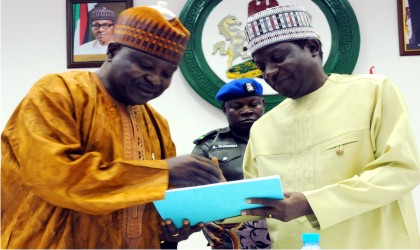
Chairman, Transition Committee, Prof. Sonni Tyoden (left), presenting the committee’s report to Governor Simon Lalong of Plateau State, in Jos on Wednesday (12/8/15). Photo: NAN
Bauchi
Some operators of Cyber Café in Bauchi engage in sharp
practices by down-loading fake police recruitment forms and extorting money from unsuspecting applicants.
Spokesman of the Bauchi Police Command, DSP Haruna Mohammed, revealed this in a statement made available to newsmen recently in Bauchi.
“It has come to the knowledge of Bauchi State Police Command that some Cyber Cafes have started down-loading police recruitment forms for applicants and extorting money from them under false pretense.
“For the avoidance of doubt, there is no recruitment going on at the moment in the Nigeria Police Force.
“The Command, therefore, wish to use this medium to advise members of the public, to disregard any recruitment adverts, in order not to fall victims of such extortionists,” he said in the statement.
Borno
The Borno State Government has said it has purchased
a recycling plant that could convert polythene wastes into positive use.
The Coordinator of the Borno State Environmental Protection Agency (BOSEPA), Alhaji Nasiru Surundi, told newsmen in Maiduguri, capital of Borno State.
Surundi said that the decision was imperative as thousands of tons of waste were being generated by the increased population without a dump site to keep them.
“In the absence of an approved dump site, the recycling machine will come handy in ensuring that the streets of Maiduguri will no longer be littered with heaps of garbage that have continued to constitute environmental nuisance.”
Surundi attributed the annual flooding in most parts of Maiduguri to the wrong attitude of people toward waste management.
FCT
The National Peace Committee has dismissed reports
that it was lobbied by former President Goodluck Jonathan to stop President Muhammadu Buhari from probing his administration.
A member of the committee chaired by retired Gen. Abdulsalami Abubakar, Bishop Mathew Hassan Kukah dismissed the report while answering questions from State House correspondents after the committee’s closed-door meeting with Buhari in Abuja.
According to him, though everybody is free to contact the committee to intervene in promoting peaceful coexistence in the society, the former president never talked to the committee for any form of intervention.
“Anybody is free to come to our committee, but President Jonathan never by telephone or by any other means sought to see the committee.
“We went to see him, but that was after we had already seen members of the political parties; we saw a few members of the civil society; we plan to see the speaker.
Gombe
The National Emergency Management Agency (NEMA)
has asked the Gombe, State Government to promptly complete work on the state’s waste recycling project to facilitate the conversion of waste to wealth.
In a communiqué after a one-day workshop organised by NEMA to seek out ways to mitigate flood, the agency said waste conversion would equally help in averting the risk of flood.
Our correspondent reports that the workshop, held in Gombe on Tuesday, focused on flood risk and the management of solid and liquid waste.
The communiqué expressed the need for the state government to hold sanitation twice a month, with an effective restriction of movement from 6 a.m. to 10 a.m.
Kaduna
Governor Nasir El-Rufa’i of Kaduna State has appointed
new Accountant-General for the state and announced the retirement of three Permanent Secretaries from the civil service.
The new Accountant-General is Malam Umar Waziri.
A statement issued by the Special Assistant on Media and Publicity to the Governor Mr Samuel Aruwan, in Kaduna described the changes as part of ongoing reorganisation of the state’s public service for greater performance.
The statement listed the retired permanent secretaries as Adamu Makadi (Local Government); Ibrahim Balarabe Musa (Youth, Sports and Culture) and Ishaku Shekari (Accountant-General).
Kano
Governor Abdullahi Ganduje of Kano State has enjoined
residents of the state to register for their National Identity Cards.
Ganduje spoke when members of the National Identity Management Commission presented him with his national identity card at the Government House, Kano.
The governor, who explained that efforts were being made to make registration easy for the people, revealed that 10 centres had been established across the state.
He said that the government would soon inaugurate a sensitisation committee to enhance registration of people for their identity cards.
Earlier, state Coordinator of the commission, Hajiya Bilkisu Dalhatu, promised to sensitise the people of the state to enrol and collect their cards.
Katsina
The Katsina House of Assembly has approved the re
quest of Governor Aminu Masari to secure N2billion loan from the Central Bank of Nigeria (CBN), to develop Micro, Small and Medium Enterprises in the state.
This followed a motion moved by the Majority Leader of the House, Alhaji Lawal Isa (Charanchi), which was seconded by Abubakar Yahaya, (Kusada).
The Majority Leader said the state government and the CBN had earlier explained to the House the importance of the loan to the state.
“We were convinced by the explanations because the loan would assist to boost socio-economic activities and eradicate poverty in the state.”
Isa further said that 60 per cent of the loan would be disbursed to women, while 40 per cent would be for males.
Kogi
A political group, Transparency Group, has advised the
leadership of the All Progressives Congress (APC) to disqualify persons with pending corruption cases from contesting its forthcoming governorship primary in Kogi.
The Coordinator of the group, Mallam Ibrahim Ocholi gave the advice in Lokoja at a press conference.
He said the party swept the polls during the last general elections based on the integrity and honesty of its leadership.
He added that the message of hope the party had been selling to Nigerians must be maintained by preventing any politician already charged to court for corruption by the EFCC from contesting election.
“President Muhammadu Buhari is known by Nigerians as an incorruptible individual.
Lagos
The Lagos State Government has denied sponsorship of
pilgrims for the 2015 Hajj as being speculated in some reports.
The Amirul Hajj and Chairman of the Ad-hoc Committee on 2015 Hajj, Alhaji Abdul Lateef Abdul Hakeem, said in a statement in Lagos that the state has not sponsored any pilgrim for the 2015 Hajj operations.
He also said that the state had no plan to sponsor any pilgrim for the 2015 hajj operations, but was only interested in making sure that state pilgrims were taken care of.
AbdulHakeem was reacting to reports that some pilgrimage forms allocated to key officials of the state government had been hijacked.
Niger
Federal Road Safety Commission (FRSC) in Niger State
has, impounded 482 vehicles in Minna and Mokwa town for non compliance to road traffic rules and regulations, State Sector Commander Susan Ajenge, has said.
Ajenge made the disclosure in Minna in an interview with newsmen.
She said: “We made the arrests through our operation `Good Morning Minna’ which I introduced on my arrival to Niger State in July, 2015.
“The operation is aimed at checking the validity of drivers’ license and the state of vehicles using the roads in order to reduce road traffic crashes.
“We impounded 190 vehicles when we commenced the operation in July followed by 208 and 49 vehicles, respectively.
Oyo
The Muslim community in Ibadan has held special
prayers for the peace and progress of the country..
The Chief Imam of Ibadanland, Sheikh Abdul-Ganiyy Agbotomokekere, who led the prayers, stressed the need for all Muslims to promote efforts geared at promoting peace in the country.
“As Muslims, it is our duty to pray for the peace of our nation because this is our father land; we must come together and ensure unity in the fight against insecurity.
“We should realise that the challenges facing the country cannot be tackled with human knowledge but only through the help of God.
“ When we seek God’s face, He would hearken to our prayers,” he said.
Plateau
The Transition Committee set up by Governor Simon
Lalong of Plateau State says the immediate past administration of former governor David Jang left a debt of N222.3 billion for the Lalong administration.The Plateau Deputy Governor and Chairman of the Committee Prof. Sonni Tyoden,made this known when he submitted the report of the committee to the governor.
Tyoden explained that the committee was made up of 12 members of the central committee, 188 other members were broken into 27 sub-committees, each handling a particular aspect of government operations.
The deputy governor said that government records showed that between May 2007 and May 2015, the state received a total income of N525.35 billion.
“The sum of N747.65 billion was said to have been expended on Plateau citizens in the last eight years.
“The hand-over notes received from the previous government stated that the level of indebtedness of government was N103.9 billion as at May 2015 but our findings put the figure at N222.3 billion.
`
Zamfara
Zamfara State Radio Station has gone off the air follow
ing a lightning that destroyed the transmitter of the state.
The Managing Director of the station, Malam Nuhu Anka,told newsmen that the station’s power generation plant, was also affected.
The managing director however gave assurance that the station would soon resume full transmission of its programmes.
He said the state government had already supplied a new power generation plant and the destroyed spare parts of the transmitter, saying they were now being installed.

Rivers state Deputy Governor Professor Ngozi Nma Odu has commended “The Port Harcourt City One Love,”a Port Harcourt based humanitarian orgnisation For it’s commitment towards alleviating the sufferings of the poor and vulnerable in the society.
Professor Ngozi Nma Odu said this while speaking at this year’s edition of “operation feed the needy” a yearly outreach program of “The Port Harcourt City One Love ” in Port Harcourt.
The Deputy Governor said by feeding more than sixty thousands hungry people within the past six years, the Port Harcourt City One Love Movement has distinguished itself as a club that cares for the less privilege in the society.
She commended the , organization for listing eleven thousand persons to be fed in the current exercise.
Meanwhile The Port Harcourt City One Love has planned a permanent solution to the problem of feeding the poor in the state.
The leader of the group Mr Idaere Gogo Ogan who said this in an interview with newsmen during the distribution of food items to the poor and vulnerables in Port Harcourt said the organization is planning a permanent food kitchen where poor and vulnerable persons can work in anytime and get fed.
Idaere Gogo Ogan said more than sixty thousands poor and vulnerable persons across Port Harcourt City and environs have been fed since the inception of “The operation feed the needy” program six years ago,adding that so far sixty thousands poor and vulnerable persons have beneffited.
He described the group as a platform to promote friendship, brotherhood, community development empathy and feeding the less privilege and hungry people
“That’s what we are doing today here,so we started the exercise six years ago”.he said.
Ogan said the effort was a private sector driven initiative but added “it also involves people in Government because the platform does not recognize any division,we bring everybody together in unity , friendship and brotherhood”he said.
He said the effort will go along way in alleviating hunger especially following the prevailing hunger in the country.
According to him “you know the country is very tough, people are hungry people are starving, there is a whole lot of economic hardship,so for us, this is just our own way of reaching out, our own social contribution to what is very difficult”he said.
Over eleven thousand persons were fed in the just concluded exercise.
Areas of coverage include, Isaac Boro park, Port Harcourt prison/Macoba, Borokiri/Enugu waterside Bundu areas Waterlines and others.
Some of the beneficiaries including an 80 years old widow commended the movement for the annual programm and urged other organizations to emulate them
John Bibor,/Esuuk Oyet/Suotor Memoye /Jeremiah Hannah
Nation
We’ll Partner Private Sector to Industrialize Rivers State – Fubara …Hints Revitalization of Ahoada, Trans Amadi Industrial layout

“Inclusive growth requires access to capital and the right conditions for businesses to deploy that capital effectively. Women-led enterprises are critical to economic activity, yet they face structural barriers.
“This intervention aims to help close that gap by providing financing that supports job creation, business expansion, and long-term sustainability for women entrepreneurs”, Edun said.
Group Head, SheVentures and Impact Segments at First City Monument Bank (FCMB), Nnenna Jacob-Ogogo said access to affordable finance remains a major constraint for women entrepreneurs.
-

 Featured4 days ago
WASSCE: RSG Distributes Science Materials To Secondary Schools
-
News4 days ago
Xenophobic Attacks: Nigerian Lives More Important Than Foreign Investment – Oshiomhole
-
Rivers4 days ago
MBA Forex Trial Adjourn To June 3, Amid Bereavement … As Court Declines Cost Application
-
News4 days ago
ActionAid Demands Probe Of Govs Using Public Funds For Campaign
-
Aviation4 days ago
Passengers Stranded As Delta Airline From Atlanta Route Back Eight Hours After
-
Business4 days ago
Customs Impound N2.35bn Cocaine, 15 Trailers of Rice
-
Politics4 days ago
2027: Bayelsa Senator Gets Critical Endorsement For Second Term
-

 Politics4 days ago
INEC Sets Rivers South-East Senatorial By-Election For June 20