
Environment
Rivers And 2015 Flood Outlook

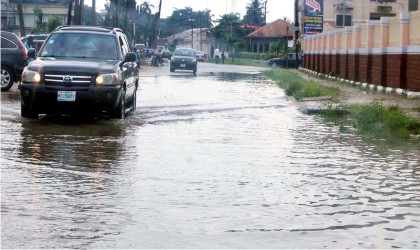
Cars wading through a flooded street in Port Harcourt recently
The Nigeria Hydro
logical Services Agency (NHSA) in its 2015 flood forecast listed Rivers and eleven other states as likely to experience flooding this year.
The eleven other states include Delta, Niger, Bayelsa and Anambra.
The rest are Taraba, Kebbi, Nasarawa, Sokoto, Adamawa, Kogi and Benue States.
And for Rivers State, the agency specifically said that coastal areas would be adversely affected due to the continuous rise in sea level and tidal surge.
With the 2012 flood disaster still fresh in people’s memories, the NHSA report has caused serious anxiety across the state.
It would be recalled that the 2012 flood disaster, reportedly caused by the opening of dams in Cameroun led to the displacement of thousands of persons across some local government areas of Rivers State.
Apart from displacing the people, the incident also caused major economic setback as farm lands and other economic activities were devastated.
The Tide also learnt that with some of the victims of the incident, yet to be fully resettled by the authorities, the recent forecast has raised serious concern over the level of preparedness by the authorities to contain the likely effect of the impending flood disaster.
A cross-section of stakeholders who reacted on the issue called on the government not to treat the report with levity, but put in place adequate measures towards containing the likely effect of the incident.
They also urged for the early relocation of people from low land to high land, while those in the likely affected areas be properly mobilised to move to higher ground in the event of a rise in sea level.
The Rivers State Director of the National Orientation Agency (NOA), Mr. Oliver Wollugbom, urged the government to pay serious attention to the issue with a view to saving the state from the havoc wrecked by the 2012 flood disaster.
Mr. Wollugbom also stressed the need for people to be environmental-friendly by keeping their drainages clean at all times.
He suggested that communities in coastal areas of the state, should be fully mobilised to move to higher grounds once the sea level rises.
“Our people should be environment friendly by ensuring that they are sanitary conscious.
“Individuals should keep their environment clean and adopt good personal hygiene”.
The NOA director also urged the government to open all drainages and gutters, while those who built along waterways be advised to remove them.
“Government must open all drainages and gutters, they should advise people who build on waterways to remove them and channel all water to canals, streams, rivers, while indiscriminate dumping must stop”, he said.
On his part, the Programme Officer of the Centre for Environment, Human Rights and Development (CEHRD), Mr. Steve Obodoekwe, stressed the need for governments across the Niger Delta to embark on awareness campaign with the view to preparing the communities on what to do, so as not to be taken unawares.
“Governments at the region should embark on awareness campaigns to prepare communtieis on what to do so as not to be taken unawares like in the past”.
“Governments should begin to mobilise resources for emergencies and agencies should be strengthened and prepared in case the prediction comes to reality”.
He also urged for the setting up of camps to contain those that might be displaced by the disaster.
“They should also begin to prepare camps in case the need arises. However, they should handle the awareness maturely in order not to throw people into panic” , he said.
Also on his part, an educationalist, Dr. Amina Fiberesima, called on the government to set up a committee to work out modalities for the sensitisation of persons likely to be affected by the impending flood disaster.
Dr. Fiberesima said that this is necessary as the education would guide them against the hazard.
He described it as a standard practice across the world where refugee camps are not neglected in educational opportunities.
Also speaking, the head, Monitoring and Planning of the Rivers State Rural Water Supply Agency (RUWASSA), Mr. Napoleon Adah, called for collaboration between coastal communities, Ministry of Special Duties and other government agencies with the view to minimising the effects of the incident.
According to him” the state government should direct the Ministry of Special Duties and other relevant ministries and agencies like RUWASSA to collaborate with the coastal local government areas to carry out sensitisation programme in their various communities.”
Mr. Adah also called for the setting up of emergency committees with members drawn from all the relevant ministries and non-governmental organisations to work out ways to assist the coastal communities.
Although, the Rivers State government is yet to issue an official statement on the impending disaster, the Permanent Secretary, Ministry of Special Duties, Mrs. Ibaniba Briggs-Iti, had in a recent event in Port Harcourt, unfolded some measures the government is taking to check future flood disasters in the state.
The report titled “Flood Management in Rivers State, Policies Programmes and Structures” listed some of the measures as channelization, sanitary waste disposal and construction of drainages.
She also said that the government would embark on the construction of flood ways to divert flood, demolition of structures on drainages and likely flood plains as well as monitoring, assessment, mopping, studies and designs for control of soil erosion, flooding, while coastal shoreline would be managed against coastal erosion and degradation.
Mrs. Briggs-Ita said that the enabling legislations such as the Rivers State Environmental Sanitation Law 1999, Rivers State Public Health Law 106 of 1999 and others, will assist the government to achieve its objective in this direction.
Critics who described the measures as very laudable, however, urged for its immediate implementation to save the state from the impending disaster.



-

 Editorial1 day ago
Enough Of Xenophobic Attacks On Nigerians
-

 Nation1 day ago
RSU, Otonti Nduka Foundation Holds Centenary Conference, Unveil Book on Values in Nigeria
-

 Oil & Energy1 day ago
Rivers PETROAN Elects 12-Member Executive
-
 Environment1 day ago
MOSOP – Tinubu Not Sincere With Ogoni People For Oil Resumption
-
Politics1 day ago
APC Group Protests Ex–Presidential Aspirant’s Disqualification From Rivers Senatorial Race
-

 News1 day ago
Fubara, Wife Hail Tinubu’s Renewed Hope Initiative …As Over 6,800 Families Benefit From Largesse In Rivers
-
Politics1 day ago
Reps Speaker Secures APC Return Ticket For Fifth Term
-

 Sports1 day ago
Oparaodu Urges Rivers United To Win Katsina United