Business
NERC Lists Challenges Of Power Sector

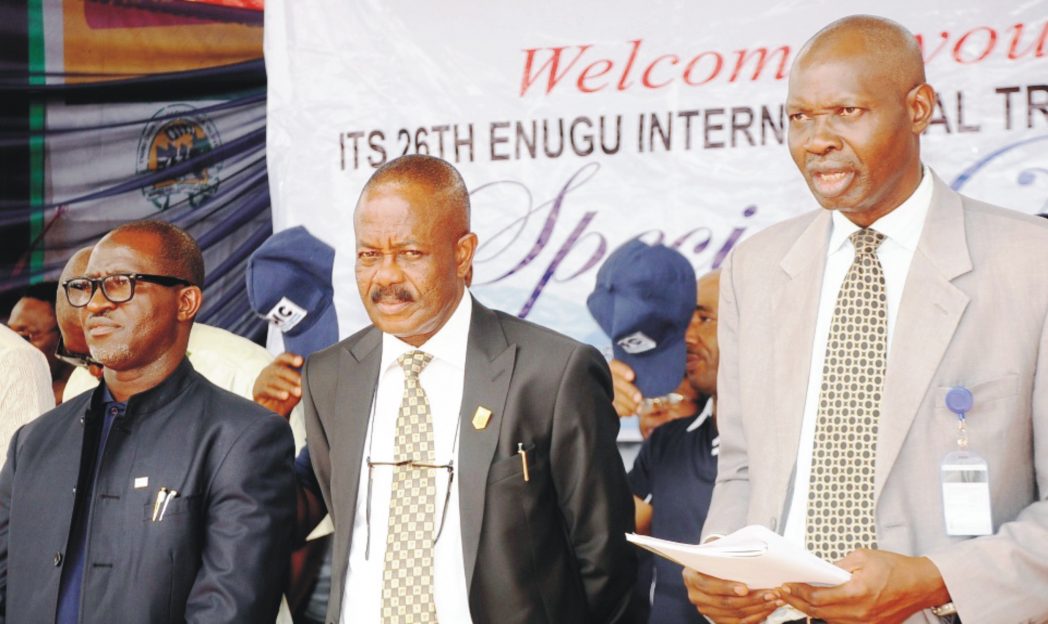
L-R: Assistant Director, Public Affairs, Nigeria Deposit Insurance Corporation (NDIC), Mr Hakeem Bakare, President, Enugu State Chamber of Commerce, Industry, Mines and Agriculture ( ECCIMA), Dr Ifeanyi Okoyi and representative of Managing Director, NDIC, Mr Frank Akinola, during NDIC Special Day at the ongoing ECCIMA International Trade Fair in Enugu, yesterday.
Nigeria’s electricity in
dustry is being hindered by producers’ inability to raise finance and natural gas shortages, curbing companies ability to boost investment in output, as the country suffers from daily blackouts, an energy regulator said.
Peak electricity output of Africa’s biggest economy is about 3,800 megawtts, with another 1,500 megawatts unavailable because of gas shortages, Bloomberg quoted the chairman of the Nigerian Electricity Regulatory Commission Mr Sam Amadi has stated.
South Africa with a third of Nigerian’s population, has eight times more installed capacity, one megawatt is enough to provide energy to 2,000 average European homes or about 333 in Japan.
“There are still issues of credit worthiness, power generation is not coming on board because the distribution companies are weak, they’re not credit worthy and cannot get financing”
Distribution companies are struggling to get consumers to pay their bills and this means that their revenue is so poor that they are unable to pay producers for power, he said.
Nigeria beset by frequent blackouts, dismantled the State monopoly and sold hydro- and gas-powered plants to try bring in investment needed to expand electricity supply.
The industry requires $18 billion to $2 billion to boost supplies to 10,000 megawatts within six years, according to the nation’s privatization agency.
“Power generation and distribution companies can now access a N213 billion ($1 billion) bailout announced by authorities in September to shore up struggling operators Amadi said. The fund is supposed to help them pay off gas-supply debts and meet debt service obligations to lenders on loans of almost N500 billion on which some were falling behind.

Business
FIRS Clarifies New Tax Laws, Debunks Levy Misconceptions
Business
CBN Revises Cash Withdrawal Rules January 2026, Ends Special Authorisation
The Central Bank of Nigeria (CBN) has revised its cash withdrawal rules, discontinuing the special authorisation previously permitting individuals to withdraw N5 million and corporates N10 million once monthly, with effect from January 2026.
In a circular released Tuesday, December 2, 2025, and signed by the Director, Financial Policy & Regulation Department, FIRS, Dr. Rita I. Sike, the apex bank explained that previous cash policies had been introduced over the years in response to evolving circumstances.
However, with time, the need has arisen to streamline these provisions to reflect present-day realities.
“These policies, issued over the years in response to evolving circumstances in cash management, sought to reduce cash usage and encourage accelerated adoption of other payment options, particularly electronic payment channels.
“Effective January 1, 2026, individuals will be allowed to withdraw up to N500,000 weekly across all channels, while corporate entities will be limited to N5 million”, it said.
According to the statement, withdrawals above these thresholds would attract excess withdrawal fees of three percent for individuals and five percent for corporates, with the charges shared between the CBN and the financial institutions.
Deposit Money Banks are required to submit monthly reports on cash withdrawals above the specified limits, as well as on cash deposits, to the relevant supervisory departments.
They must also create separate accounts to warehouse processing charges collected on excess withdrawals.
Exemptions and superseding provisions
Revenue-generating accounts of federal, state, and local governments, along with accounts of microfinance banks and primary mortgage banks with commercial and non-interest banks, are exempted from the new withdrawal limits and excess withdrawal fees.
However, exemptions previously granted to embassies, diplomatic missions, and aid-donor agencies have been withdrawn.
The CBN clarified that the circular is without prejudice to the provisions of certain earlier directives but supersedes others, as detailed in its appendices.
Business
Shippers Council Vows Commitment To Security At Nigerian Ports
-
Featured5 days agoOil & Gas: Rivers Remains The Best Investment Destination – Fubara
-
Nation5 days ago
MOSIEND Calls For RSG, NDDC, Stakeholders’ Intervention In Obolo Nation
-
News5 days agoNDLEA Arrests Two, Intercepts Illicit Drugs Packaged As Christmas Cookies
-
News5 days agoTroops Rescue 12 Abducted Teenage Girls In Borno
-
News5 days agoInvestment In Education Remains Top Priority For Gov Fubara – SSG
-
News5 days agoChina Alerts Rivers, A’Ibom, Abia Govs To Economic Triangle
-
Featured5 days agoLady Fubara Lauds Rivers Women On Peace, Development
-
News5 days agoTinubu Nominates Ex-INEC Chair Yakubu, Fani-Kayode, Omokri, 29 Others As Ambassadors