
Nation
THE STATES

FCT
The Exam Ethics Marshals International (EEMI), a Non-Governmental Organisation (NGO), said it would distribute 37,000 safe kits to schools across the country to promote security consciousness. Mr Ike Oneyechere, the chairman of the organisation, disclosed this in an interview with newsmen in Abuja. Oneyechere said the project would empower stakeholders to tackle insecurity in schools.
“Safe school is a project started in 2014 to address insecurity and safety challenges in schools. It is the only well researched, tested and acclaimed programme in Nigeria for building capacity of education stakeholders on safe school best practices.
“Our target is to distribute at least 37,000 kits to schools across the country; we plan to start in the first week of April.”
Gombe
The Gombe State Government has awarded contract for the construction of three cottage hospitals in Billiri, Shongom and Balanga local government areas at a combined cost of N600 million.
Dr Kennedy Ishaya, the state’s Commissioner for Health, told newsmen in Gombe on Thursday that the hospitals would be constructed in Dezari, Bore and Nyuwar villages, respectively.
He said the decision to construct the hospitals was informed by the immediate need of the community.
The commissioner said that each of the hospital would gulp N200 million and they would be completed within five months.
She said the hospitals would be fully equipped with modern facilities on completion.
Kennedy said that “there is enough manpower that will work in the hospitals.
“In the last three years, we were having problem of manpower; we had only 127 nurses and midwives, but now we have 500 of them,” he said.
Jigawa
Malam Abdullahi Muhammad, the World Health Organisation (WHO) representative in Malammadori, Jigawa, has called for greater involvement of livestock farmers in polio immunisation exercise.
Muhammad made the call at the polio task force committee meeting in Malammadori.
He also urged the local council to provide adequate logistics and allowances to immunisation personnel to facilitate smooth conduct of the exercise.
He said that the forum was created to mobilise herdsmen to present their children for immunisation against the disease.
“Miyetti-Allah Fulani organisation should engage its people in the communities to enhance participation in polio immunisation,” he said.
The WHO representative noted that effective participation by communities would ensure total eradication of the disease.
Kano
The Code of Conduct Bureau (CCB) on Thursday stated that it issued 12,242 forms to members of the public in Kano State in the past 12 months.
The state Director of the CCB, Malam Umar Saulawa, disclosed this when he spoke with newsmen in Kano.
He said that the primary aim of the bureau was to maintain public morality and accountability.
The Director reaffirmed that “it is mandatory to all public officers to fill the forms, in order to scrap fraud and corruption in the society.” Mati said that 90 per cent of the forms issued had been completed by public officers and returned to the bureau.
“We receive assets declaration, examine the assets declaration and ensure that they comply with the requirements.
Kaduna
The Kaduna State command of the National Drug Law Enforcement Agency (NDLEA) said it would raid all the black spots in the state before the February elections. The commandant of the agency, Mr Samuel Azige, said this in an interview with newsmen in Kaduna.
According to Azige, the aim of the exercise is to rid the state of political thugs who usually perpetrate unscrupulous acts after taking illicit drugs. He said the agency was disturbed by the negative attitude of youths at political rallies.
He called on parents and communities to support the agency in the efforts to deter the youths from indulging in drug abuse and trafficking.
“We want to ensure a peaceful election by raiding all black spots which the youths mostly use as avenues for hawking and using illicit drugs.
Kebbi
Maj.-Gen. Sarkin-Yaki Bello (rtd), the Peoples Democratic Party (PDP) governorship candidate in Kebbi state, has pledged to transform the state, if voted into office.
Speaking at a rally in Zuru, headquarters of Zuru Local Government Area, Bello said that he would focus on economy, education, health, power, and agriculture sectors.
He appealed to the people to vote for him, promising to improve their social and economic lives.
The PDP candidate also said that he would provide equal opportunities to all communities, irrespective of tribal, religious and political affiliations.
He added that improvement in the economic status of households and provision of infrastructure would be enhanced under his administration.
He pledged to uphold equity in the provision of amenities, especially in the agriculture and education sectors.
Katsina
The Police in Katsina State have arrested 24 persons in connection with the attack on the convoy of PDP Presidential campaign in Katsina last Tuesday.
The Deputy Commissioner of Police in the state, Mr Bala Zamasenchi, told newsmen in Katsina that knives, daggers, and machetes were recovered from the suspects.
He said the suspects would be prosecuted after investigation, stressing that “anybody behind the act will face the wrath of the law.’’
Zamasenchi advised politicians to stop over- heating the polity and play politics in accordance with the provisions of the law.
Lagos
Some graduates of the National Open University (NOUN) on have appealed to the Federal Government to allow them to enroll in the National Youth Service Corps (NYSC).
Speaking with newsmen in Lagos, Mrs Chioma Emmanuel, a 29-year-old graduate of Mass Communication, said participating in the scheme would enable graduates to get jobs faster. “They told us that we are not going for the National Youth Service. I just want them to do something very fast, because I believe going for service is an opportunity for one to get a job fast.
“Also, it will give us an opportunity to go to the different fields or those places where we are supposed to work at least to get enlightened.“
Oyo
The Country Manager, HarvestPlus Nigeria, Dr Paul Ilona, says the organisation has trained 300 National Youth Corps (NYSC) members on the benefits of vitamin A cassava production. Ilona told newsmen in Ibadan that the corps members were serving in Akinyele Local Government Area of Ibadan. HarvestPlus is an international organisation that collaborates with the International Institute of Tropical Agriculture (IITA), Ibadan.
The organisation is currently leading a global effort to breed and disseminate micronutrient rich staple food crops to reduce hunger in rural areas.
The country manager said the corps members were sensitised on the opportunities that could be derived in vitamin A cassava production, its value and marketing.
He said this would help to make them self-employed rather than waiting for white collar jobs.
Plateau
The Plateau office of the Public Complaints Commission has said that it resolved a total of 313 cases in 2014.
The Director of Investigation, Mr Marcellinus Suwa, told newsmen in Jos on Thursday that the cases were among the 638 complaints the commission investigated in the period under review, adding that 325 complaints were still under investigation. Suwa said that majority of the complaints arose from non-payment of pension and gratuity.
He urged concerned authorities to stop frustrating pensioners over their entitlements.
He also called for prompt response by public and private organisations in Plateau to the commission’s inquiries or be prepared to face the wrath of the law.
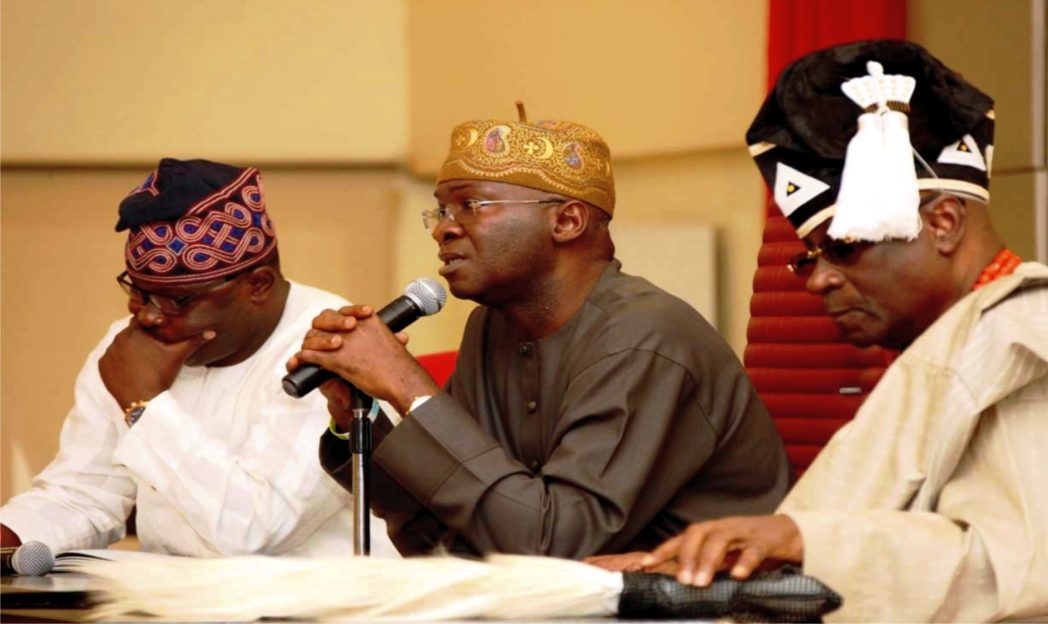
L-R: Lagos State Commissioner for Local Government and Chieftaincy Affairs, Mr Ademorin Kuye; Governor Babatunde Fashola and Oba Rilwan Akiolu of Lagos, at a meeting of traditional rulers with Governor Fashola in Lagos recently.



The Head of the Department of Anatomy at the University of Port Harcourt’s College of Health Sciences, Prof Gabriel Sunday Oladipo, has underscored the urgent need for Nigeria to develop a comprehensive forensic science infrastructure, warning that the nation’s ability to investigate and solve crime is being hampered by lack of scientific data and systems.
In his inaugural lecture titled, “Man: Fearfully Different, Wonderfully Made,” delivered as part of the 207th Inaugural Lecture Series of the university, Prof Oladipo highlighted that while no two individuals are exactly the same, the country currently lacks the robust systems needed to collect and manage biological and anthropometric data that could support criminal investigations.
He explained that the natural variations among humans — from fingerprints to physical measurements — form the foundation of personal identification in forensic work. These biological differences, he said, are essential for distinguishing one person from another, especially in the context of criminal investigations where clarity of identity can mean the difference between justice and impunity. Without this scientific foundation, he argued, law enforcement agencies lack a critical tool in the fight against crime.
Experts have noted that Nigeria’s forensic science capacity has historically lagged behind needs, with only a few forensic facilities available and many law enforcement agencies struggling to access or use scientific evidence effectively. One review of the state of forensic investigation in Nigeria found that outdated facilities and limited adoption of modern forensic methods have left many cases unsolved or poorly investigated, even as crime rates rise across the country.
In Lagos, efforts to improve forensic capabilities have focused on DNA analysis, with the Lagos State DNA Forensic Centre — the first of its kind in West Africa — providing critical support for criminal investigations and helping to identify human remains, link related cases, and assist with paternity testing. However, such initiatives are yet to be replicated at a national scale, leaving many regions without access to these vital scientific tools.
Prof Oladipo’s lecture went beyond academic theory to propose concrete actions. He called for the establishment of a National Institute of Forensic Science responsible for creating and managing a nationwide anthropometric and forensic data bank. This repository, he stressed, would significantly enhance Nigeria’s capacity to track crime, assist law enforcement agencies, and improve the administration of justice by providing reliable scientific evidence for investigative and legal processes.
He also highlighted the importance of strengthening research and training in forensic science. Many Nigerian universities currently lack the funding and infrastructure to offer complete undergraduate or postgraduate programs in areas such as forensic anthropology, DNA analysis, and crime scene investigation, a gap that forces aspiring experts to rely on collaborations with institutions abroad. By fostering a research-friendly environment and securing greater support from both government and private sectors, Nigerian institutions could produce homegrown experts capable of advancing forensic science in the country.
Awareness of forensic science’s role in criminal justice remains low among the general public and even among some security professionals. Studies have shown that a significant portion of Nigerians are unfamiliar with basic forensic concepts or the existence of tools such as DNA profiling and national forensic databases — tools that are common features of criminal justice systems in countries like South Africa and the United Kingdom.
Prof Oladipo also urged regular training and retraining programs to keep forensic practitioners updated with evolving scientific methods. According to him, continuous professional development is critical in a field where technological advances — from biometric databases to digital forensic tools — are transforming how crimes are investigated and solved.
The lecture was attended by academics, students, and professionals drawn to the intersection of science, identity, and justice, all of whom heard the professor make a compelling case for scientific innovation and institutional reform as central to Nigeria’s effort to contain crime and strengthen its justice system.
The event not only showcased Prof Oladipo’s expertise in human anatomy and forensic psychology but also positioned forensic science as a strategic national priority — one that could bring clarity to investigations, support victims and their families, and ultimately enhance public safety across Nigeria.

The University of Port Harcourt Women Association (UPWA) on Thursday staged a vibrant and memorable edition of its Annual Inter-House Sports Competition at the University of Port Harcourt Sports Village, drawing an impressive turnout of pupils, parents, staff and invited guests.
The event, organised by the UPWA International Group of Schools, brought together children from the pre-nursery, nursery and secondary sections in a colourful celebration of youth athleticism, discipline and teamwork. The arena came alive with cheers and excitement as pupils, clad in their various house colours, marched in a ceremonial parade before proceeding to compete in a wide range of track and field events, relays, novelty races and other team-based activities designed to promote physical fitness and healthy competition.
Declaring the competition open, the Vice-Chancellor of the University of Port Harcourt, Professor Owunari Georgewill, commended UPWA for sustaining a tradition that continues to nurture young talents beyond the classroom. He noted that sports remain a critical component of holistic education, helping to build resilience, confidence, leadership skills and social interaction among children.
In her remarks, the President of UPWA, Professor Udeme Georgewill, expressed appreciation to parents, teachers and members of the organising committee for their dedication and sacrifice in ensuring the success of the programme despite prevailing economic challenges. She described the event as a reflection of unity and collective effort within the school community.
“This is the first time White House is emerging overall winner, and that shows remarkable improvement and great sportsmanship,” she said. “We all had fun. It is not easy putting an event like this together considering the economic situation, but we are grateful to the parents for being part of this journey. The excitement everywhere is truly heartwarming.”
The competition featured spirited participation from the various houses, including Purple House, San Chicago Red House and White House, with pupils demonstrating strength, speed, coordination and teamwork. Parents and supporters filled the stands, cheering enthusiastically and adding colour to the spectacle, while teachers ensured orderliness and safety throughout the proceedings.
Professor Georgewill emphasized that the true essence of sports lies not merely in winning trophies but in participation and personal growth. “Sports is not just about winning. It is an avenue for growth, discipline and opportunity. The fact that a child is able to participate is already a win. Losing this year does not mean you cannot win next year. Keep trying,” she encouraged, urging pupils to see both victory and defeat as stepping stones to greater achievements.
She further observed that while there are many competing interests in the Nigerian sports sector, consistent grassroots investment remains essential for discovering and nurturing future champions.
The colourful ceremony culminated in medal presentations, trophy awards and group photographs, with UPWA executives, including Vice President I, Professor Adedamola Onyeaso, joining the participating teams to celebrate the day’s achievements.
The annual inter-house sports competition continues to stand as one of UPWA’s flagship events, reinforcing its commitment to balanced education, character formation and the promotion of healthy lifestyles among its pupils.
-
Politics2 days ago
2027: NIGERIANS FAULT INEC ON DIGITAL MEMBERSHIP REGISTER DIRECTIVE
-

 Environment2 days ago
LAWMA Director Says Sweeping Reforms Have Improved Waste Collection
-
Politics2 days ago
LP Crisis: Ex-NWC Member Dumps Dumps Abure Faction
-

 Sports2 days ago
Abia Not Sure To Secure continental Ticket
-

 Politics2 days ago
Umahi Dismisses Allegations On Social Media, Insists On Projects Delivery
-

 Transport2 days ago
FAAN Announces Pick-Up Points for Go-Cashless Cards
-
Sports2 days ago
La Liga: Yamal Records First Career Hat-trick
-

 Sports2 days ago
City Survive Leeds’ Challenge At Elland Road