
Nation
THE STATES

Gombe
An Islamic cleric, Malam Salihu Tafawa-Balewa,
has advised traditional and religious leaders, as well as elders in Gombe State to caution candidates for the February elections to maintain peaceful campaigns.
He gave the advice in an interview with newsmen in Gombe.
He said leaders’’ fatherly advice was necessary for maintaining peace, understanding and unity before, during and after the elections in the state and across the country.
He added that “leaders and elders must caution candidates in their areas; candidates must be advised to know and understand that at the end of the elections, only one person will emerge as winner.
“There is need for them to conduct their political activities peacefully so that at the end, people will not have problems between them and their supporters.’’
Kano
The Managing Director of Kano State Roads
Maintenance Agency (KARMA), Mr Abubakar Jibril, said the agency had rehabilitated 42 township roads in the state between January and December 2014.
He told newsmen in Kano that the rehabilitation work was carried out in seven local government areas of the state.
He said the agency was established by the Kano State Government to repair dilapidated township roads across the 44 local government areas of the state.
He added that the agency was also mandated to maintain the roads, as well as clear the drains in local government areas.
Kebbi
The All Progressives Congress (APC) governorship
candidate in Kebbi State, Senator Atiku Bagudu, has appealed to voters in the state to vote wisely and shun financial inducement during the February general elections.
Bagudu, who made the appeal in Dakingarim, Suru Local Government Area at the inauguration of his campaign team, urged the electorate to vote for candidates whose party’s manifestos are people-friendly.
“Your permanent voter card is your right; you must not trade it for material and financial gains, ‘’ he said.
Bagudu called on registered voters in the state to collect their permanent voter cards and vote for APC candidates.
Kwara
A pharmacist, Lanre Alege, has urged Nigerians to be wary of seven dangerous acts after meal.
Alege, who is of the University of Ilorin Teaching Hospital (UITH), spoke while delivering a lecture at the Kwara Stadium Complex during the monthly keep fit exercise for members of staff of the tertiary health institution.
Acts to avoid, he said, included smoking after meals, eating fruits immediately after meals, drinking tea, loosening the belt, taking bath as well as walking about and sleeping immediately after meals.
“When you eat your fruits with meals, the fruit sticks in the stomach along with the content of the meal and cannot reach the intestine in time.
“Lying there, they get spoilt and spoil the remaining food in the stomach too,’’ he said.
Nasarawa
Some residents of Nassarawa State have said that
the Presidential candidate of the All Progressives Congress (APC), Gen. Mohammadu Buhari can change Nigeria for good.
They gave their opinions in separate interviews with newsmen in Lafia.
The APC gubernatorial running mate in the state, Mr Silas Agara, said Buhari “is an upright person who has nothing to gain in deceiving Nigerians.”
“If you study him as a person, you will notice clearly that this man has one goal in mind and that is to rescue Nigerians from recession, corruption and so many other problems that are facing us.
“Even the opposition admits that he is a man of trust and incorruptibility, and that is why they are very worried now.’’ he said.
Niger
Niger State APC Gubernatorial Candidate, Alhaji
Abubakar Bello, says he will have zero tolerance for corruption in the state, if elected governor on February 28.
Bello made the pledge on Sunday while addressing newsmen in Minna
“ I will have zero tolerance for corruption, and one way I will address corruption is to lead by setting a good example for others,” he said
He also said that he would not probe past administrations, to save vital time needed to deliver dividends of governance to the people.
“Probe is not a priority for me, because it will take up the timeý I would have used to work for the good people of the state.”
Ondo
The Director of Planning, Research and Statistics at
the Teaching Service Commission (TESCOM) in Ondo State, Mr Olusola Akanle, has reiterated government’s commitment to regular inspection and monitoring of public secondary schools.
Speaking with newsmen in Akure, Akanle said the major problem in public secondary schools was lack of adequate monitoring.
“We have told the principals that when we are not there, they are our representatives and should make sure that the teachers are on their toes.
“Responsible teachers do not have to wait for the principal to tell them their duties since they are sufficiently trained, experienced and should be dedicated to their duties.”
Sokoto
The Chairman, Sabon Birni Local Government Council in
Sokoto State, Alhaji Idris Gobir, has solicited the support of religious and traditional rulers in mobilising the electorate to collect their Permanent Voter Cards.
Gobir told newsmen in Sokoto that religious leaders should inform the people through their sermons the benefits of the voter cards.
He described the PVC as “the weapon needed by the electorate to elect candidates that will meet their expectations through the provision of the dividends democracy.’’
He said, “good governance will only be possible if the electorate participate in all the electoral processes.’’
Gobir advised the electorate in the area not to sell their voter cards and shun all forms of violence before, during and after the general elections.
Taraba
The governorship candidate of the All Progressives
Congress (APC) in Taraba State, has appealed to the electorate to give her the mandate to make the difference.
Alhassan made the appeal in an interview in Jalingo after a reception in her honour by supporters and party faithful.
She said men had ruled the state since its creation in 1991 but had not recorded the desired impact on the lives of the common people.
She added that “I want to appeal to the people of Taraba State to try a woman for once and I can assure you that you will see a great difference.’’
Alhassan, who denied allegations that she was still in the Peoples Democratic Party (PDP), said she had submitted her PDP membership card to the party’s state Chairman, Mr Victor Bala and had picked up that of APC, which she said was her current party.
Zamfara
The Peoples Democratic Party (PDP) gubernatorial
candidate, Alhaji Mamuda Shinkafi , has promised to improve education, healthcare services and security in Zamfara State, if elected.
Shinkafi, who was the former governor of the state under the ANPP, made the promise in Gusau at the flag-off of his campaign.
“It is unfortunate that instead of the state to be progressing in the areas of education, healthcare, and security, it is undergoing serious backwardness.”
According to him, when he left office in 2011, the state government had over 100 medical doctors and now has less than 40 doctors.
“My administration, if re-elected in February, will give priority to education, healthcare, security, harness mineral resources, as well as improve farming activities in the state,’’ he said.
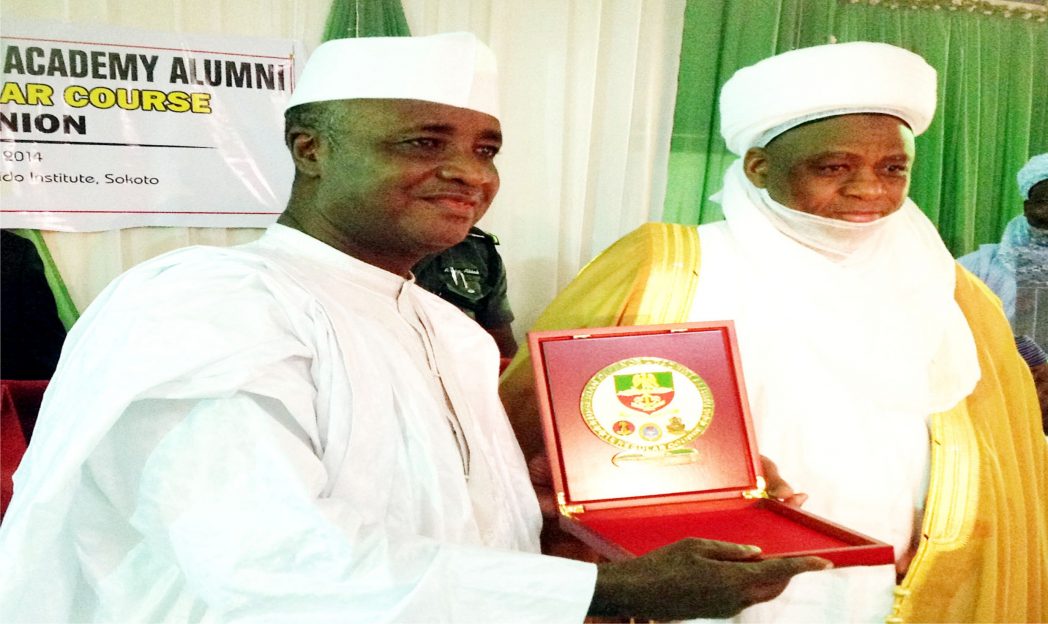
Governor Aliyu Wamakko of Sokoto State (left), receiving a souvenir from Sultan of Sokoto, Alhaji Sa’ad Abubakar 111 for attending the Nigerian Defence Academy Alumni 18th Regular Course Re-union in Sokoto.



The Head of the Department of Anatomy at the University of Port Harcourt’s College of Health Sciences, Prof Gabriel Sunday Oladipo, has underscored the urgent need for Nigeria to develop a comprehensive forensic science infrastructure, warning that the nation’s ability to investigate and solve crime is being hampered by lack of scientific data and systems.
In his inaugural lecture titled, “Man: Fearfully Different, Wonderfully Made,” delivered as part of the 207th Inaugural Lecture Series of the university, Prof Oladipo highlighted that while no two individuals are exactly the same, the country currently lacks the robust systems needed to collect and manage biological and anthropometric data that could support criminal investigations.
He explained that the natural variations among humans — from fingerprints to physical measurements — form the foundation of personal identification in forensic work. These biological differences, he said, are essential for distinguishing one person from another, especially in the context of criminal investigations where clarity of identity can mean the difference between justice and impunity. Without this scientific foundation, he argued, law enforcement agencies lack a critical tool in the fight against crime.
Experts have noted that Nigeria’s forensic science capacity has historically lagged behind needs, with only a few forensic facilities available and many law enforcement agencies struggling to access or use scientific evidence effectively. One review of the state of forensic investigation in Nigeria found that outdated facilities and limited adoption of modern forensic methods have left many cases unsolved or poorly investigated, even as crime rates rise across the country.
In Lagos, efforts to improve forensic capabilities have focused on DNA analysis, with the Lagos State DNA Forensic Centre — the first of its kind in West Africa — providing critical support for criminal investigations and helping to identify human remains, link related cases, and assist with paternity testing. However, such initiatives are yet to be replicated at a national scale, leaving many regions without access to these vital scientific tools.
Prof Oladipo’s lecture went beyond academic theory to propose concrete actions. He called for the establishment of a National Institute of Forensic Science responsible for creating and managing a nationwide anthropometric and forensic data bank. This repository, he stressed, would significantly enhance Nigeria’s capacity to track crime, assist law enforcement agencies, and improve the administration of justice by providing reliable scientific evidence for investigative and legal processes.
He also highlighted the importance of strengthening research and training in forensic science. Many Nigerian universities currently lack the funding and infrastructure to offer complete undergraduate or postgraduate programs in areas such as forensic anthropology, DNA analysis, and crime scene investigation, a gap that forces aspiring experts to rely on collaborations with institutions abroad. By fostering a research-friendly environment and securing greater support from both government and private sectors, Nigerian institutions could produce homegrown experts capable of advancing forensic science in the country.
Awareness of forensic science’s role in criminal justice remains low among the general public and even among some security professionals. Studies have shown that a significant portion of Nigerians are unfamiliar with basic forensic concepts or the existence of tools such as DNA profiling and national forensic databases — tools that are common features of criminal justice systems in countries like South Africa and the United Kingdom.
Prof Oladipo also urged regular training and retraining programs to keep forensic practitioners updated with evolving scientific methods. According to him, continuous professional development is critical in a field where technological advances — from biometric databases to digital forensic tools — are transforming how crimes are investigated and solved.
The lecture was attended by academics, students, and professionals drawn to the intersection of science, identity, and justice, all of whom heard the professor make a compelling case for scientific innovation and institutional reform as central to Nigeria’s effort to contain crime and strengthen its justice system.
The event not only showcased Prof Oladipo’s expertise in human anatomy and forensic psychology but also positioned forensic science as a strategic national priority — one that could bring clarity to investigations, support victims and their families, and ultimately enhance public safety across Nigeria.

The University of Port Harcourt Women Association (UPWA) on Thursday staged a vibrant and memorable edition of its Annual Inter-House Sports Competition at the University of Port Harcourt Sports Village, drawing an impressive turnout of pupils, parents, staff and invited guests.
The event, organised by the UPWA International Group of Schools, brought together children from the pre-nursery, nursery and secondary sections in a colourful celebration of youth athleticism, discipline and teamwork. The arena came alive with cheers and excitement as pupils, clad in their various house colours, marched in a ceremonial parade before proceeding to compete in a wide range of track and field events, relays, novelty races and other team-based activities designed to promote physical fitness and healthy competition.
Declaring the competition open, the Vice-Chancellor of the University of Port Harcourt, Professor Owunari Georgewill, commended UPWA for sustaining a tradition that continues to nurture young talents beyond the classroom. He noted that sports remain a critical component of holistic education, helping to build resilience, confidence, leadership skills and social interaction among children.
In her remarks, the President of UPWA, Professor Udeme Georgewill, expressed appreciation to parents, teachers and members of the organising committee for their dedication and sacrifice in ensuring the success of the programme despite prevailing economic challenges. She described the event as a reflection of unity and collective effort within the school community.
“This is the first time White House is emerging overall winner, and that shows remarkable improvement and great sportsmanship,” she said. “We all had fun. It is not easy putting an event like this together considering the economic situation, but we are grateful to the parents for being part of this journey. The excitement everywhere is truly heartwarming.”
The competition featured spirited participation from the various houses, including Purple House, San Chicago Red House and White House, with pupils demonstrating strength, speed, coordination and teamwork. Parents and supporters filled the stands, cheering enthusiastically and adding colour to the spectacle, while teachers ensured orderliness and safety throughout the proceedings.
Professor Georgewill emphasized that the true essence of sports lies not merely in winning trophies but in participation and personal growth. “Sports is not just about winning. It is an avenue for growth, discipline and opportunity. The fact that a child is able to participate is already a win. Losing this year does not mean you cannot win next year. Keep trying,” she encouraged, urging pupils to see both victory and defeat as stepping stones to greater achievements.
She further observed that while there are many competing interests in the Nigerian sports sector, consistent grassroots investment remains essential for discovering and nurturing future champions.
The colourful ceremony culminated in medal presentations, trophy awards and group photographs, with UPWA executives, including Vice President I, Professor Adedamola Onyeaso, joining the participating teams to celebrate the day’s achievements.
The annual inter-house sports competition continues to stand as one of UPWA’s flagship events, reinforcing its commitment to balanced education, character formation and the promotion of healthy lifestyles among its pupils.
-
Politics2 days ago
2027: NIGERIANS FAULT INEC ON DIGITAL MEMBERSHIP REGISTER DIRECTIVE
-

 Environment2 days ago
LAWMA Director Says Sweeping Reforms Have Improved Waste Collection
-
Politics2 days ago
LP Crisis: Ex-NWC Member Dumps Dumps Abure Faction
-

 Sports2 days ago
Abia Not Sure To Secure continental Ticket
-

 Politics2 days ago
Umahi Dismisses Allegations On Social Media, Insists On Projects Delivery
-

 Transport2 days ago
FAAN Announces Pick-Up Points for Go-Cashless Cards
-
Sports2 days ago
La Liga: Yamal Records First Career Hat-trick
-

 Sports2 days ago
City Survive Leeds’ Challenge At Elland Road