
Nation
THE STATES

Bauchi
The Police command in Bauchi said it had arrested 10
suspected rustlers in the state.
The Spokesman of the command, DSP Haruna Mohammed, said this while briefing newsmen in Bauchi.
Mohammed said the rustlers include Yusuf Abdulkadir, Dare Karimu, Mamuda Sulai, Abdulkadir Usman, Ali Sulai, Maiwada Jahono, Buba Ali, Hassan Sale, Sale Jakudu and Alhaji Ahmed Mohammed.
He said the suspects were arrested on Dec. 10, at about 2:40 p.m. by police detectives attached to Dass Division with the help of Danga Vigilante Group.
Mohammed said the suspects had before their arrest engaged the police in fierce exchange of gunfire at Dajin Village,Tafawa Balewa Local Government Areas.
Benue
Governor Gabriel Suswam of Benue State said he had
kept his promise to the people of Masev, Ihiarev, Nongo Development Association (MINDA) by ensuring that Mr Terhemen Tarzoor, a youth from the area, would succeed him.
Suswam stated this while playing host to MINDA Youths Emancipation Moment at the Government House, Makurdi.
our correspondent reports that Tarzoor won the December 8 governorship primaries of the Peoples Democratic Party (PDP) in the state.
“We in Benue have decided to hand over power to the youths because they represent our future.
“The same thing is happening in the United State of America, Britain, among others, where youths are doing very well in leadership positions by ruling the biggest countries in the world, he said”.
Ekiti
An Ado-Ekiti Chief Magistrates’ Court in Ekiti State,
has remanded three accused persons, Sunday Daramola,20, Tope Olatunji,27, and Seun Adeniyi, 20, in prison for allegedly raping a teenager.
The prosecutor, Sgt. Bamikola Olasunkanmi, told the court that the accused committed the offence on Dec.8 at Okeoja St., Igbemo -Ekiti.
Olasunkanmi alleged that the accused persons, on the said date, unlawfully gang raped the girl, inflicting grievous harm on her.
According to him, the offence is punishable under Section 516 and 358 of the Criminal Code Law, Laws of Ekiti State, 2012.
He added that the case file had been forwarded to the office of the State Directorate of Public Prosecutions for legal advice.
Kano
The Kano Electricity Distribution Company (KEDCO)
has concluded all the necessary arrangements to import 100, 000 pre-paid meters for distribution to customers in 2015.
The Managing Director of the company, Alhaji Jamilu Gwamna, made this known at Customers’ Interactive Session on Credited Advance Payment for Metering Implementation (CAPMI) in Kano recently. Our correspondent reports that the forum was organised by the Nigerian Electricity Regulatory Commission (NERC) to sensitise electricity customers on the CAPMI.
He said the measure was necessary in order to reduce incessant complaints by customers on crazy billing as well as to ensure effective service delivery.
“Even though, they may not be enough, but we can start with this number since we will continue to bring them in batches,” he said.
Gwamna said the company had also planned to invest in solar power but the issue of land was the major challenge facing the company.
Nasarawa
The Nasarawa State House of Assembly has voted in
favour of autonomy for local government councils in the country and the abolition of states’ electoral commissions.
In a unanimous decision, the house said that scrapping electoral commission in the states and autonomy for local government councils were in the interest of peace and grassroots development in the country.
our correspondent reports that the decision was part of the assembly’s contribution to the amendment of the nation’s 1999 Constitution.
Presenting the matter earlier, Speaker of the assembly, Alhaji Musa Mohammed, urged members to consider the bill above personal interest.
Moving the motion on both issues, the Deputy Majority Leader of the house, Mr Yahaya Usman, said, “My colleagues, in the interest of peace and speedy development across the country, there is need for the autonomy for local governments.
“This is because local governments are closer to the people at the grassroots.
Niger
The Niger State Government says it has distributed 128
motorcycles to agricultural extension workers in the state, to ease their mobility.
Managing Director of the Niger State Agricultural and Mechanisation Development Authourity (NAMDA), Alhaji Baba Madugu, made this known in Minna.
He said that the programme was in collaboration with the international donor agencies, adding that it would improve the dissemination of modern technologies among rural farmers.
Madugu said that female extension workers would also get 20 per cent of the motorcycles.
“This is the second phase of the distribution of 128 units of motorcycles to our extension workers, who are the front line staff of delivering the mandate of NAMDA.
Ogun
Mr Tunde Awolana, the General Manager of Ogun State
Broadcasting Corporation (OGBC), said the corporation required N608 million to function effectively in 2015.
Awolana disclosed this in Abeokuta while defending the 2015 budget proposal of the corporation before the Ogun House of Assembly.
He said the corporation was expected to generate N200 million as Internally Generated Revenue (IGR) with a recurrent expenditure of N298 million and N310 million for capital expenditure.
The general manager explained that the capital projects would include improving the signal strength of its AM and FM channels in order to increase the audience base and media rating.
On her part, the Commissioner for Culture and Tourism, Mrs Yewande Amusan, presented a total expenditure of N547 million for 2015.
Sokoto
Sokoto State Government has donated six 36-seater
buses to three tertiary educational Institutions in the state.
The institutions include the state university, state polytechnic and the Shehu Shagari College of Education, Sokoto.
Presenting the vehicles in Sokoto, Wamakko said each of the institutions was given two buses.
He said the vehicles were provided to alleviate transportation problems of the Institutions, adding, “the buses will also help in boosting their sources of revenue and reduce heavy dependence on government.
“I must express my appreciation to the various leaders of the institutions for their contribution in boosting standard of education in the state.”
Taraba
The Taraba State Command of the Nigeria Immigration
Service (NIS) has repatriated 11 nationals of the Niger Republic who were residing in the state illegally.
The NIS State Comptroller, Mr Habibu Haruna, disclosed this at a news briefing in Jalingo.
Haruna said the immigrants were arrested because they entered into the Takum axis of the state without valid traveling documents.
He said the aliens did not have the required traveling documents as stipulated by the Economic Community of West African States (ECOWAS).
The comptroller, who was represented by the command’s Public Relations Officer, Mr Solomon Gisilambe, said that the presence of the foreigners raised fears amongst residents of Takum.
Zamfara
The Zamfara State Eye Centre, Gusau, has treated 15,000
patients of various eye diseases from 2012 to date.
The Assistant Chief Nursing Officer in charge of the centre, Alhaji Lawwali Hassan, said this in an interview with in Gusau on recently.
Lawwali said that the centre had recorded many successes in the treatment of various eye diseases.
According to him, the centre was owned by the state government but funded by Sightsavers International which provided medication and other components needed for the operation.
“The centre is established within King Fahd Abdul’aziz Women and Children Hospital, Gusau, and the patients mostly treated are those suffering from cataract, while others are with trauma and foreign body removal.
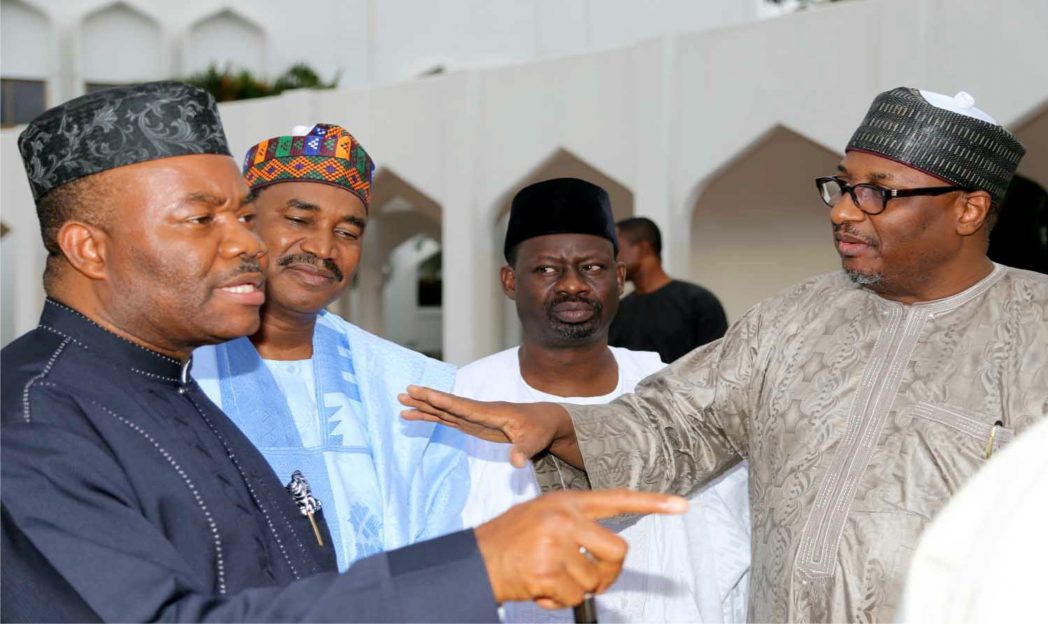
L-R: Governor Godswill Akpabio of Akwa Ibom State, Governor Ibrahim Shema of Katsina State, Governor Ibrahim Dankwambo of Gombe State and PDP National Chairman, Alhaji Adamu Mu’azu, after a meeting with President Goodluck Jonathan at the Presidential Villa, Abuja




The Hydrocarbon Pollution Remediation Project (HYPREP) has commemorated the 15th anniversary of the release of the United Nations Environment Programme (UNEP) Environmental Assessment Report on Ogoniland, reaffirming its commitment to restoring the environment and improving the livelihoods of affected communities.
In a statement signed by the Project Coordinator, Prof Nenibarini Zabbey, to commemorate the anniversary, HYPREP described the anniversary as a significant milestone in Nigeria’s environmental restoration efforts, noting that the project has made remarkable progress in implementing the recommendations of the landmark UNEP report released on August 4, 2011.
The UNEP report had revealed extensive oil pollution across Ogoniland, severe environmental degradation, and serious public health risks resulting from decades of petroleum operations. It also recommended an initial $1 billion fund to commence the cleanup of the affected communities.
According to HYPREP, the Federal Government formally launched the Ogoni clean-up in 2016, while the Project Coordination Office was established in 2017 to drive the implementation of UNEP’s recommendations.
Zabbey said the current administration has continued to prioritise the project under the Renewed Hope Agenda.
Providing an update on the cleanup, the Project Coordinator disclosed that 30 of the 65 contaminated sites identified by UNEP have been fully remediated, while work is ongoing at several medium- and high-risk locations. It also stated that more than 1.5 million mangrove seedlings have been planted as part of what it described as the world’s largest restoration of oil-degraded mangroves, with over 1,000 hectares of shoreline already rehabilitated.
Zabbey further revealed that 49 Ogoni communities have been connected to potable water schemes through multiple water projects and booster stations aimed at providing safe drinking water across the region.
In the health sector, he said the 100-bed Ogoni Specialist Hospital in Kpite and the 43-bed Cottage Hospital in Buan are nearing completion, adding that several existing health facilities have been upgraded with modern medical equipment, while five ambulances have been donated to improve emergency healthcare services. The Project Coordinator also disclosed that a three-year human health biomonitoring study is being conducted in collaboration with the World Health Organization’s International Agency for Research on Cancer (IARC).
On economic empowerment, Zabbey stated that the Project has created more than 8,000 direct jobs and trained thousands of Ogoni youths and women in various vocational and technical skills, including software development, cybersecurity, aviation, commercial diving, seafaring, mechatronics, and creative arts. The project also reported awarding scholarships to more than 1,000 students, providing grants to small businesses, and supporting persons living with special needs through skills acquisition programmes.
The statement further highlighted ongoing legacy projects, including the Ogoni Power Project and the Centre of Excellence for Environmental Restoration, which it said is about 96 per cent complete. HYPREP also welcomed the recent designation of the Ogoni Wetland as a Ramsar Site of International Importance and pledged to continue promoting biodiversity conservation and sustainable management of the ecosystem.
Marking the anniversary, Zabbey said the progress achieved over the past 15 years demonstrates the collective commitment of government, development partners, stakeholders, and local communities to restoring Ogoniland. He called for renewed collaboration to sustain the cleanup effort, promote environmental sustainability, and support the long-term development of the region. 3
-

 News2 days ago
RSG Targets Nine Million Residents in Mosquito Net Distribution Campaign
-

 Oil & Energy2 days ago
Aiyedatiwa Signs New Electricity Bill
-

 Oil & Energy2 days ago
NLNG Commissions Research And Innovation Centre In RSU
-

 Maritime2 days ago
Marine Minister Commends President Tinubu On NPERA Bill Assent
-

 News2 days ago
KenPoly Holds Eight Convocations, August 29
-

 News2 days ago
RSG Begins Another Phase of Projects Commissioning Today
-

 News2 days ago
RMAFC Completes Revenue Sharing Review, Proposes New Pay
-

 Maritime2 days ago
NAGAFF Petitions IGP Over Alleged Maritime Police Harassment