
Nation
THE STATES

Borno
A man claiming to be a member of Boko Haram has main
tained that the Federal Government must release its members detained in numerous facilities nationwide before the terrorist group releases the 219 Chibok schoolgirls it has held in captivity for almost three months.
This came as the National Council of State (NCS), at the end of its meeting Tuesday, assured the Nigerian public that schoolgirls will be rescued very soon but failed to give detail as to how this would be achieved.
The Federal Government had given the same assurance Monday when the Coordinator of the National Information Centre, Mr. Mike Omeri, said the girls would soon be freed.
Speaking on the BBC World Service, the man whose voice was disguised in order to conceal his identity, said he was a teacher or scholar in the sect and joined the group in 2004.
He said that the girls were in “a state of amnesty”, healthy and eating well, adding that the Christians who refused to convert to Islam were not forced to do so as it is anti-Islamic.
The Boko Haram member maintained that the girls were taken for a specific reason and reiterated the condition for their release, adding that the girls would be released once the Federal Government met the terrorist group’s demands for a prisoner exchange deal.
Ekiti
The Peoples Democratic Party, Ekiti State, has threat
ened to sue the Ekiti State House of Assembly for contempt if it took further steps on the bill seeking creation of the new 18 Local Council Development Authorities.
The party which gave the warning in a letter by its Legal Adviser, Mr. Kolapo Kolade, to the Speaker, Adewale Omirin, in Ado Ekiti last Wednesday.recalled that the party had gone to court to challenge the bid to create the LCDAs by the Governor, Dr. Kayode Fayemi.
Kolade warned that it will be contemptuous for the Assembly to pass the bill when there was a pending suit in Court.
Citing Cap 8, Section 54(5) of the standing order of the Assembly, the party quoted that “No matter, pending in Court of Law shall be entertained by the House in order not to prejudice the decision of the court in respect of the matter.”Similarly, it is in law that when an application for injunction is pending in Court, none of the parties should take step regarding the issue raised therein.
“We therefore wish that you will be advised accordingly as we are aware that the issue of the creation of LCDAs which is the subject matter of the suit under reference is said to have passed the First Reading in the House on 7th July, 2014 despite the pendency of the suit and the fact that you have adequate notice of same.
FCT
The National Security Adviser (NSA), retired Col. Sambo
Dasuki, said recently that Nigeria respects the sovereignty of its neighbours and has no “territorial ambition’’ over the disputed Bakassi Peninsula with Cameroon.
Dasuki said in Abuja at the opening of the Nigeria/Cameroon Trans-Border Security Committee holding from July 8-11. that the security meeting held in Paris on May 17 and London on June 4, under the auspices of the leadership of both countries underscored the need for the meeting
He said that the forum would provide a unique opportunity for border security agencies of the two countries to meet and discuss issues that hitherto has been difficult.
On his part, the Head of Cameroon Delegation, Mr Rene Sadi, the Minister of Territorial Administration and Decentralisation, said that the meeting would assist both countries to urgently take measures to wipe out criminality from the borders.
Kano
The Kano State Government said it had recruited 998
new teachers for public secondary schools in the state.
Governor Rabiu Kwankwaso made this known recently when he distributed appointment letters to newly recruited teachers employed into the state civil service.
Kwankwaso said that the introduction of free education necessitated the recruitment of the teachers to boost the manpower in the teaching profession in the state and further appealed to the new employees to be good ambassadors of the state wherever they found themselves.
“The recruitment also became necessary so as to provide qualified staff with a view to improving teaching and learning in schools. Our administration is vigorously pursuing mass literacy campaign to stamp out illiteracy from the state”, he said.
Kogi
A Lokoja Chief Magistrate Court has ordered that three
men be kept in custody over their alleged involvement in the kidnap of children of the Kogi State House of Assembly speaker. The Chief Magistrate, Mr. Levi Animoku, gave the order in his ruling after the accused- Abdulwahab Bajeh, Sule Ganiyu and Yunusa Abdulmalik- were arraigned in Lokoja.
They were charged with criminal conspiracy and kidnapping, contrary to section 97 of the Penal Code Law and sections 3(a) and 7(a) of Kogi State Kidnapping, Thuggery and other Related Offences (Prohibition) Law 2010.
It will be recalled that seven year Ogirima Lawal and her three-year-old younger brother Hafiz Lawal, both children of the speaker, Alhaji Momoh-Jimoh Lawal, were on April 15 kidnapped by four unidentified gunmen from their family house in Okengwe, Okene Local Government were released on June 6, after horrifying 53 days in the kidnappers’ custody.
Kwara
An Ilorin High Court in Kwara State yesterday, con
victed four criminals to death by hanging for armed robbery and criminal conspiracy.
The condemned convicts; Ibrahim Olayiwola, AbdulWaheed Aliyu, Tunde Kareem and Omotayo Isah, who broke down shortly after the judgement was handed down by Justice S.T Umar, were charged for robbing petroleum attendants of Rockfield Petroleum Filling Station, Odota, Ilorin in February 2011 contrary to the provisions of Section 97 of the Penal Code and Section 1 (2) of the Robbery and Firearms (Special provisions) Act, CAP R11 Laws of Federation of Nigeria 2004.
Lagos
The Lagos State Government on Thursday said that it
would channel its available resources to combat overcrowded classrooms in public schools in the state.
Mrs Gbolahan Daodu, Executive Secretary, Lagos State Universal Basic Education Board, disclosed this to the News Agency of Nigeria in Lagos.
Daodu said that the state government was working toward having not more than 50 pupils in a classroom, as required by standards.
She stressed that the influx of people to the state everyday poses a serious challenge to the policy.
“We will try and accommodate all pupils but the influx of people into the state is a challenge.
“Lagos is a small state with limited land space, yet millions of people come in on a daily basis and they expect the government to cater for them.
“We are striving to meet the need of all of them.
“Our attempt is to ensure that we do not have more than 50 pupils at the maximum, in each class,” she said.
Daodu said that state government would provide access to education for pupils, irrespective of the challenges confronting schools in the state.
Osun
The prime suspect in the bomb that exploded inside a
Peugeot 505 saloon car at the Ministry of Water Resources, Abere,Osun State, on June 15, 2007, Richard Abayomi Adesanmi, said he was lodged at the State Government House, Osogbo, instead of prison custody .
Adesanmi was ordered to be remanded in prison custody by Magistrate (now Justice) Jide Falola on March 10, 2008 alongside some chieftains of defunct Action Congress of Nigeria, ACN, who were accused of complicity in the bomb blast. When the case came up for further hearing yesterday before Justice Adeyinka Aderibigbe, Adesanmi confessed that he was not taken to prison as ordered by the court.
Attorney-General and Commissioner for Justice in the state, Mr. Wale Afolabi, while cross examining the suspect, confronted Adesanmi with the fact that he was lodged at Government House instead of the prison, and the suspect admitted.
Taraba
No fewer than 50,000 persons, mainly women, children
and the aged, have been displaced from their homes in various parts of Taraba following the recent crisis in the area, the National Emergency Management Agency (NEMA), has said.
NEMA’s Operations Officer in Gombe State office, Zainab Umar, said this yesterday in Bali, Taraba State, while distributing relief materials at one of the camps occupied by victims of the recent communal conflict.
She explained that NEMA had donated 20 trucks of relief materials and had commenced distribution of assorted materials comprising food, non-food items and medical supplies to the displaced persons.
“No fewer than 9,000 displaced persons have taken refuge in some places of worship and residences in Bali, headquarters of Bali council area and its environs,” she said.
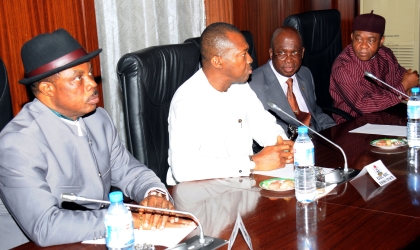
L-R: Governors Willie Obiano of Anambra State, Sullivan Chime of Enugu State, Martins Elechi of Ebonyi State and Theodore Orji of Abia State, during their meeting with President Goodluck Jonathan at the Presidential Villa in Abuja, recently.

Rivers state Deputy Governor Professor Ngozi Nma Odu has commended “The Port Harcourt City One Love,”a Port Harcourt based humanitarian orgnisation For it’s commitment towards alleviating the sufferings of the poor and vulnerable in the society.
Professor Ngozi Nma Odu said this while speaking at this year’s edition of “operation feed the needy” a yearly outreach program of “The Port Harcourt City One Love ” in Port Harcourt.
The Deputy Governor said by feeding more than sixty thousands hungry people within the past six years, the Port Harcourt City One Love Movement has distinguished itself as a club that cares for the less privilege in the society.
She commended the , organization for listing eleven thousand persons to be fed in the current exercise.
Meanwhile The Port Harcourt City One Love has planned a permanent solution to the problem of feeding the poor in the state.
The leader of the group Mr Idaere Gogo Ogan who said this in an interview with newsmen during the distribution of food items to the poor and vulnerables in Port Harcourt said the organization is planning a permanent food kitchen where poor and vulnerable persons can work in anytime and get fed.
Idaere Gogo Ogan said more than sixty thousands poor and vulnerable persons across Port Harcourt City and environs have been fed since the inception of “The operation feed the needy” program six years ago,adding that so far sixty thousands poor and vulnerable persons have beneffited.
He described the group as a platform to promote friendship, brotherhood, community development empathy and feeding the less privilege and hungry people
“That’s what we are doing today here,so we started the exercise six years ago”.he said.
Ogan said the effort was a private sector driven initiative but added “it also involves people in Government because the platform does not recognize any division,we bring everybody together in unity , friendship and brotherhood”he said.
He said the effort will go along way in alleviating hunger especially following the prevailing hunger in the country.
According to him “you know the country is very tough, people are hungry people are starving, there is a whole lot of economic hardship,so for us, this is just our own way of reaching out, our own social contribution to what is very difficult”he said.
Over eleven thousand persons were fed in the just concluded exercise.
Areas of coverage include, Isaac Boro park, Port Harcourt prison/Macoba, Borokiri/Enugu waterside Bundu areas Waterlines and others.
Some of the beneficiaries including an 80 years old widow commended the movement for the annual programm and urged other organizations to emulate them
John Bibor,/Esuuk Oyet/Suotor Memoye /Jeremiah Hannah
Nation
We’ll Partner Private Sector to Industrialize Rivers State – Fubara …Hints Revitalization of Ahoada, Trans Amadi Industrial layout

“Inclusive growth requires access to capital and the right conditions for businesses to deploy that capital effectively. Women-led enterprises are critical to economic activity, yet they face structural barriers.
“This intervention aims to help close that gap by providing financing that supports job creation, business expansion, and long-term sustainability for women entrepreneurs”, Edun said.
Group Head, SheVentures and Impact Segments at First City Monument Bank (FCMB), Nnenna Jacob-Ogogo said access to affordable finance remains a major constraint for women entrepreneurs.
-

 Featured2 days ago
WASSCE: RSG Distributes Science Materials To Secondary Schools
-
News2 days ago
Xenophobic Attacks: Nigerian Lives More Important Than Foreign Investment – Oshiomhole
-
Rivers3 days ago
MBA Forex Trial Adjourn To June 3, Amid Bereavement … As Court Declines Cost Application
-
News2 days ago
ActionAid Demands Probe Of Govs Using Public Funds For Campaign
-
Aviation3 days ago
Passengers Stranded As Delta Airline From Atlanta Route Back Eight Hours After
-
Business3 days ago
Customs Impound N2.35bn Cocaine, 15 Trailers of Rice
-
Politics2 days ago
2027: Bayelsa Senator Gets Critical Endorsement For Second Term
-

 Politics2 days ago
INEC Sets Rivers South-East Senatorial By-Election For June 20