
Nation
THE STATES

Bauchi
The Programme Manager, Bauchi State Agricultural
Development Project, Dr Iliyasu Gital, recently advocated enhanced recruitment, training and deployment of extension workers to boost the country’s agricultural sector.
Gital said in Bauchi that poor agricultural extension service was affecting the national food security and the agricultural transformation agenda of the present administration.
He described the extension service as “very poor and low’’ because the ratio of farmer per extension officer stood at one extension officer to about 10,000 farmers.
The programme manager said that it was only in Bauchi State that the ratio was one extension officer to about 1,000 farmers.
He said those trained were currently training farmers and some agents that were not opportune to attend the training sessions.
Benue
The Principal of Government College, Makurdi, Mr Godfrey
Ugudu, has said the school had received letter from Boko Haram sect threatening to attack the school.
Ugudu, who announced this at a news conference in Makurdi and added that the school received two letters which had the same content on May 14.
“The two letters, which were written in pidgin English, were sighted inside one of the classrooms and the second one was slipped into the staff room’’, he said.
The principal commended the government and security operatives in the state for their prompt response to the issue, adding that he had informed the Principal of Mount Saint Gabriel.
The Police Public Relations Officer in the state, Dan Ezeala, confirmed the report and assured that police were on top of the situation.
Borno
The Borno State Government last Sunday said it had
sponsored 50 students to India on irrigation agriculture.
A statement by Malam Isa Gusau, Special Adviser to Governor Kashim Shettima, stated that it was part of the state government’s approaches to fight the menace of insurgents.
The statement stated that the students left Nigeria for India on Saturday on board an Ethiopian airline in Abuja.
It stated that Governor Kashim Shettima addressed them at Ogbeh farms in Kuje Area Council of the Federal Capital Territory.
Shettima said the beneficiaries were selected across the 27 local government areas of the state for even spread and disclosed that the trainees were to undergo a three-week train-the-trainers course on irrigation equipment installation, effective utilisation and maintenance.
Gombe
Governor Ibrahim Dankwambo of Gombe State last
Saturday appealed to abductors of female students of Government Girls Secondary School, Chibok, Borno State to release them.
Dankwambo made the appeal in Gombe while speaking at the inauguration of an organisation, ‘Talba-Neighbour-to Neighbour’ to provide poverty alleviation materials to the less privileged persons in the state.
The governor called on the abductors to release the innocent girls to reunite with their families.
“I, on behalf of the government and people of Gombe State, call on whoever that abducted the Chibok girls to release them. “The girls are innocent; they should be released and the abductors should come out and talk if it is somebody’s fault,” he said.
Jigawa
The Kafinhausa Local Government Council in Jigawa State
last Saturday inaugurated a Special Task Force to mobilise people to participate in polio immunisation.
The Chairman of the council, Alhaji Balo Tambale, made the announcement at a meeting with the committee members in Kafinhausa, the headquarters of the council.
Tambale, who is also the chairman of the committee, said that membership of the committee was made up of community and religious leaders as well as health workers.
He named other members of the committee to include representatives of the police and non governmental organisations.
Tambale said that the committee was to mobilise people, ensure effective monitoring and supervision of the exercise in the area stating that the council would also reward any community leader who recorded the highest coverage in the next round of immunisation in the area.
Kano
Local councils election holding in Kano State has recorded
low turn out of women in parts of the state. Areas affected include Unguwar Gano and Unguwar Fulani in Tarauni Local Government Area and some parts of Na’ibawa in Kumbotso Local Government.
Some of the residents said they did not allow their wives to come out to vote for fear of violence during the election.
One of them, Malam Saminu Bala, however, said he would “monitor the situation” before allowing his wives to come out to vote.
The situation is similar in Gwale Local Government Area, where the Information Officer of the council, Hajiya Amina Dankadai, confirmed the low turnout of women in polling units across the area.
However, local governments like Gwarzoo and Ungogo had recorded large turn out of women, who were seen patiently waiting in queues, to cast their vote.
Lagos
A new cable television network to “advance the cause of
the Catholic faith in Africa, Europe and parts of Asia is to hit the airwaves on May 22.
The station, known as Lumen Christi, located at Km. 15 on the Lagos-Epe Expressway at Lekki, Lagos, is to transmit free-to-air programmes, produced by various Catholic parishes in Nigeria and other African countries.
The Proprietor of the network, Mr Robert Olagunju, said the station would transmit its programmes in English with sub-titles in French and occasionally in Spanish, Portuguese, Swahili and Pidgin.
Olagunju, a Catholic faithful, said that he built the station to commemorate his 50th birthday and to show gratitude to God and humanity.
Olagunju said that the station would among other programmes, offer religious cartoons for kids as well as faith sessions, to be anchored by priests and other religious people.
Nasarawa
Governor Tanko Al-Makura of Nasarawa State, last Sunday
donated N8 million to some farmers affected by communal clash in four local government areas of the state.
The governor, who also donated relief materials such as foodstuff, mattresses and ground-nut oil, had visited the victims in Doma.
The communities that benefited included Idada, Abaabu, Tachia and Jangaru, all in Doma, Obi, Keana and Awe Local Government Areas of the state.
Al-Makura said that the donation was to provide relief to the affected persons to enable them resettle, adding that the welfare of the citizens of the state was his priority.
The governor also assured residents of adequate security, saying and stressed the need for residents of the state and all Nigerians to be united and to live in peace with one another.
Ogun
The Federal Road Safety Commission (FRSC) in Ogun State
last Saturday, warned motorists to exercise caution and drive carefully during the rainy season to prevent accidents.
Sector Commander, Mr Adegoke Adetunji, gave the advice in an interview in Abeokuta and said that the warning became necessary because the rate of road traffic accidents was always high and worrisome during the rainy season.
“During the rainy season we have a lot of road crashes because drivers, especially the commercial drivers, fail to do those things that they are expected to do to make their vehicle road worthy.
“I want to advise our drivers to always pull off the road for safety when there is poor visibility during down pour,’’ he said.
The sector commander advised the motorists to maintain the normal speed limit stated in the Highway Code.
“It does not mean that when an official of the FRSC tells you that you have a limit of 100 kilometres per hour, you must stick to it; the weather condition should determine your speed. “The Ogun command will continue to sensitise the people at various motor parks and other places across the state to safety tips and the need to drive carefully this period,’’ he said.
Oyo
The Oyo State Commissioner of Police, Mr Mohammed
Indabawa, recently in Ibadan urged various communities in the country to engage in community policing.
Indabawa, represented by the Police Public Relations Officer (PPRO), Mrs Bisi Clet-Ilobanafor, said this during the 5th Anniversary Lecture on Road Accident Information and Rescue Organisation with the lecture “Developing an Effective National Security.’’
Indabawa said that community policing was the collaboration of the community members with the police to ensure that the society was free of crime.
He said that the police could not achieve any meaningful success in crime prevention without the support of the community.
In his remark, Mr Okanlawon Bamgboye, National Executive Coordinator of the Community Policing, said that the objective of the lecture was to look at the present security challenges in Nigeria and the way forward.
Sokoto
Senator Ahmed Maccido ( PDP-Sokoto), said last Saturday
that he had built five Information, Communications and Technology ( ICT) Centres with N250 million.
Maccido, who represents Sokoto Central Senatorial District, said that the centers were established in Sokoto South, Sokoto North, Kware, Binji and Tangaza local governments to encourage youth in the constituency to be ICT literate.
He said in Sokoto that all the centres had been fully equipped and made operational.
“These centres will help in training the teeming youths from the constituency, as the ICT is now the vogue globally. “ The gesture is aimed at making them employable, while most of them will be transformed into employers of labour,” he added.
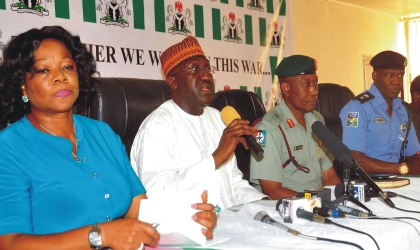
L-R: Deputy Director, Department of Security Service (DSS), Mrs Marilyn Ogar, Director-General, National Orientation Agency (NOA), Mr Mike Omeri, Director, Defence Information, Maj.-Gen. Chris Olukolade and Force Public Relations, Mr Frank Mba, at the news conference on security in Abuja, yesterday.



The Head of the Department of Anatomy at the University of Port Harcourt’s College of Health Sciences, Prof Gabriel Sunday Oladipo, has underscored the urgent need for Nigeria to develop a comprehensive forensic science infrastructure, warning that the nation’s ability to investigate and solve crime is being hampered by lack of scientific data and systems.
In his inaugural lecture titled, “Man: Fearfully Different, Wonderfully Made,” delivered as part of the 207th Inaugural Lecture Series of the university, Prof Oladipo highlighted that while no two individuals are exactly the same, the country currently lacks the robust systems needed to collect and manage biological and anthropometric data that could support criminal investigations.
He explained that the natural variations among humans — from fingerprints to physical measurements — form the foundation of personal identification in forensic work. These biological differences, he said, are essential for distinguishing one person from another, especially in the context of criminal investigations where clarity of identity can mean the difference between justice and impunity. Without this scientific foundation, he argued, law enforcement agencies lack a critical tool in the fight against crime.
Experts have noted that Nigeria’s forensic science capacity has historically lagged behind needs, with only a few forensic facilities available and many law enforcement agencies struggling to access or use scientific evidence effectively. One review of the state of forensic investigation in Nigeria found that outdated facilities and limited adoption of modern forensic methods have left many cases unsolved or poorly investigated, even as crime rates rise across the country.
In Lagos, efforts to improve forensic capabilities have focused on DNA analysis, with the Lagos State DNA Forensic Centre — the first of its kind in West Africa — providing critical support for criminal investigations and helping to identify human remains, link related cases, and assist with paternity testing. However, such initiatives are yet to be replicated at a national scale, leaving many regions without access to these vital scientific tools.
Prof Oladipo’s lecture went beyond academic theory to propose concrete actions. He called for the establishment of a National Institute of Forensic Science responsible for creating and managing a nationwide anthropometric and forensic data bank. This repository, he stressed, would significantly enhance Nigeria’s capacity to track crime, assist law enforcement agencies, and improve the administration of justice by providing reliable scientific evidence for investigative and legal processes.
He also highlighted the importance of strengthening research and training in forensic science. Many Nigerian universities currently lack the funding and infrastructure to offer complete undergraduate or postgraduate programs in areas such as forensic anthropology, DNA analysis, and crime scene investigation, a gap that forces aspiring experts to rely on collaborations with institutions abroad. By fostering a research-friendly environment and securing greater support from both government and private sectors, Nigerian institutions could produce homegrown experts capable of advancing forensic science in the country.
Awareness of forensic science’s role in criminal justice remains low among the general public and even among some security professionals. Studies have shown that a significant portion of Nigerians are unfamiliar with basic forensic concepts or the existence of tools such as DNA profiling and national forensic databases — tools that are common features of criminal justice systems in countries like South Africa and the United Kingdom.
Prof Oladipo also urged regular training and retraining programs to keep forensic practitioners updated with evolving scientific methods. According to him, continuous professional development is critical in a field where technological advances — from biometric databases to digital forensic tools — are transforming how crimes are investigated and solved.
The lecture was attended by academics, students, and professionals drawn to the intersection of science, identity, and justice, all of whom heard the professor make a compelling case for scientific innovation and institutional reform as central to Nigeria’s effort to contain crime and strengthen its justice system.
The event not only showcased Prof Oladipo’s expertise in human anatomy and forensic psychology but also positioned forensic science as a strategic national priority — one that could bring clarity to investigations, support victims and their families, and ultimately enhance public safety across Nigeria.

The University of Port Harcourt Women Association (UPWA) on Thursday staged a vibrant and memorable edition of its Annual Inter-House Sports Competition at the University of Port Harcourt Sports Village, drawing an impressive turnout of pupils, parents, staff and invited guests.
The event, organised by the UPWA International Group of Schools, brought together children from the pre-nursery, nursery and secondary sections in a colourful celebration of youth athleticism, discipline and teamwork. The arena came alive with cheers and excitement as pupils, clad in their various house colours, marched in a ceremonial parade before proceeding to compete in a wide range of track and field events, relays, novelty races and other team-based activities designed to promote physical fitness and healthy competition.
Declaring the competition open, the Vice-Chancellor of the University of Port Harcourt, Professor Owunari Georgewill, commended UPWA for sustaining a tradition that continues to nurture young talents beyond the classroom. He noted that sports remain a critical component of holistic education, helping to build resilience, confidence, leadership skills and social interaction among children.
In her remarks, the President of UPWA, Professor Udeme Georgewill, expressed appreciation to parents, teachers and members of the organising committee for their dedication and sacrifice in ensuring the success of the programme despite prevailing economic challenges. She described the event as a reflection of unity and collective effort within the school community.
“This is the first time White House is emerging overall winner, and that shows remarkable improvement and great sportsmanship,” she said. “We all had fun. It is not easy putting an event like this together considering the economic situation, but we are grateful to the parents for being part of this journey. The excitement everywhere is truly heartwarming.”
The competition featured spirited participation from the various houses, including Purple House, San Chicago Red House and White House, with pupils demonstrating strength, speed, coordination and teamwork. Parents and supporters filled the stands, cheering enthusiastically and adding colour to the spectacle, while teachers ensured orderliness and safety throughout the proceedings.
Professor Georgewill emphasized that the true essence of sports lies not merely in winning trophies but in participation and personal growth. “Sports is not just about winning. It is an avenue for growth, discipline and opportunity. The fact that a child is able to participate is already a win. Losing this year does not mean you cannot win next year. Keep trying,” she encouraged, urging pupils to see both victory and defeat as stepping stones to greater achievements.
She further observed that while there are many competing interests in the Nigerian sports sector, consistent grassroots investment remains essential for discovering and nurturing future champions.
The colourful ceremony culminated in medal presentations, trophy awards and group photographs, with UPWA executives, including Vice President I, Professor Adedamola Onyeaso, joining the participating teams to celebrate the day’s achievements.
The annual inter-house sports competition continues to stand as one of UPWA’s flagship events, reinforcing its commitment to balanced education, character formation and the promotion of healthy lifestyles among its pupils.


