
Nation
THE STATES

Adamawa
No fewer than 102, 560 Internally Displaced Persons (IDPs)
were registered by the Adamawa State Emergency Management Agency (ADSEMA) between January and March this year, its Executive Secretary, Malam Haruna Hamman, has said.
Hamman said last Thursday in Yola that most of those registered were victims of various insurgents attacks and other conflicts within and outside the state.
The scribe explained that the displaced persons were spread across the 21 local government areas of the state with Madagali local government, which is on the border with Borno, leading with 31,666 IDPs.
He commended the state and local governments for their support to those displaced by the conflicts, and called for more assistance to them and the communities hosting them.
Benue
Assistant Parish Priest, Saint Theresa’s Catholic Parish,
Makurdi, Reverend Fr. Isaac Shityo, yesterday advised Nigerians to seek God’s intervention for the rescue of the Chibok girls.
Shityo, who said this at a sermon yesterday in Makurdi, lamented over the situation where people were insulting and criticising security agents following the delay in rescuing the abducted girls.
“Boko Haram is not the only body committing crime in our society today. Here in Makurdi, we see and hear all kinds of crime perpetrated by our children. Are they too insurgents? “As Christians, we need to go to any length to bring up our children in the best ways possible,” he said.
Shityo said that God and the country’s forefathers who paid supreme prices for the unity of Nigeria would not forgive the present generation if they destroyed the legacy left.
Borno
The Borno State Government yesterday donated N10
million to victims of last week’s suspected Boko Haram attack in Limankara village in Gwoza Local Government Area of the state.
Governor Kashim Shettima, represented by the Commissioner for Commerce and Investment, Dr Asabe Vilita, said he was deeply touched by the incident.
Receiving the donation, the District Head of the community, Mr Baba Lawan, thanked the government for the gesture, and pledged to be fair in the distribution of the money.
Lawan said that about 80 per cent of the houses in the community were burnt by the insurgents in addition to some places of worship.
Jigawa
The Jigawa State Government says it has approved the
release of N718.8 million to the State Universal Basic Education Board (SUBEB) and the newly established State University in Kafin-Hausa.
The State Commissioner for Information, Youths and Sports, Alhaji Babandi Ibrahim, explained that N604.3 million was approved as a counterpart fund for SUBEB.
According to him, the Federal Government will also contribute to the fund to execute projects in primary and junior secondary schools across the state.
He said N114.5 million was approved for the newly established State University, Kafin-Hausa.
The commissioner said the fund was approved during the State Executive Council meeting held last Wednesday.
Ibrahim said the government was committed to providing quality education in the state.
Kaduna
Governor Mukhtar Yero of Kaduna State last Thursday
directed the Ministries of Works, Land and Education to intervene in resolving the recent crisis in Kachia following a trespass on a Muslims’ prayer ground.
Yero gave the directive during a visit to the town after the crisis which led to loss of lives and property on Sunday.
The crisis erupted when part of the fence surrounding the Muslim prayer ground was allegedly pulled down by a Christian group, claiming that the fence had blocked access to their community.
Yero, in a statement signed by his Media aide, Alhaji Ahmed Maiyaki, directed the ministries to work together in resolving the issue.
The governor also called on people in the area to educate and prevent their children from engaging in violent acts and other social vices.
Katsina
A Sociology lecturer at the Umaru Musa Yar’Adua
University, Katsina, Dr Kwaghmande Joseph, has said that Nigeria must tackle corruption in order to improve its image in the international community.
Joseph said this yesterday in a paper entitled: “The Challenges of Corruption on Ethical Practices and Values of Nigeria in the 21st Century.”
He presented the paper at an interactive summit on anti-corruption, ethics and values organised by the Office of the Special Adviser to the President on Ethics and Values in collaboration with an NGO, Global Network, Monitoring and Development Initiative.
Earlier, the Executive Director of the NGO, Mr Muhammad Haruna, said the summit was organised for local government chairmen, vice chairmen and secretaries of councils in the state.
The Chairman of Faskari Local Government Council, Alhaji Isyaku Ahmad, averred that local councils should not be viewed as the most corrupt institution in the country.
Kebbi
The Kebbi State Government says it will spend N4
billion on the provision and improvement of infrastructure and social amenities, including water, electricity and roads in different parts of the state.
The Commissioner for Information, Alhaji Sani Kanya, who disclosed this to journalists in Birnin Kebbi on Thursday, said that out of the amount, about N1.2 billion would be spent on digitisation of equipment at the state-owned radio and television stations.
Kanya said a committee had been set up to ensure the installation of the digital equipment in the two stations by January 2015.
The commissioner said that the installation of the digital equipment was in line with the 2008 Geneva global rules for the replacement of analogue equipment in media organisations.
Kwara
Kwara State Government said it would spend N7.2 billion
on the Ilorin metropolis water reticulation project.
Senior Special Assistant to the Governor on Investment, Promotion and Strategy, Mr Yomi Ogunsola, said this at a news conference in Ilorin.
Ogunsola said the state government had spent more than N5.2 billion on the project, bringing it to about 98 per cent completion stage.
He said N2 billion would be used from the proposed N23 billion bond to complete the water project.
Ogunsola said the bond would also be spent on the renovation of 120 schools and the indoor Sports Hall of the State Stadium Complex in Ilorin.
Lagos
The members of the Nigerian Association of Women
Journalists (NAWOJ) have elected, Mrs Ifeyinwa Omowole of the News Agency of Nigeria as its new president.
Omowole, polled 469 votes to defeat her opponent, Mrs Fatima Abdulkareem, who scored 198 votes in the 2014 NAWOJ elections in Badagry, Lagos.
In her acceptance speech yesterday, Omowole pledged to give NAWOJ a responsive leadership that would encourage capacity building of its members to enhance their profession.
She assured that her tenure would wear a human face, adding that the new executive would initiate a website for the association for global interactions.
Earlier, Malam Mohammad Garba, National President, Nigeria Union of Journalists (NUJ), advised the new officers to embark on capacity building of their colleagues to be able to match the times.
Osun
Authorities of Osun State Polytechnic, (OSPOLY), Iree,
have directed the staff of the institution to resume administrative and academic activities today, Monday.
The Registrar, Mr Busari Salawu, who gave the directive last Thursday in Osogbo, said, “all members of staff are enjoined to resume at their respective duty posts on Monday, May 19.
“Students who are on mid-semester break are to resume for academic duties on the afore-mentioned date,” the statement added. It will be recalled that members of the Academic Staff Union of Polytechnics (ASUP) have been on strike in the last 10 months.
The union is demanding increased welfare packages as well as improved funding of polytechnic education in the country.
Zamfara
The Nigeria Security and Civil Defence Corps (NSCDC),
said it had arrested a Principal, Mr Mahmud Gaya, for alleged illegal registration of 99 ‘students’ for WAEC, NECO and JSCE examinations.
The Public Relations Officer of Gusau Command of NSCDC, Mr Aminu Ismail, said on Thursday that Gaya is the principal of Alheri Group of Schools, Gusau, and that the matter was reported to the command by the school’s proprietress, Mrs Chioma Ugorji.
Ismail said Gaya registered 27 and 36 candidates for WAEC and NECO examinations respectively, while each of the students paid N16, 650.
When questioned, the principal admitted doing so, saying it was a mistake.
He said he assumed the position of school principal since December 2008 and had never been found wanting. “I am married and have three children.”
The NSCDC said the suspect would soon appear in court.
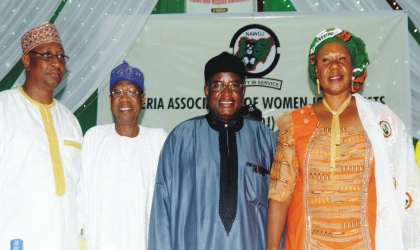
L-R: NUJ National President, Mr Garba Mohammed, National Publicity Secretary, APC, Alhaji Lai Mohammed, Representative of President of Nigeria, Alhaji Garba Kakarfi and former NAWOJ National President, Mrs Asabe Baba-nahaja, at the opening of NAWOJ national delegates conference in Badagry, Lagos, last Saturday.



The Head of the Department of Anatomy at the University of Port Harcourt’s College of Health Sciences, Prof Gabriel Sunday Oladipo, has underscored the urgent need for Nigeria to develop a comprehensive forensic science infrastructure, warning that the nation’s ability to investigate and solve crime is being hampered by lack of scientific data and systems.
In his inaugural lecture titled, “Man: Fearfully Different, Wonderfully Made,” delivered as part of the 207th Inaugural Lecture Series of the university, Prof Oladipo highlighted that while no two individuals are exactly the same, the country currently lacks the robust systems needed to collect and manage biological and anthropometric data that could support criminal investigations.
He explained that the natural variations among humans — from fingerprints to physical measurements — form the foundation of personal identification in forensic work. These biological differences, he said, are essential for distinguishing one person from another, especially in the context of criminal investigations where clarity of identity can mean the difference between justice and impunity. Without this scientific foundation, he argued, law enforcement agencies lack a critical tool in the fight against crime.
Experts have noted that Nigeria’s forensic science capacity has historically lagged behind needs, with only a few forensic facilities available and many law enforcement agencies struggling to access or use scientific evidence effectively. One review of the state of forensic investigation in Nigeria found that outdated facilities and limited adoption of modern forensic methods have left many cases unsolved or poorly investigated, even as crime rates rise across the country.
In Lagos, efforts to improve forensic capabilities have focused on DNA analysis, with the Lagos State DNA Forensic Centre — the first of its kind in West Africa — providing critical support for criminal investigations and helping to identify human remains, link related cases, and assist with paternity testing. However, such initiatives are yet to be replicated at a national scale, leaving many regions without access to these vital scientific tools.
Prof Oladipo’s lecture went beyond academic theory to propose concrete actions. He called for the establishment of a National Institute of Forensic Science responsible for creating and managing a nationwide anthropometric and forensic data bank. This repository, he stressed, would significantly enhance Nigeria’s capacity to track crime, assist law enforcement agencies, and improve the administration of justice by providing reliable scientific evidence for investigative and legal processes.
He also highlighted the importance of strengthening research and training in forensic science. Many Nigerian universities currently lack the funding and infrastructure to offer complete undergraduate or postgraduate programs in areas such as forensic anthropology, DNA analysis, and crime scene investigation, a gap that forces aspiring experts to rely on collaborations with institutions abroad. By fostering a research-friendly environment and securing greater support from both government and private sectors, Nigerian institutions could produce homegrown experts capable of advancing forensic science in the country.
Awareness of forensic science’s role in criminal justice remains low among the general public and even among some security professionals. Studies have shown that a significant portion of Nigerians are unfamiliar with basic forensic concepts or the existence of tools such as DNA profiling and national forensic databases — tools that are common features of criminal justice systems in countries like South Africa and the United Kingdom.
Prof Oladipo also urged regular training and retraining programs to keep forensic practitioners updated with evolving scientific methods. According to him, continuous professional development is critical in a field where technological advances — from biometric databases to digital forensic tools — are transforming how crimes are investigated and solved.
The lecture was attended by academics, students, and professionals drawn to the intersection of science, identity, and justice, all of whom heard the professor make a compelling case for scientific innovation and institutional reform as central to Nigeria’s effort to contain crime and strengthen its justice system.
The event not only showcased Prof Oladipo’s expertise in human anatomy and forensic psychology but also positioned forensic science as a strategic national priority — one that could bring clarity to investigations, support victims and their families, and ultimately enhance public safety across Nigeria.

The University of Port Harcourt Women Association (UPWA) on Thursday staged a vibrant and memorable edition of its Annual Inter-House Sports Competition at the University of Port Harcourt Sports Village, drawing an impressive turnout of pupils, parents, staff and invited guests.
The event, organised by the UPWA International Group of Schools, brought together children from the pre-nursery, nursery and secondary sections in a colourful celebration of youth athleticism, discipline and teamwork. The arena came alive with cheers and excitement as pupils, clad in their various house colours, marched in a ceremonial parade before proceeding to compete in a wide range of track and field events, relays, novelty races and other team-based activities designed to promote physical fitness and healthy competition.
Declaring the competition open, the Vice-Chancellor of the University of Port Harcourt, Professor Owunari Georgewill, commended UPWA for sustaining a tradition that continues to nurture young talents beyond the classroom. He noted that sports remain a critical component of holistic education, helping to build resilience, confidence, leadership skills and social interaction among children.
In her remarks, the President of UPWA, Professor Udeme Georgewill, expressed appreciation to parents, teachers and members of the organising committee for their dedication and sacrifice in ensuring the success of the programme despite prevailing economic challenges. She described the event as a reflection of unity and collective effort within the school community.
“This is the first time White House is emerging overall winner, and that shows remarkable improvement and great sportsmanship,” she said. “We all had fun. It is not easy putting an event like this together considering the economic situation, but we are grateful to the parents for being part of this journey. The excitement everywhere is truly heartwarming.”
The competition featured spirited participation from the various houses, including Purple House, San Chicago Red House and White House, with pupils demonstrating strength, speed, coordination and teamwork. Parents and supporters filled the stands, cheering enthusiastically and adding colour to the spectacle, while teachers ensured orderliness and safety throughout the proceedings.
Professor Georgewill emphasized that the true essence of sports lies not merely in winning trophies but in participation and personal growth. “Sports is not just about winning. It is an avenue for growth, discipline and opportunity. The fact that a child is able to participate is already a win. Losing this year does not mean you cannot win next year. Keep trying,” she encouraged, urging pupils to see both victory and defeat as stepping stones to greater achievements.
She further observed that while there are many competing interests in the Nigerian sports sector, consistent grassroots investment remains essential for discovering and nurturing future champions.
The colourful ceremony culminated in medal presentations, trophy awards and group photographs, with UPWA executives, including Vice President I, Professor Adedamola Onyeaso, joining the participating teams to celebrate the day’s achievements.
The annual inter-house sports competition continues to stand as one of UPWA’s flagship events, reinforcing its commitment to balanced education, character formation and the promotion of healthy lifestyles among its pupils.


