
News
Power Supply Worsens Nationwide

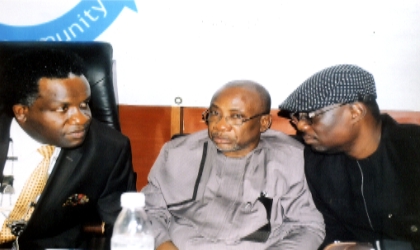
L-R: President, PHCCIMA, Engr Emeka Unachukwu, former President, PHCCIMA, Sir Godfrey Ohuobunwa and former President, FOSSCCIMA, Prince Billy Gillis Harry, during the council meeting of PHCCIMA, recently.
Power supply to states across the federation worsened in the month of March, a survey released yesterday by NOI Polls, a notable indigenous survey organisation, has revealed.
This is coming as investors in the country’s power assets attributed their poor performance during the period to gas supply constraints as a result of incessant gas pipeline vandalism perpetuated by miscreants.
The poll results revealed that the situation of power nationwide worsened in March, and stated that majority of Nigerians, 54 per cent, claimed that power had gone bad or worsened.
It said another 17 per cent revealed that they saw no difference at all, bringing the figure to a total of 71 per cent.
It said, “This month shows an all-time low rating of power, 29 per cent for those who experienced an improvement, over the 15-month period that NOI Polls has tracked improvements in household power supply nationwide.
“These are some of the key findings from the Governance Snap Poll conducted on March 24, 2014.”
It noted that the survey was conducted by NOI Polls to gauge the opinions and perceptions of Nigerians regarding the approval rating of President Goodluck Jonathan, the performance of the president on key elements of his transformation agenda, and the state of power supply in the country.
It added, “Further findings across the geo-political zones indicate that the highest proportion of respondents that reported bad/worsened power supply was from the South-West region with 66 per cent of respondents, followed by the South-South region with 59 per cent and the North East region with 58 per cent.
“Highest proportion that reported no difference at all was the North Central, 29 per cent, and those who saw slight improvements were the North-West, 28 per cent, and South-East, 30 per cent.”
When contacted to comment on why power supply had worsened despite the fact that the sector had been privatised, Managing Director/Chief Executive Officer, Geregu Power Plc, Mr. Adeyemi Adenuga, told our correspondent that the situation was beyond privatising the sector.
He said, “Poor power supply is largely due to pipeline vandalism. As far as our gas pipelines are being vandalised by miscreants, the problem may continue.
“We are all in Nigeria and I think this issue is something outside the issue of privatisation. It is not today that it started and it has been felt by the Nigerian Gas Company and some other companies as well.”
Adenuga said until oil theft is addressed, gas pipeline vandalism may persist, as both had things in common.
He added, “The day they get the solution to oil theft, I think there will be solution to gas pipeline vandalism. However, there is no cause for alarm because they are working hard to address this issue.”
The Chairman, Presidential Task Force on Power, Mr. Beks Dagogo-Jack, corroborated Adenuga’s views, and added that the Federal Government was working hard to address the situation.
“This prompted the approval of $1billion by the president to address these issues of vandalism and theft,” he said.
Meanwhile, the Federal Government has concluded plans to rehabilitate about thirty dams to boost power supply in the country.
The dams, recommended by the Ministry of Water Resources, are expected to generate additional 147.60 megawatts to the existing power source.
Minister of Water Resources, Mrs. Sarah Ochekpe, who made the disclosure in Abuja during a media briefing, said access to electricity is put at 40 per cent.
The minister, who was represented by Director, Dams and Reservoir Operations in the ministry, Dr Emmanuel Adanu, explained that while constructing dams in the past and recently for water supply and irrigation, it constituted small hydro power plants in the construction processes.
According to her, the ministry has partnered the energy sector to conduct studies on the proposed dams and engineering designs of the small hydro power schemes accompanying each of them.
She said this was to serve project activities and generate electricity to rural communities, adding that the supply of water and energy are important to achieving sustainable national development.
“In Nigeria, statistics have shown that shown that only forty per cent of the people have access to electricity, 60 per cent of the population has access to safe drinking water while access to sanitation is put at 41 per cent.
“As part of integrated river basin development, the ministry and some RBDAs while constructing dams in the 19802 s and recently for water supply and irrigation incorporated small hydro power plants to generate electricity to serve the project activities and the host of rural communities.
“Based on the collaboration between the water and energy sectors, Federal Ministry of Power conducted the feasibility studies and engineering design of some of the small hydro power schemes mentioned above for rehabilitation and concession to boost electricity supply in Nigeria.
“No nation can develop without adequate supply of water and energy. Demand for water will continue to increase significantly over the coming decades. The need for increased collaboration and cooperation between the agencies and stakeholders in the water and energy sectors cannot be over-emphasized,” she said.



Rivers State Governor, Sir Siminalayi Fubara, has commended the leadership of the All Progressives Congress (APC) in Rivers State over the outcome of last Saturday’s presidential primary election that saw President Bola Ahmed Tinubu sweeping the poll with a total of 280,082 votes.
Fubara, who served as the State Collation Officer for the primary election, said that while the APC had a total of 297,068 registered members, the number of those accredited for the election was 280,082.
According to him, all those accredited for the election, cast their ballot for Tinubu, leaving Stanley Osifo, his only opponent, with no votes.
Fubara expressed delight at the peaceful and seamless process which he said was as a result of good planning by the party.
“I feel that this process has recorded one of the most organised outings of our great party in recent times. The only reason it came out this way has to do with good planning. In all, I want to say that I’m really impressed with the process.
“So, I can say here that having taken time to go through the figures diligently, I, Siminalayi Fubara, who is standing as the State Collation Officer, hereby certify that the information contained in my own spreadsheet represents the true, correct and accurate record of the summary of results from the 23 LGAs of Rivers State,” he said.
The governor said that while it was evident that President Tinubu defeated his opponent in the primary election in the State, the report would be sent to the APC headquarters in Abuja where the results will be formally declared.

The Federal Government has called for increased private sector participation and donor funding to sustain ongoing gains in the Ogoni environmental restoration project under the Hydrocarbon Pollution Remediation Project.
Speaking at a conference on donor facilitation and diplomatic support for HYPREP in Abuja, yesterday, the Minister of Environment, Balarabe Lawal, stressed that the Ogoni cleanup programme was designed as a long-term intervention requiring sustained funding, technical support, and international cooperation.
“The project is supposed to be a lifespan project. We must move towards achieving its main aim, which is environmental restoration and sustainable development,” he added.
Lawal acknowledged the contributions of the United Nations Environment Programme, describing its assessment as the scientific foundation of the ongoing remediation efforts in Ogoni land.
“We are all here because of that UNEP report. It provided the scientific foundation for what has become one of the world’s most ambitious environmental remediation programmes,” he said.
According to him, hundreds of hectares of hydrocarbon-polluted land have been remediated, while additional sites are currently undergoing cleanup operations.
“We have remediated hundreds of hectares of polluted land, and more sites are still being worked on. Water schemes have also been delivered to affected communities,” he stated.
He added that ecosystem restoration, livelihood support programmes, and healthcare projects were ongoing across affected communities.
“Body health facilities are being constructed, livelihood programmes are empowering thousands, and we are also restoring access to safe drinking water because the first victim of pollution is water,” he said.
The minister also disclosed that the Centre of Excellence for Environmental Restoration was nearing completion, describing it as a major milestone in the project.
“If you go there, you will see one of the biggest edifices being constructed under HYPREP. It will serve as a postgraduate and research institute for environmental remediation,” Lawal said.
Despite the progress, he warned that funding challenges remain a major threat to sustaining the project.
“While substantial progress has been made, the journey is not yet complete. The implementation of UNEP recommendations requires long-term commitment and sustained financial and technical support,” he said.
Lawal therefore, appealed to development partners, donor agencies, international financial institutions, foundations, and private sector players to scale up their support.
“We need your support—financial, technical, scientific, and strategic. No organisation or government can do it alone,” he said.
He further described the Ogoni cleanup as a global model for environmental recovery, climate resilience, and international cooperation.
“The restoration of Ogoni land is not merely a Nigerian undertaking; it is a global model. Its success will show what is possible when governments, communities, and partners work together,” he added.
Also speaking, the Chairman of the Board of Trustees of the Ogoni Trust Fund, Emmanuel Deeyah, said the conference was organised to attract financial, technical, and institutional support for the cleanup exercise.
“We are looking for resources, financial support, expertise, partnership, and collaboration. Government cannot do everything alone,” he said.
Deeyah said the agitation for environmental justice in Ogoni dated back to 1991 when residents drew global attention to the environmental degradation caused by oil exploration activities.
“We farm in Ogoni land and we also fish, but our waters were polluted and the land could no longer support farming activities,” he said.
He explained that the UNEP report recommended that oil companies should contribute $1bn every five years for 30 years to support the remediation programme.
“We have done 10 years now and we have not even received the full $1bn that was supposed to be contributed. The refineries and local operators have not contributed a dime,” he stated.
Last week, the Hydrocarbon Pollution Remediation Project announced the closure of 30 contaminated sites in Ogoniland, Rivers State, while investigations have commenced on 18 high-risk polluted locations in residential communities.

The Inspector-General of Police, Olatunji Disu, yesterday paid a courtesy visit to the Federal Ministry of Works in Abuja as part of efforts to strengthen collaboration on critical infrastructure projects nationwide.
The visit, disclosed in a statement posted on X by the Nigeria Police Force, was attended by the Minister of Works, David Umahi; the Minister of State for Works, Bello Goronyo; and directors of the ministry.
According to the statement, discussions during the meeting centred on ongoing infrastructural projects nationwide, particularly the Lagos-Calabar Coastal Highway and other major road construction initiatives aimed at improving national development and connectivity.
The police chief reportedly reaffirmed the NPF’s commitment to providing security support for the execution of critical national infrastructure projects across the country.
“The Nigeria Police Force will continue to provide adequate security support and deploy necessary operational resources to ensure the smooth execution and protection of critical national infrastructure projects nationwide,” the statement read.
The meeting was also said to have highlighted the need for stronger inter-agency collaboration in protecting public infrastructure from vandalism and other security threats capable of disrupting construction activities.
PUNCH reports that the Federal Government had raised concerns over acts of vandalism along the Lagos-Calabar Coastal Highway corridor, with Umahi warning that the destruction of drainage systems and road infrastructure could threaten the durability of the project.
-

 Politics3 hours ago
APC PRIMARIES: FUBARA’S WITHDRAWAL, HISTORIC SACRIFICE FOR NATIONAL STABILITY ……. GROUP
-

 News5 hours ago
Court Sentences Seven To Death Over Murder Of Cleric In Rivers
-

 News14 hours ago
Group Hails Tinubu, Chinda Emergence
-

 Comment6 hours ago
Rivers @59: Progress Through Tough Times
-

 News6 hours ago
Fubara Assures Completion Of Ongoing Projects In Rivers …As Airport Road Bypass Hits 65% Completion
-

 News6 hours ago
Fubara Promises To Deliver State Secretariat Early 2027
-

 Politics3 hours ago
IPAC Flays INEC Over Election Guidelines Judgement
-

 Politics3 hours ago
NDC To Adopt Electronic Voting For Future Primaries